



Cadence Introduces Maestro AI Models for Chip and System Design
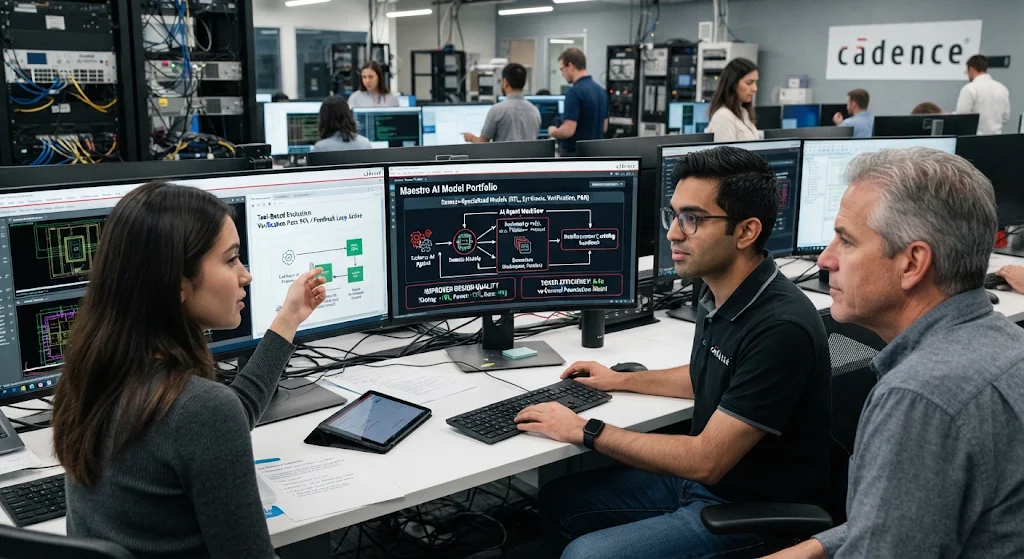
Cadence has introduced the Maestro AI Model Portfolio for chip and system design workflows. The announcement describes domain-specialised models connected to Cadence agents, engineering tools and reinforcement-learning feedback. Reported initial results include improvements in quality and token efficiency relative to a general-purpose foundation model. These are company-reported comparisons, not a universal measure of performance across every design task. For engineering teams, the important development is the proposed use of tool-based evaluation to guide an agent’s next decision.
Specialisation changes what must be evaluated
A general language model can explain terminology without being dependable at executing a complex design sequence. A domain-specialised model is intended to connect more closely to that sequence, but its capability still needs to be demonstrated. The relevant question is whether it can carry out the required task while respecting the actual design constraints. Fluency and successful tool invocation are useful signals, but neither independently establishes an acceptable design result.
A meaningful evaluation should identify the starting specification, the tools available to the agent and the criteria used to judge the output. It should also describe the cases where the workflow fails or requires intervention. Without those boundaries, an impressive aggregate improvement can be difficult for a customer to translate into an implementation decision for its own engineering work.
Verified feedback needs the right objective
Cadence describes feedback from established engineering tools and deterministic solvers. That can create a stronger basis for learning than an assessment based only on whether generated text appears plausible. However, the solver answers the problem it is given. If the objective or constraints omit an important requirement, an agent can improve the reported score while moving away from the intended product outcome.
Engineers should therefore review both the evaluation method and the definition of success. Power, performance, physical constraints and manufacturing considerations may interact. A workflow intended to explore those trade-offs should preserve the alternatives and the reasons for selecting one. That record lets the team examine whether the improvement is technically useful rather than simply numerically favourable within a narrow test.
Efficiency claims need comparable work
Token efficiency is relevant to the resource cost of a model-driven workflow, but it is only one part of total execution effort. Tool calls, simulation time and the need for human correction also affect the practical result. Comparing two systems requires an equivalent task and an equivalent acceptance threshold. Fewer model tokens do not necessarily mean a lower cost for producing a release-quality outcome.
The same care applies to productivity expectations quoted by customers. An anticipated improvement during deployment is different from a measured result across a stable production process. Teams considering the technology should establish their own baseline and include the time spent preparing data, checking outputs and resolving failures. Those activities determine whether automation frees engineering capacity in practice.
Deployment is part of the design workflow
The announced architecture includes cloud and customer-controlled on-premises options. The appropriate choice depends on the information being processed and the organisation’s operational requirements. Access control, configuration management and update policy remain necessary regardless of where the models run. A secure installation should also keep a reviewable record of the agent’s actions and the design versions it changed.
Maestro is notable for combining specialised models with an existing engineering-tool environment rather than presenting AI as a separate conversational layer. Its value will become clearer through reproducible task results and production evidence. Engineers should judge that evidence against their own constraints, with particular attention to whether the automated workflow produces decisions that remain technically correct and explainable.
Source — dailycadcam.com. Source publication date 2026-10-30. Engineering analysis: The CAD Verse.
Report an image

 MEMBERS · ONE ENGINEERING COMMUNITY
 Engineering videos and tutorials
 Engineering marketplace and professional opportunities
 Courses, tutorials and learning paths
 Engineering files and CAD models
 Global engineering portfolios and professional network
Discussion
0 CommentsShare your thoughts and engineering insights with the community.
Comments are closed for this article.
No comments yet. Be the first to share your thoughts.