


Wire EDM Approach Addresses Marine Coupling Keyways
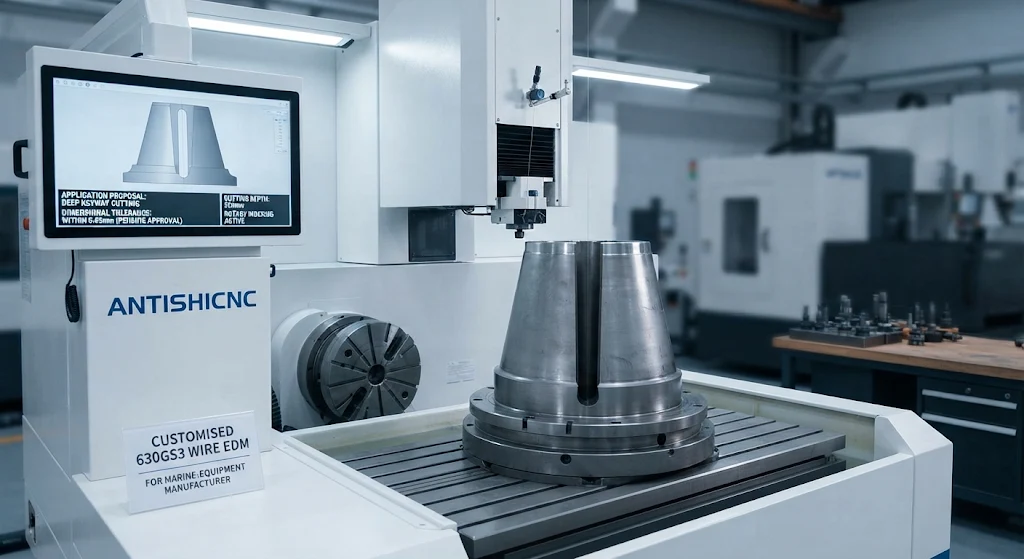
Shanghai ANTISHICNC has proposed a customised 630GS3 wire EDM configuration for a marine-equipment manufacturer needing deep keyways in tapered coupling hubs. The reported requirement combines a cutting depth up to 500 millimetres with dimensional tolerances within 0.05 millimetres. The proposed machine includes customised vertical travel and rotary indexing. The configuration remains subject to final specification approval, so the news concerns an application proposal rather than completed production acceptance or independently demonstrated component capability.
The bore establishes the keyway context
A keyway is not an isolated slot. Its location must relate to the bore and to the mating assembly so that the finished coupling can be assembled as intended. In a deep component, establishing and maintaining that relationship can be as demanding as achieving the slot width. The datum strategy should make clear how the bore axis and the required angular position are established.
For a designer, the drawing should distinguish the dimensional requirements that control fit from those that control alignment. A general statement about machining accuracy may not communicate both. The manufacturing engineer then needs a setup and measurement approach that can demonstrate those relationships through the relevant depth, rather than checking only the easily accessible end of the feature.
Custom travel needs a complete setup study
The proposal includes a vertical travel adapted to the workpiece height and a worktable capacity reported at 700 kilograms. Those machine limits are useful screening information, but they do not define whether every hub can be loaded, located and processed conveniently. Fixture height, access and handling clearance also occupy the available envelope. The actual component and fixture should be considered together.
A setup study should examine how the heavy workpiece reaches its final location and how the operator confirms that location before cutting. The approach should avoid relying on an inaccessible feature for a critical check. Planning those activities early can reveal whether a nominally suitable travel requires additional fixture or handling provisions to become a practical production arrangement.
Wire conditions matter through a long cut
The source identifies automatic wire tensioning and process settings intended for high-strength alloy steels. These are relevant because a deep cutting task places demands on maintaining a stable cutting condition along the feature. The proposed configuration should be evaluated with a representative material and geometry, including the required finish and any subsequent operation.
An application trial should examine more than whether the wire completes the path. Width, form and alignment through the cut should be assessed using a suitable measuring method. The inspection results should be connected to the setup and process record so that the team can distinguish a locating problem from a cutting-condition issue if the result varies.
Define approval before the machine is built
The proposed rotary indexing can support angular positioning, while the reported programming tools include measurement and alignment functions. Their value depends on the agreed operating sequence. The specification should identify which functions are required, what the operator must establish and what evidence will demonstrate acceptance of the completed system.
For The CAD Verse readers, this project illustrates why customised machine selection begins with a component requirement rather than an equipment catalogue. The combination of depth, alignment and handling creates the real engineering problem. A successful outcome will require the customer and supplier to agree the complete setup, machining and inspection route, then demonstrate that route on representative coupling geometry before treating the proposal as a proven production process.
Source — mtimagazine.com. Source publication date 2026-10-16. Engineering analysis: The CAD Verse.
Report an image
 MEMBERS · ONE ENGINEERING COMMUNITY
 Engineering videos and tutorials
 Engineering marketplace and professional opportunities
 Courses, tutorials and learning paths
 Engineering files and CAD models
 Global engineering portfolios and professional network
Discussion
0 CommentsShare your thoughts and engineering insights with the community.
Comments are closed for this article.
No comments yet. Be the first to share your thoughts.