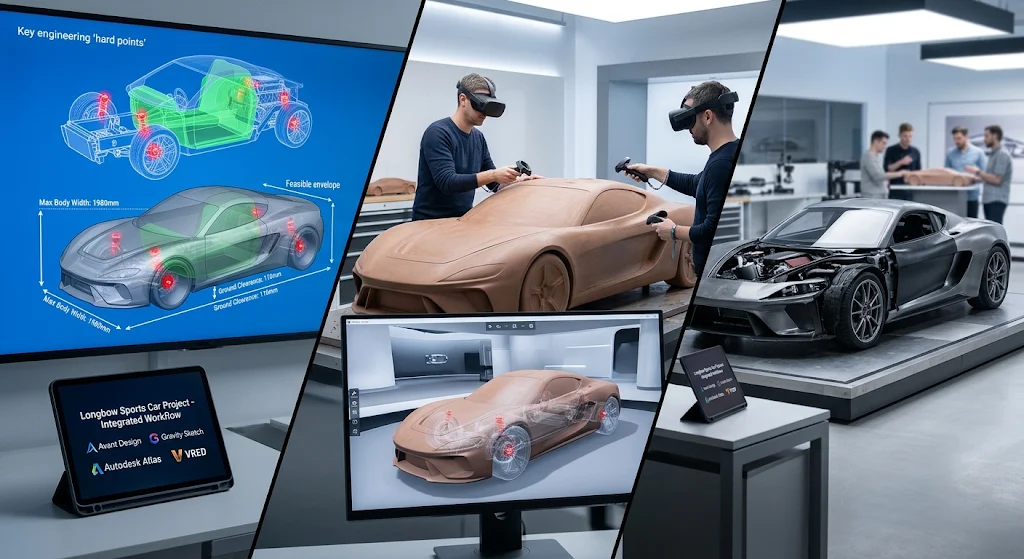
Avant Design’s work on the Longbow sports-car project illustrates how a small consultancy can use immersive tools throughout design development rather than only for a final presentation. The reported workflow combines Gravity Sketch for early three-dimensional exploration, Autodesk Alias for surface development and VRED for visual review. Virtual reality provides a common space in which designers and clients can inspect alternatives at meaningful scale. The engineering interest is the continuity between concept, controlled geometry and a decision about what should progress.
Start with hard points and a feasible envelope
The source describes an early feasibility exercise that provided the platform and fixed constraints around which the body could be developed. That is important because expressive exterior surfaces still have to relate to underlying architecture. A visually strong concept becomes more useful when the team understands which dimensions are negotiable and which correspond to components or interfaces that cannot move easily.
Designers should keep those constraints visible during concept exploration. An immersive model can support evaluation of proportions, but it should not allow a presentation surface to become detached from the engineering envelope. Clear ownership of reference geometry helps the team explore freely without losing track of what the concept is expected to accommodate. That connection becomes more important as attractive images begin to influence stakeholder expectations.
Immersive review changes the feedback loop
Avant uses VR at several stages, from shaping early forms to reviewing developed surfaces and alternative configurations. The benefit is the opportunity to examine relationships without waiting for a separate physical model at every iteration. Participants can compare versions, lighting and context within one session. That can shorten the interval between a design observation and the next revision.
However, each viewing method has limits. The consultancy’s estimate of the feedback obtained through VR is an account of its own experience, not a universal measure of equivalence with a clay model. The appropriate method depends on the question being asked. Surface perception, physical interaction and engineering clearance may require different forms of evidence. A productive workflow chooses the review medium deliberately rather than assuming one replaces every other method.
Preserve design intent through the CAD handover
Moving from an early immersive form into a surface-modelling environment is a consequential transition. The model needs to retain the intended character while becoming suitable for further development. The team should identify which curves, proportions and surface relationships define that character. Otherwise, a technically cleaner reconstruction can drift away from the concept that stakeholders approved.
Revision records and review captures can help explain that evolution. When a change is made for packaging or manufacturing reasons, the designer should be able to compare its visual effect with the previous version. That makes the trade-off explicit and reduces the risk that several individually reasonable adjustments accumulate into an unintended overall result. Controlled comparison is as useful for aesthetics as it is for dimensional engineering.
Distinguish concept imagery from released geometry
The article also describes internal use of AI-generated images to explore presentation direction, while retaining a more controlled process for final outputs. That distinction is valuable. An image can suggest a lighting or composition choice without establishing manufacturable geometry. The project team should keep the role of that material clear so that a convincing visual is not mistaken for an engineering definition.
Avant’s continued involvement in physical prototype work reinforces the connection between the digital design and the resulting object. For The CAD Verse readers, the case shows that immersive tools are most useful when embedded in an accountable development process. The aim is not simply to produce a compelling virtual car, but to help the team make clearer design decisions and carry the selected intent through the subsequent engineering and prototype stages.
Source — develop3d.com. Source publication date 2026-03-10. Engineering analysis: The CAD Verse.