






Choosing a CNC Machine: Capability, Part Families and Total Production Needs
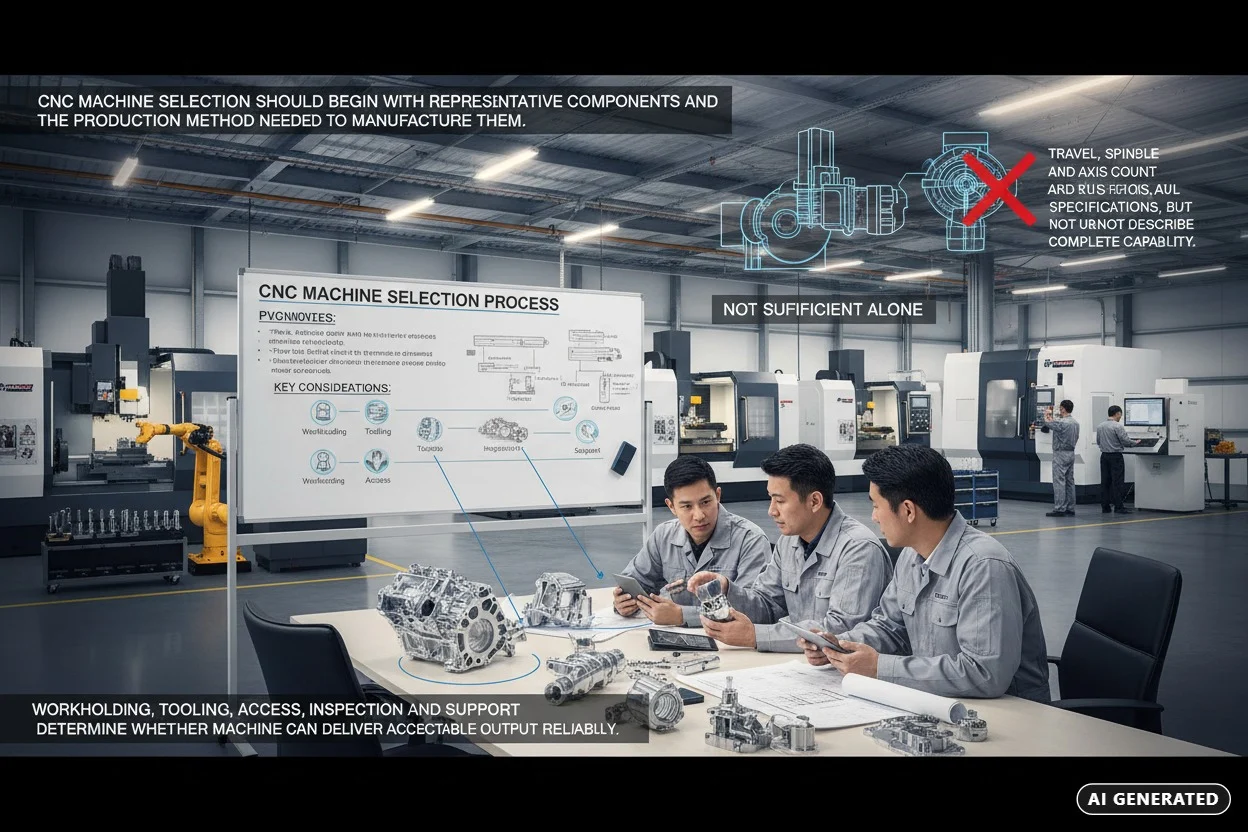
CNC machine selection should begin with representative components and the production method needed to manufacture them. Travel, spindle speed and axis count are useful specifications, but they do not describe complete capability. Workholding, tooling, access, inspection and support determine whether the machine can deliver acceptable output reliably.
Describe the Work
Identify material grades, component sizes, required features and expected quantities. Include difficult but normal jobs rather than evaluating only the easiest demonstration part. The relationship between features can be as important as their individual dimensions. Multiple setups may create quality or handling demands that influence the machine choice.
Evaluate the Working Envelope
Nominal travel does not equal usable space for every fixture and tool combination. Check the complete assembly, including holders, rotary tables and loading access. Tool reach and rigidity can limit a process even when the component fits inside the enclosure. Chip handling and coolant requirements should also match the work.
Assess Productive Capability
Spindle characteristics, axis dynamics and control functions should be evaluated against the actual operations. Advertised maximum values may not occur simultaneously or be useful for the selected job. Tool-change time, setup work and inspection interruptions contribute to actual output. Trials should represent a complete cycle.
Include Ownership Requirements
Service access, training, maintenance and spare parts influence long-term availability. Software and postprocessor support need to be considered before commissioning. A low purchase price can be outweighed by process limitations, while unnecessary complexity can increase support requirements without providing useful benefit.
For a family of machined housings, compare the complete production route on each candidate machine. Assess loading, critical feature relationships and normal tool replacement. Record the assumptions behind capacity estimates and leave room for realistic production variation. The decision should connect verified machining capability with practical operation and support over the expected service life.
Additional Engineering Considerations
Capacity estimates should be tested against a realistic product mix. A machine optimized around one demonstration part may become less suitable when frequent changeovers, long tools or inspection delays are included. Ask which operations would remain external and how that affects handling and lead time. Evaluate the support required to introduce new jobs as well as repeat existing ones. This produces a more useful ownership comparison than dividing available hours by a best-case cycle, and helps prevent an investment based on capacity that cannot be achieved consistently in the actual workshop.
Practical Verification Priorities
The first verification priority is representative part-family trials. Establish the relevant condition before comparing alternatives, and retain enough setup information for another engineer to repeat the check. A result obtained under a different condition may answer a different question, even when the reported values appear comparable.
The next priority is usable envelope with real fixtures and tools. Decide what evidence would show that this part of the method is working and what finding would require investigation. Use representative inputs rather than only selected favorable samples. Where a change is introduced, record the technical reason and assess its effect on connected requirements.
Finally, verify complete cycle, service requirements and process capability rather than isolated catalog maxima. Define the acceptance basis and preserve the observations that support the decision. If an unexpected result appears, investigate both the physical process and the measurement method before applying a correction. This keeps development decisions traceable and helps the production team restore the accepted condition after normal adjustments or maintenance.
Report an image

 MEMBERS · ONE ENGINEERING COMMUNITY
 Engineering videos and tutorials
 Engineering marketplace and professional opportunities
 Courses, tutorials and learning paths
 Engineering files and CAD models
 Professional engineering projects
Discussion
0 CommentsShare your thoughts and engineering insights with the community.
Comments are closed for this article.
No comments yet. Be the first to share your thoughts.