






DNC in Manufacturing: Program Transfer, Revision Control and Reliability
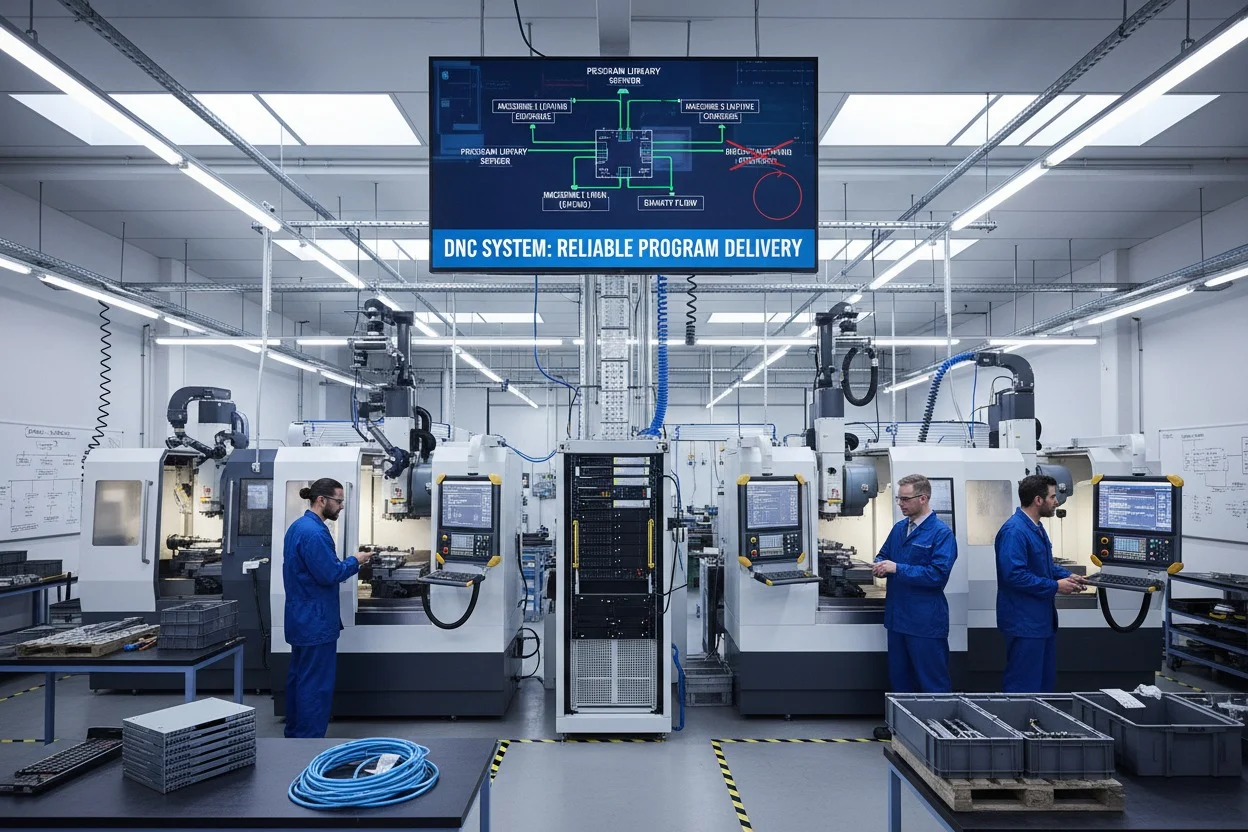
DNC refers to arrangements for connecting numerical-control equipment with systems that store or deliver machining programs. The term has been used in more than one historical sense, including direct and distributed numerical control. In a practical workshop, the important question is how approved program data reaches the correct machine reliably.
Separate Storage from Execution
A central program repository can improve organization, but the machine still needs data compatible with its control and configuration. Transferring a file successfully does not establish that it is the correct revision or appropriate for the current setup. Program identity and authorization must remain clear.
Transfer Methods and Compatibility
Machines may use different communication interfaces and file-handling capabilities. Some applications transfer complete files, while others depend on a controlled streaming arrangement. Communication settings and supported program conventions should be confirmed for each machine. An unreliable connection can interrupt a process even when the code itself is valid.
Revision Management
The repository should distinguish released programs from work in progress. Naming conventions, access controls and recorded changes help prevent unintended use of an obsolete file. Shop-floor edits need a defined return path so an approved correction is not lost or replaced by an older central copy.
Operational Support
Recovery after interruption should follow a controlled method. Staff need to know which program and setup were active and how the machine’s state is verified before resuming. Backups should preserve the required information, not merely duplicate unorganized files across several computers.
For a workshop with mixed generations of CNC equipment, document machine-specific transfer requirements and test them with representative programs. Monitor failures and the time required to resolve them. A useful DNC arrangement reduces uncertainty in program distribution while maintaining traceability. Its value is not simply fewer manual transfers, but a reliable connection between the released digital instruction and the machine performing the work.
Additional Engineering Considerations
A central repository should make authority clear, not simply make files easy to find. Users need to distinguish approved output from backups, test versions and programs intended for another machine. Transfer logs can assist traceability if their meaning is understood and retained appropriately. A successful send should not automatically be interpreted as confirmation that the machine executed the intended revision. Consider how the workshop verifies that relationship. This closes the gap between data distribution and production control, where many practical benefits and risks of connected CNC operation actually arise.
Practical Verification Priorities
The first verification priority is machine-specific communication and file compatibility. Establish the relevant condition before comparing alternatives, and retain enough setup information for another engineer to repeat the check. A result obtained under a different condition may answer a different question, even when the reported values appear comparable.
The next priority is approved revision identity and controlled shop-floor edits. Decide what evidence would show that this part of the method is working and what finding would require investigation. Use representative inputs rather than only selected favorable samples. Where a change is introduced, record the technical reason and assess its effect on connected requirements.
Finally, verify tested interruption recovery and repository backup procedures. Define the acceptance basis and preserve the observations that support the decision. If an unexpected result appears, investigate both the physical process and the measurement method before applying a correction. This keeps development decisions traceable and helps the production team restore the accepted condition after normal adjustments or maintenance.
Report an image
 MEMBERS · ONE ENGINEERING COMMUNITY
 Engineering videos and tutorials
 Engineering marketplace and professional opportunities
 Courses, tutorials and learning paths
 Engineering files and CAD models
 Professional engineering projects
Discussion
0 CommentsShare your thoughts and engineering insights with the community.
Comments are closed for this article.
No comments yet. Be the first to share your thoughts.