






Industrial Robot Types: Matching Kinematics to the Manufacturing Task
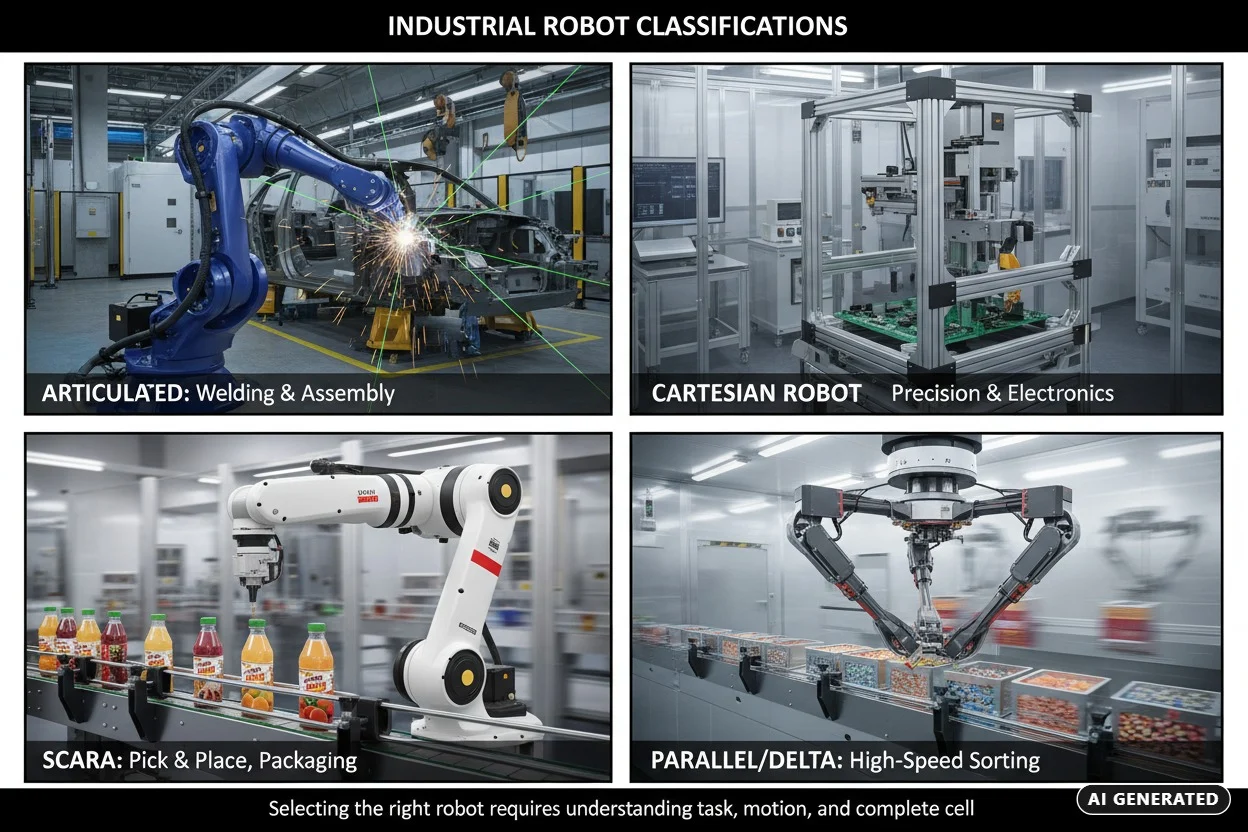
Industrial robots can be classified by their mechanical arrangement, motion capability and intended application. Articulated, Cartesian, SCARA and parallel configurations provide different combinations of reach, orientation control and workspace. Selecting a type requires understanding the task and the complete cell rather than comparing payload alone.
Kinematics and Workspace
An articulated robot can provide substantial orientation flexibility, but its reachable volume does not describe every usable approach. Cartesian systems offer motion along defined linear axes, while SCARA arrangements are often suited to particular assembly and handling tasks. Parallel mechanisms can provide useful dynamics within their intended workspaces. Each configuration has practical limits.
Payload Beyond Part Weight
The end effector, services and component contribute to the load. Their mass distribution and required acceleration also matter. A payload figure should be interpreted using the manufacturer’s conditions. A tool that is acceptable in one orientation or motion profile may require a different assessment in another.
Accuracy and Repeatability
Repeatability describes returning to a position under defined conditions; it is not identical to absolute positioning accuracy. The process may require calibration, sensing or suitable mechanical references. A task that tolerates variation through compliant tooling differs from one requiring precise contact with a small feature.
Cell Integration
Fixtures, conveyors, guarding and maintenance access influence the usable layout. Robot reach studies should include the complete tool and workpiece. Cable routing and recovery from normal interruptions need attention. A fast nominal robot movement may contribute little if feeding or inspection limits the cycle.
For a pick-and-place application, evaluate representative products, approach directions and gripping requirements. Include the time needed to confirm a successful grip and release. Test the complete sequence rather than a single unloaded motion. The correct robot configuration supports the process consistently while remaining practical to program, maintain and integrate with the rest of production.
Additional Engineering Considerations
Robot evaluation should distinguish the tool-center motion from the full swept volume. A wrist, elbow or service bundle can interfere even when the programmed point clears the fixture. Payload distribution can also change the feasible movement. Use the actual end effector and representative part in reach and cycle studies. Check whether alternative orientations solve access problems without creating another constraint. These studies should support an integrated cell layout, because relocating a fixture after equipment purchase may affect loading, guarding, conveyors and maintenance access as well as robot motion.
Practical Verification Priorities
The first verification priority is usable workspace and required tool orientations. Establish the relevant condition before comparing alternatives, and retain enough setup information for another engineer to repeat the check. A result obtained under a different condition may answer a different question, even when the reported values appear comparable.
The next priority is complete payload including tool and mass distribution. Decide what evidence would show that this part of the method is working and what finding would require investigation. Use representative inputs rather than only selected favorable samples. Where a change is introduced, record the technical reason and assess its effect on connected requirements.
Finally, verify integrated cycle with sensing, services and controlled recovery. Define the acceptance basis and preserve the observations that support the decision. If an unexpected result appears, investigate both the physical process and the measurement method before applying a correction. This keeps development decisions traceable and helps the production team restore the accepted condition after normal adjustments or maintenance.
Report an image
 MEMBERS · ONE ENGINEERING COMMUNITY
 Engineering videos and tutorials
 Engineering marketplace and professional opportunities
 Courses, tutorials and learning paths
 Engineering files and CAD models
 Professional engineering projects
Discussion
0 CommentsShare your thoughts and engineering insights with the community.
Comments are closed for this article.
No comments yet. Be the first to share your thoughts.