






Centrifugal Casting: Rotating Molds and Quality Control
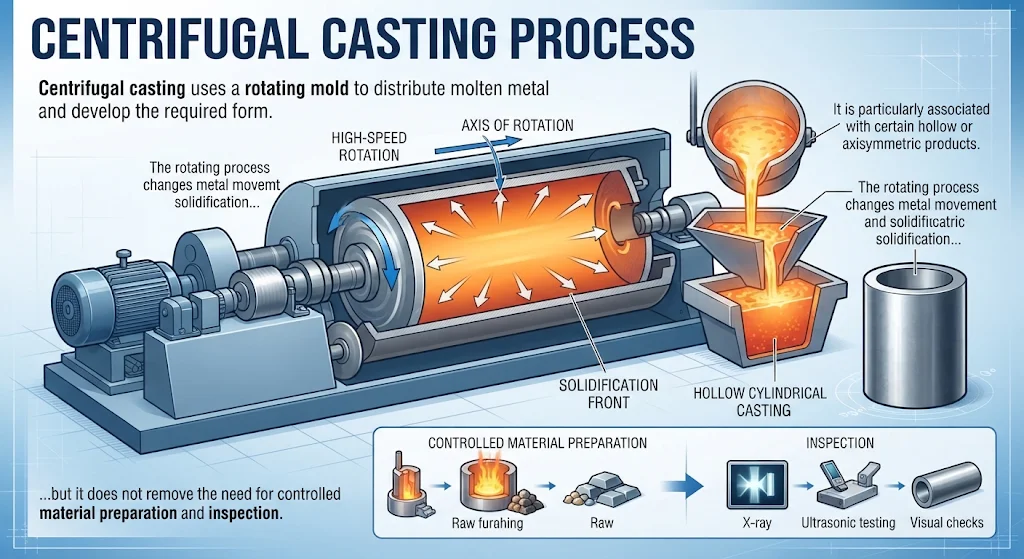
Centrifugal casting uses a rotating mold to distribute molten metal and develop the required form. It is particularly associated with certain hollow or axisymmetric products. The rotating process changes metal movement and solidification, but it does not remove the need for controlled material preparation and inspection.
Understand the Arrangement
Different centrifugal casting arrangements serve different component types. The mold axis, metal delivery and intended geometry determine how the process operates. A general description of rotational force is not enough to specify a production method. The foundry must establish conditions suited to the alloy and component.
Metal Delivery and Mold Condition
Pouring consistency and mold preparation influence the starting condition. Temperature, coatings and surface condition affect filling and heat transfer. Uncontrolled variations can lead to differences in wall distribution or defects. The process should record the conditions actually used rather than only the target settings.
Solidification and Material Distribution
The development of the casting can vary through its section. Regions with different thermal history or composition may require consideration. Machining allowances should reflect the intended final component and any material that must be removed. A sound external surface does not prove that every region is acceptable.
Verification
Inspect relevant dimensions, wall thickness and material quality. The method should reflect the product’s function and defect risks. Sampling only the most convenient location may miss variation through length or section. Traceability should connect results to the casting batch and process conditions.
For a sleeve, evaluate the internal and external machining allowances as well as the as-cast shape. Confirm the finished material condition and relevant mechanical requirements after processing. Representative trials and suitable inspection establish whether the centrifugal method is capable. The useful objective is repeatable product quality across the required section, supported by control of rotation, metal delivery and cooling.
Additional Engineering Considerations
The sampling strategy should reflect the way the process develops material through the casting. A result from one location may not represent another region with different cooling or material distribution. Agree which areas require evidence and how they will be related to the finished geometry. If machining removes part of the as-cast section, evaluate the material that remains in service. Keeping these relationships explicit prevents a favorable result from a convenient sample being used to justify a region whose condition has not actually been represented.
Practical Verification Priorities
The first verification priority is casting arrangement matched to alloy and geometry. Establish the relevant condition before comparing alternatives, and retain enough setup information for another engineer to repeat the check. A result obtained under a different condition may answer a different question, even when the reported values appear comparable.
The next priority is controlled mold and pouring conditions. Decide what evidence would show that this part of the method is working and what finding would require investigation. Use representative inputs rather than only selected favorable samples. Where a change is introduced, record the technical reason and assess its effect on connected requirements.
Finally, verify wall distribution and required material quality after machining. Define the acceptance basis and preserve the observations that support the decision. If an unexpected result appears, investigate both the physical process and the measurement method before applying a correction. This keeps development decisions traceable and helps the production team restore the accepted condition after normal adjustments or maintenance.
Report an image

 MEMBERS · ONE ENGINEERING COMMUNITY
 Engineering videos and tutorials
 Engineering marketplace and professional opportunities
 Courses, tutorials and learning paths
 Engineering files and CAD models
 Professional engineering projects
Discussion
0 CommentsShare your thoughts and engineering insights with the community.
Comments are closed for this article.
No comments yet. Be the first to share your thoughts.