






Robot Grippers: Contact, Retention and Reliable Part Handling
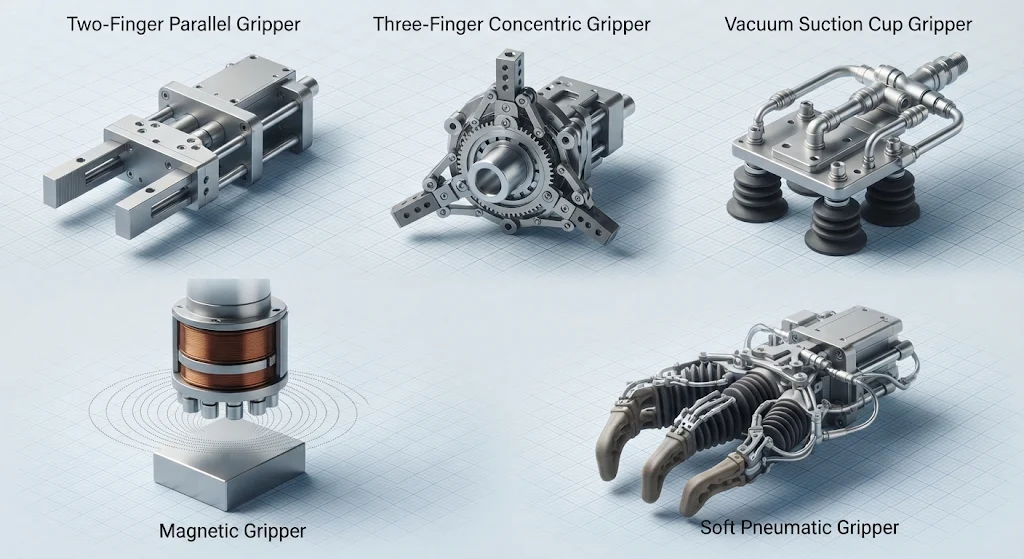
A robot gripper provides the physical interface between the robot and the handled object. It must acquire, retain and release the part under the intended motion and process conditions. Reliable gripping depends on geometry, material, sensing and the way the object is presented, not simply on the actuator’s advertised force.
Choose the Contact Method
Mechanical fingers, vacuum devices and other gripping approaches suit different surfaces and shapes. A porous or textured component may challenge vacuum retention, while delicate surfaces can be marked by concentrated mechanical contact. Selection should reflect actual production parts and their approved variation.
Define Location and Retention
The gripper should establish a useful and repeatable relationship to the part. Increasing force can damage a component without correcting uncertain location. Finger geometry and support contacts should consider how the part will behave during acceleration, rotation and any subsequent process load.
Include Services and Sensing
Air lines, cables and sensors form part of the moving tool assembly. Their mass and routing affect integration. Position feedback or part-presence sensing can help identify failed acquisition, but the selected signal must actually indicate the required condition. Closed fingers do not necessarily prove that the correct part has been retained.
Plan Release and Recovery
Release should place the part in a controlled condition without dragging or sticking. Surface contamination, static effects or deformed packaging can influence handling. A failed pick should produce a defined response rather than an uncontrolled continuation of the cycle.
For a sheet metal handling task, account for edge variation, oil and local flexibility. Test the gripper with representative parts and motion rather than ideal samples at low speed. Inspect for marking and deformation after repeated cycles. An effective end effector combines suitable contact geometry with predictable detection and recovery, making the complete handling process stable rather than just demonstrating one successful lift.
Additional Engineering Considerations
The acquisition method should tolerate normal presentation variation without hiding an incorrect grip. Compliance can help guide a component into contact, but its effect on final location must be understood. If the task needs precise placement, establish whether the gripper or a later fixture defines the final reference. A practical trial includes oil, surface changes and approved dimensional variation where relevant. Evaluate how the controller identifies an unsuccessful attempt and prevents further damaging motion. This makes the gripper part of a verified handling method rather than an isolated mechanism rated only by force.
Practical Verification Priorities
The first verification priority is actual part surface and geometric variation. Establish the relevant condition before comparing alternatives, and retain enough setup information for another engineer to repeat the check. A result obtained under a different condition may answer a different question, even when the reported values appear comparable.
The next priority is retention during representative motion and process loads. Decide what evidence would show that this part of the method is working and what finding would require investigation. Use representative inputs rather than only selected favorable samples. Where a change is introduced, record the technical reason and assess its effect on connected requirements.
Finally, verify meaningful grip confirmation, controlled release and fault recovery. Define the acceptance basis and preserve the observations that support the decision. If an unexpected result appears, investigate both the physical process and the measurement method before applying a correction. This keeps development decisions traceable and helps the production team restore the accepted condition after normal adjustments or maintenance.
Report an image

 MEMBERS · ONE ENGINEERING COMMUNITY
 Engineering videos and tutorials
 Engineering marketplace and professional opportunities
 Courses, tutorials and learning paths
 Engineering files and CAD models
 Professional engineering projects
Discussion
0 CommentsShare your thoughts and engineering insights with the community.
Comments are closed for this article.
No comments yet. Be the first to share your thoughts.