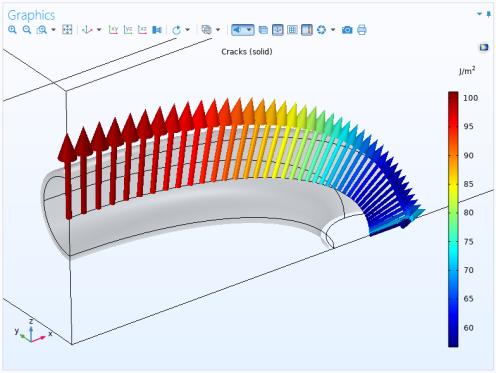
Understanding crack propagation is essential for structural integrity assessment. In fracture mechanics, the Stress Intensity Factor (SIF) describes the local stress field near a crack tip and helps engineers evaluate the conditions that drive crack growth.
For complex three-dimensional crack geometries, calculating the complete stress intensity distribution can be computationally demanding. Engineers often need to consider different loading conditions, crack shapes and material responses.
A study published in Scientific Reports on October 28, 2026, introduces an Enhanced-piFNO framework designed to predict stress intensity factor distributions along complex crack fronts.
The method uses a neural-operator architecture combined with mechanics-based regularisation. Its purpose is to learn relationships between input conditions and crack-front response while retaining information from the underlying physical problem.
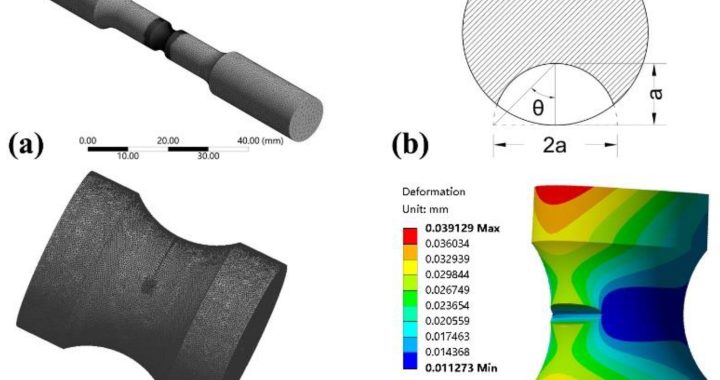
The researchers evaluated the framework using multiple data sources. These included compressor-blade simulations with different loading paths, displacement fields obtained through Digital Image Correlation and selected benchmark cases.
The study reports validation R² values of 0.9977 and 0.9986 for Mode I and Mode II predictions on grouped DIC-derived data. It also reports lower normalised errors than selected comparison methods in several evaluated benchmark cases.
What this means for CAE
The important development is not simply the use of AI in engineering. It is the combination of data-driven prediction with mechanics-based constraints.
A model that predicts crack behaviour without respecting physical relationships can produce results that look plausible but are not reliable for engineering decisions.
Physics-informed approaches aim to improve the relationship between computational efficiency and mechanical consistency.
Such methods could eventually support faster screening of structural designs, fatigue-critical components and fracture-mechanics scenarios. However, surrogate predictions still require careful validation against numerical and experimental reference data before they can be used in safety-critical assessments.
For CAE professionals, the study illustrates how machine learning is moving from general-purpose prediction toward specialised computational mechanics.