


DMG MORI easyFIX Automates Vice Adjustment for Mixed Batches
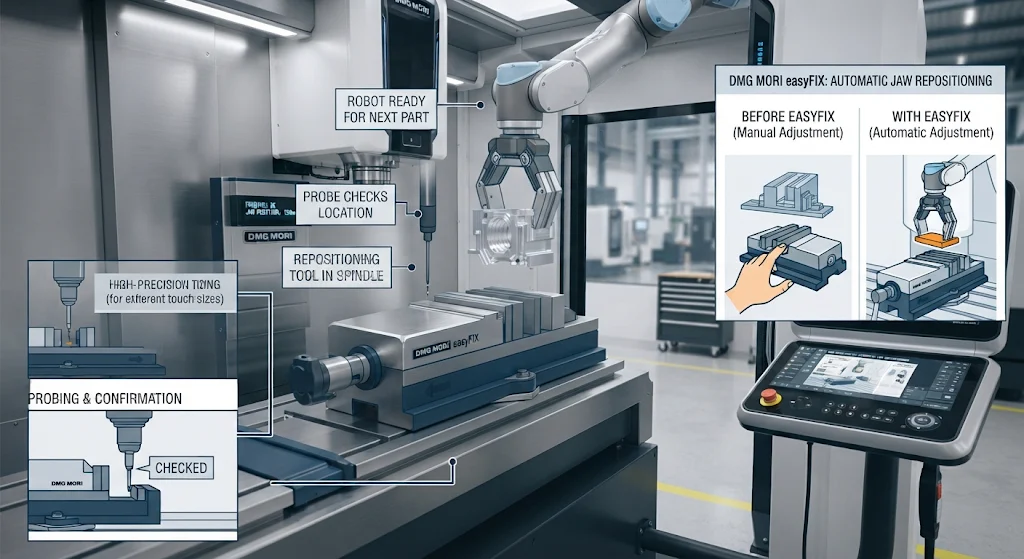
DMG MORI’s easyFIX vice is designed to adjust automatically between different workpiece sizes within compatible automation arrangements. The announcement distinguishes the short clamping stroke from the larger repositioning of the movable jaw. A device exchanged into the spindle moves the jaw, after which probing checks the location before the first component is loaded. This addresses a familiar obstacle in mixed-batch automation: the robot may be ready for the next part, while the fixture still requires a person to change its opening.
Adjustment and clamping are different functions
Repositioning the jaw establishes the space needed for the next workpiece, while the subsequent clamping action secures it for machining. Treating those as separate functions makes the concept easier to evaluate. The adjustment range does not describe the working clamping stroke, and neither figure alone establishes suitability for a particular part. The geometry of the jaw and the intended contact surfaces also matter.
For a process engineer, the next question is how the component is located after the opening has changed. A vice can accommodate a different size without automatically preserving the desired datum relationship. The programme, robot loading position and inspection method should all refer to the same fixture definition. That becomes especially important when a job family contains similar-looking parts with different machining origins.
Probing closes part of the setup loop
The reported sequence uses a spindle-mounted probe to determine the vice position and verify the new jaw location. This provides feedback on a setup action that would otherwise rely only on the commanded movement. The value lies in detecting a discrepancy before a workpiece enters the cutting cycle. The production method should specify what happens when the measured position is outside the allowed condition.
That check should not be interpreted more broadly than its scope. Verifying the jaw location does not necessarily establish workpiece seating, correct stock or the absence of debris on a locating face. Those conditions need their own controls where they influence the result. A reliable automated cell uses several complementary checks rather than expecting one measurement to represent the entire setup.
Force must match the component
The range includes pneumatic and hydraulic configurations with different stated forces. A higher available force is not automatically preferable for every part. Thin or compliant workpieces can deform under restraint, while heavier cutting conditions may require a different support arrangement. The selected jaws and pressure settings should suit the actual component and operation.
Designers should also consider whether the clamped state changes a functionally important shape. If the component relaxes after release, the final inspection needs to reflect that condition. A successful clamping strategy provides enough security for machining while keeping the finished geometry within its requirements. Force capability is one input to that decision, alongside support, contact area and cutting access.
Mixed production needs a complete changeover definition
Automatic jaw adjustment can remove one manual action, but a batch change may also involve tools, programmes, raw-material identification and inspection settings. The cell should confirm that all of those elements correspond to the new job before machining begins. The easyFIX configuration should therefore be included in a wider recipe or setup definition rather than managed as an isolated mechanism.
The system’s engineering relevance is the move from automating repeated loading to automating a controlled part of fixture changeover. For a manufacturer with compatible part families, that can make mixed batches more practical. Its value depends on a verified relationship between jaw adjustment, component location and the rest of the production setup, with a clear response when the expected condition is not achieved.
Source — mtimagazine.com. Source publication date 2026-10-30. Engineering analysis: The CAD Verse.
Report an image
 MEMBERS · ONE ENGINEERING COMMUNITY
 Engineering videos and tutorials
 Engineering marketplace and professional opportunities
 Courses, tutorials and learning paths
 Engineering files and CAD models
 Global engineering portfolios and professional network
Discussion
0 CommentsShare your thoughts and engineering insights with the community.
Comments are closed for this article.
No comments yet. Be the first to share your thoughts.