
Fives Expands Support Around Machine-Tool Lifecycle Management
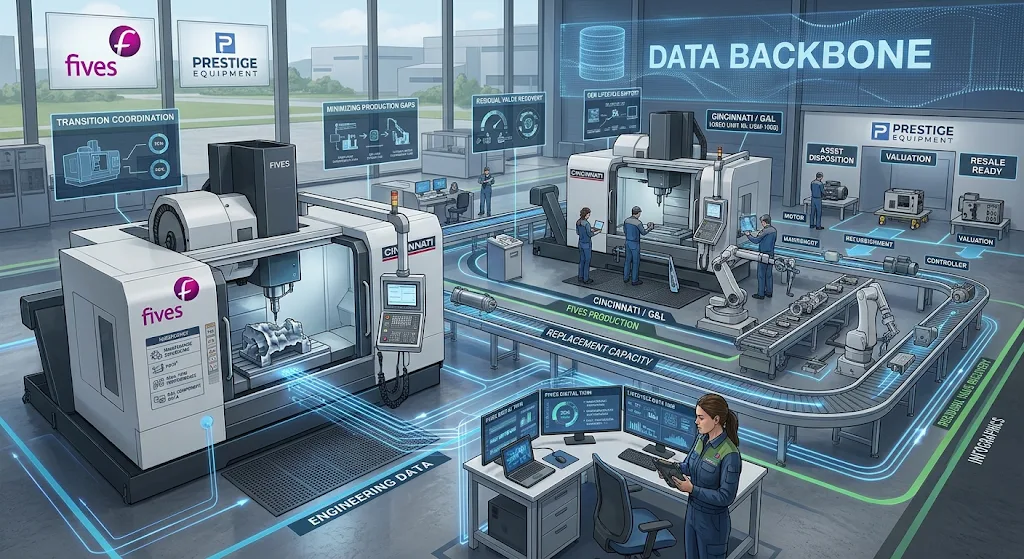
Fives Machining Systems and Prestige Equipment have entered a strategic partnership covering used machinery, asset recovery and machine tool lifecycle support. Fives is the original equipment manufacturer behind the Cincinnati and Giddings and Lewis brands, while Prestige specialises in industrial asset disposition and used equipment. Their agreement connects the sale or recovery of existing assets with services for maintaining, modernising and replacing production equipment.
For a manufacturer, this addresses a transition that is often more complicated than ordering a new machine. An existing asset may still be producing parts, may have residual value and may require specialist work before relocation or resale. At the same time, replacement capacity must be commissioned without creating a production gap. Coordinating these activities can be as consequential as the purchase price of the new equipment.
Joining recovery with continued support
Under the agreement, Prestige will support Fives customers with surplus machinery sales, asset disposition programmes, trade in options, appraisals and access to used equipment markets. Fives will support Prestige customers through OEM maintenance, parts, technical services, retrofits, rebuilds and new machine systems. Preventive maintenance, health assessments and relocation are also identified in the offering. The announcement describes access to capabilities rather than fixed commercial terms for every transaction.
That distinction matters when comparing options. A trade in can simplify a purchase, but its financial value depends on the equipment’s condition and the terms of the replacement. A rebuild can preserve a useful machine, but only if the underlying structure and process capability justify the investment. An appraisal helps establish value; it does not independently establish the suitability of a machine for a particular tolerance or production duty.
From an engineering perspective, machine health assessment is a useful connection between financial and technical decisions. Age alone is a weak description of capability. Wear, geometry, controls, service history and the availability of critical parts can affect whether a machine remains useful. Understanding those factors before deciding to sell, relocate or rebuild creates a more defensible investment plan.
Planning the handover of production
A manufacturing team evaluating modernisation should define the work the equipment must support over the next planning period. Changes in materials, component sizes and automation expectations may make a machine less suitable even when it remains mechanically sound. Conversely, a stable product family may continue to be served effectively by a well maintained asset. The right decision depends on the future process, not simply the appeal of newer technology.
Relocation introduces another set of requirements. The machine must be removed, transported, installed and checked in its new environment. Utilities, foundations and access can affect the project, while production programmes and fixtures may require requalification. The source does not give a standard relocation procedure, but its inclusion in the partnership recognises that asset movement is an engineering service as well as a logistics task.
The arrangement may be particularly relevant during factory expansion, consolidation or a broader technology upgrade, as the companies suggest. These projects often involve several assets at different stages of usefulness. A combined route to recovery and support could reduce the effort of coordinating separate organisations, although the report provides no quantified project savings or guaranteed resale outcomes.
The wider significance is a more connected approach to capital equipment decisions. Machines can be maintained, upgraded, transferred and sold before they are replaced or retired. By linking those options, Fives and Prestige are offering manufacturers another way to evaluate the full lifecycle of production assets. Engineers remain central to that evaluation because the recoverable value of a machine and its remaining process capability are related, but different, measures.
Source — mtimagazine.com. Source publication date 2026-02-20. Engineering analysis: The CAD Verse.
Rate This Article
Share This Article
Share engineering knowledge with your network.

 MEMBERS · ONE ENGINEERING COMMUNITY