






Seco Updates ER HP Collet Chucks for High-Speed Machining
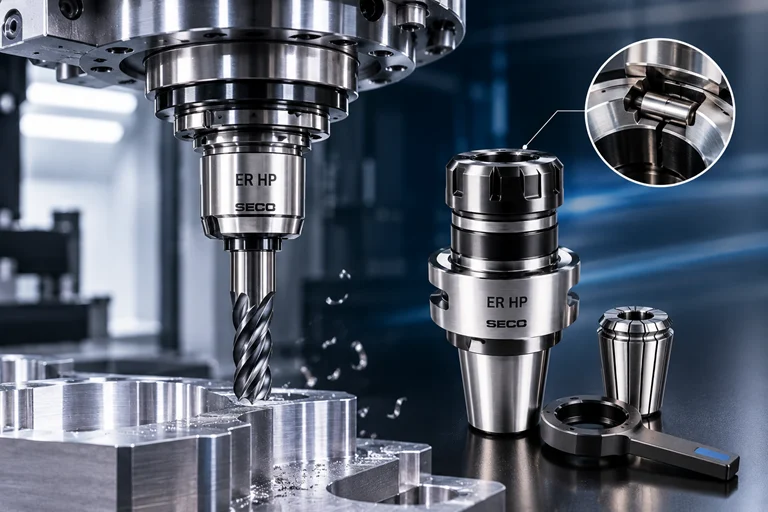
Seco has updated its ER HP collet chuck range for high-speed milling and five-axis work. The company highlights balancing, rigidity, clamping force and run-out performance, together with a roller-key installation method. These are supplier claims about the tooling system rather than guaranteed results for every operation. For a machining team, the announcement concerns a small but consequential part of the process: the interface that determines how the cutting tool is held and presented to the spindle.
The holder belongs in the process definition
A tool assembly includes the cutter, collet, holder and the way those elements are prepared. Changing one component can alter reach, clearance and the behaviour under load. A programme that worked with one assembly should not be assumed to perform identically with another that shares the same nominal cutting diameter. The approved setup should identify the complete arrangement where those differences influence the result.
Run-out is relevant because the cutting edges may not share the load evenly when the tool does not rotate as intended. That can affect finish and tool life, but the outcome also depends on the cutter, material and engagement. A holder specification is therefore a useful input to process selection rather than a substitute for checking the assembled tool. Measurement should reflect the actual assembly and the location relevant to the operation.
Reach competes with rigidity
Five-axis access often requires a balance between avoiding collisions and limiting unnecessary extension. A longer assembly may reach a feature more easily while creating a less favourable mechanical condition. The solution is not always to select the shortest possible tool, because the holder and spindle must still clear the component and fixture. The geometry of the entire assembly should be included in the CAM review.
Designers can help by recognising when a small geometric change would simplify access. A deeper pocket or a restricted approach can create a tooling requirement with consequences for machining time and repeatability. Discussing those features before release may remove the need to solve an avoidable reach problem entirely through the toolholding system.
Installation consistency influences repeatability
Seco’s roller-key arrangement is presented as a way to simplify setup. Ease of use can reduce changeover effort, but the shop still needs a consistent preparation method. Cleanliness, correct component selection and the supplier’s assembly instructions remain relevant. An apparently simple clamping operation can produce variable results if different operators prepare the assembly in different ways.
The same principle applies when investigating a machining problem. Replacing a holder without checking assembly practice may hide the original cause or introduce another variable. A useful trial compares known configurations under comparable conditions and records the tool condition. This makes it easier to determine whether a change in finish or tool life is associated with the holder or with another process input.
Verify the benefit on representative operations
A workshop considering the updated range should select tests that represent both the access constraints and the cutting loads it expects. Measure component quality and tool behaviour, and include the time needed to prepare and change the assembly. A useful improvement may involve more dependable setup as well as faster cutting. The relevant result is the performance of the complete process.
The ER HP update underlines the importance of toolholding in modern machining. Its value will be demonstrated where the selected assembly provides adequate clearance, controlled rotation and reliable clamping for a specific job. Treating the holder as a defined engineering interface helps turn catalogue capabilities into a repeatable production method.
Source — mtimagazine.com. Source publication date 2026-10-30. Engineering analysis: The CAD Verse.
Report an image
 MEMBERS · ONE ENGINEERING COMMUNITY
 Engineering videos and tutorials
 Engineering marketplace and professional opportunities
 Courses, tutorials and learning paths
 Engineering files and CAD models
 Professional engineering projects
Discussion
0 CommentsShare your thoughts and engineering insights with the community.
Comments are closed for this article.
No comments yet. Be the first to share your thoughts.