
Guhring presents new turning tool lines at MACH 2026
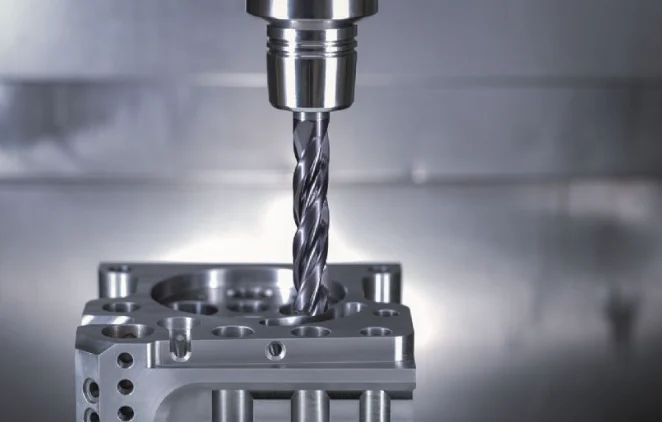
Guhring is presenting new turning and drilling options at MACH 2026, including the System 208 platform for small turned components and additional solid-carbide drilling tools. The announcement addresses several different process constraints: working in confined spaces, obtaining repeatable insert position and reducing separate drilling operations. For a manufacturing engineer, the value of such developments depends on how they fit into the complete component route rather than on the number of new tools displayed.
Compact tooling must preserve a stable reference
System 208 uses precision-ground, double-edged inserts for operations including grooving, parting and turning, with a reported maximum grooving depth of eight millimetres. The source also gives a changeover accuracy figure of plus or minus 0.015 millimetres. That figure concerns the tooling interface and should not be treated as a general tolerance capability for every finished component.
The final feature depends on the machine, setup, workpiece support and cutting conditions as well as the insert position. Workshops should establish how a replacement insert affects the feature they actually inspect. If a change requires an offset adjustment, that procedure needs to be documented. Repeatable changeover is most valuable when it supports a predictable production decision rather than merely a favourable interface measurement.
Confined access changes the planning exercise
Small turned parts often place adjacent features close together, limiting the available tool approach and clearance. The programmer should verify the complete tool assembly against the component and neighbouring equipment. A cutting edge may reach the required position while its holder or another installed tool does not have sufficient clearance. That check belongs in the setup definition, not as an improvised correction during the first production run.
The workpiece also changes as material is removed. A thin section or slender extension may become less supported later in the sequence. Choosing when to groove or part a component can therefore matter as much as selecting the insert geometry. A stable sequence should preserve the support required for the most demanding operation and provide a practical way to confirm the result.
Reducing operations changes verification responsibilities
The FT 200 U drill is described as supporting depths up to 12 times diameter without a separate pilot operation in its intended applications. The announcement attributes this to features of its tip and flute design. That is an application claim to verify with the actual material, diameter and equipment. Eliminating a pilot operation does not remove the need to demonstrate position, size and chip evacuation at the required depth.
Similarly, a step drill that combines a hole and countersink can reduce tool changes, but it connects the dimensions of two features to one tool and one operation. The engineer should confirm that its geometry matches the drawing and that wear can be managed without compromising either requirement. Combined operations are useful when they simplify a controlled process, rather than merely reducing the operation count.
Tool management supports the physical process
The presentation also includes storage and dispensing systems. Controlled access to the right tooling can support repeatable setups, especially when visually similar tools have different lengths, geometries or application ranges. The management record should distinguish those variants and make the approved replacement available when needed. Availability and identification are practical parts of process reliability.
Guhring reports tool-life improvements in selected field trials, but those results do not establish an improvement on every customer job. A workshop evaluation should record the baseline, cutting conditions and replacement criterion before drawing conclusions. The wider engineering opportunity is to connect precise tooling, a sensible operation sequence and controlled tool supply so that the finished component remains consistent through normal production changes.
Source — mtimagazine.com. Source publication date 2026-04-10. Engineering analysis: The CAD Verse.
Report an image

 MEMBERS · ONE ENGINEERING COMMUNITY
Discussion
0 CommentsShare your thoughts and engineering insights with the community.
Comments are closed for this article.
No comments yet. Be the first to share your thoughts.