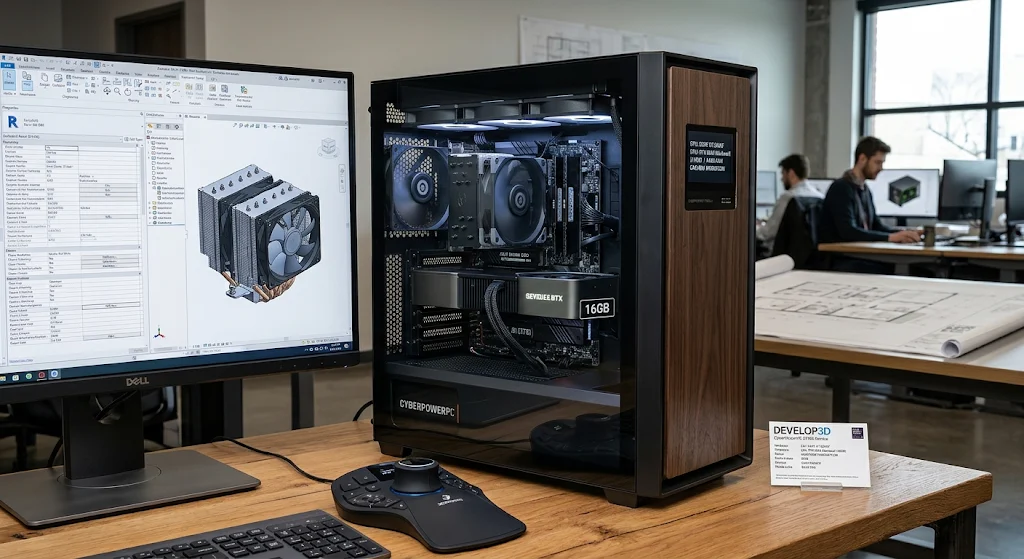
A DEVELOP3D review of CyberPowerPC’s Intel Core U7WS workstation examines a configuration aimed at everyday CAD, BIM and entry level visualisation rather than maximum specification. The tested tower combines an Intel Core Ultra 7 265KF, an Nvidia RTX Pro 2000 Blackwell with 16 gigabytes of memory, 64 gigabytes of system RAM and a 2 terabyte NVMe drive. At the reviewed price of £2,200 excluding VAT, the emphasis is on balancing the components around typical professional workloads.
The review describes CyberPowerPC UK’s expansion from its gaming background into professional workstations under the NXPower business. That heritage is visible in component selection, but the enclosure adopts a quieter visual language with dark walnut accents. For a design studio, appearance may help the machine fit its environment, while the more consequential engineering questions concern sustained performance, cooling and the match between hardware and applications.
Choosing the processor for the work
The Core Ultra 7 265KF has eight performance cores and twelve efficiency cores, with boost frequency up to 5.5 gigahertz. In the review’s CAD, BIM and reality modelling tests, its behaviour was close to that of the flagship Core Ultra 9 comparison. Rendering was different: the tested processor was approximately 16 to 22 percent slower across V-Ray, Corona and Cinebench. Those results demonstrate why a processor choice should follow the workload mix.
A design office spending most of its time in interactive modelling may receive little benefit from paying for additional multithreaded capacity. A user rendering on the CPU for hours each day may value it much more. These are purchasing implications of the reported tests, not new performance measurements. The relevant comparison should use the applications and datasets that occupy the user’s working week.
Thermal behaviour was encouraging in the source review. During extended rendering, the CPU maintained an all core frequency around 4.82 gigahertz. Cooling uses a Corsair Nautilus 360 RS liquid unit with a Thermal Grizzly Kryosheet interface. The review reports generally restrained noise, with only a modest increase during sustained work. That is useful evidence about the tested build, while leaving room conditions and future configurations as variables.
Balanced memory, graphics and expansion
The 64 gigabytes of DDR5 memory is installed as two 32 gigabyte modules, and the primary drive is a Kingston Fury Renegade G5. Those choices provide a substantial starting configuration without making storage or memory the dominant cost. Capacity needs should still be checked against actual projects: a workstation that is responsive on a modest model may behave differently when several large applications are open together.
The RTX Pro 2000 Blackwell is intended to support GPU accelerated visualisation as well as graphics. Its 16 gigabyte memory capacity is relevant when scenes become larger, but capacity alone does not establish rendering speed. The review notes that the system can be configured with more powerful GPUs, subject to power supply requirements. That flexibility is part of the tower’s appeal, although the price and thermal balance would change with the selected hardware.
The Lian Li Lancool 217 enclosure is relatively large for the installed low profile GPU. The reviewer sees the extra space as useful for airflow and upgrades. Side mounted front connectivity and a second power button are practical details that users should assess in relation to where the tower will sit.
The review’s strongest finding is the value of a coherent configuration. The tested machine prioritises the work most designers perform while retaining useful visualisation capability. It offers a case for specifying a workstation around demonstrated application needs, with sustained behaviour and upgrade plans considered alongside headline processor and graphics specifications.
Source — develop3d.com. Source publication date 2026-02-05. Engineering analysis: The CAD Verse.