
Schunk launches spin-off for humanoid robot hands
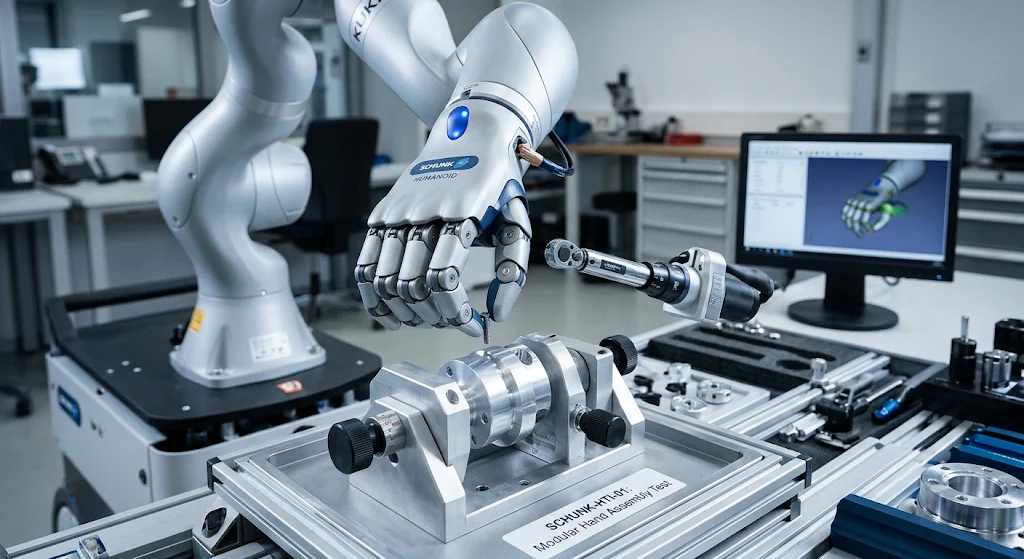
Schunk has established Schunk Humanoid Robotics GmbH to consolidate its work on humanoid robotics and develop modular hands for industrial applications. The spin off began at the start of January 2026 and builds on the parent company’s experience in gripping technology. Its immediate focus is a new anthropomorphic five finger hand incorporating a wrist and forearm, with a prototype described as approaching readiness for use.
The announcement places the hand within the wider challenge of making humanoid systems useful in industrial environments. A mobile or human shaped robot still needs an effective physical interface with tools, products and fixtures. That interface must reconcile dexterity with reliability. A hand that can perform an impressive demonstration is only one part of a system that must repeat a task under changing contact conditions over a production shift.
A component business around the hand
Schunk says the new company will draw on existing infrastructure, testing and development facilities, including its CoLabs robot application centres. It also points to an international research network and established access to customers. Those resources may help connect component development with real handling requirements. They are not, by themselves, evidence that the new prototype has met a particular industrial endurance or safety specification.
The modular approach is especially relevant to system integration. A hand, wrist and forearm form a chain of mechanical and control interfaces, and each affects reach, payload and manipulation. For a robot developer, modularity is useful when it reduces integration effort without obscuring the limits of the component. Interface definition needs to encompass electrical connections, communications and service procedures as well as the mounting geometry.
Schunk has worked with a five finger gripping hand for more than a decade, according to the source. That experience offers continuity between earlier research applications and the proposed industrial product direction. The reported organisational change is intended to speed the transfer of innovation into market ready products. The article does not provide a launch date, commercial specification or confirmed production capacity for the next generation hand.
Industrial dexterity needs a task definition
From an engineering viewpoint, the first test of a humanoid hand is the work it must perform. Different tasks place very different demands on finger force, contact compliance and precision. Picking a rigid component, manipulating a flexible object and using an existing hand tool should not be treated as equivalent demonstrations. A purchaser needs evidence related to the intended object range and operating conditions.
The surrounding product and workstation design also matter. Components with accessible grasp regions and predictable presentation can simplify manipulation, while obstructed access may consume the apparent advantage of additional fingers. Designers evaluating humanoid handling should examine the complete interaction: approach, initial contact, secure grasp, movement, release and recovery from an unsuccessful attempt. These stages expose requirements that a single static payload figure cannot describe.
Maintenance is another practical consideration. An industrial hand operates at the point of contact with the work and may encounter contamination, abrasion or accidental impacts. The source gives no protection rating or maintenance interval for the forthcoming prototype. Those details will be necessary for a realistic comparison with established end effectors in a production application.
The spin off signals that Schunk sees a dedicated commercial opportunity in humanoid manipulation, supported by its existing gripping business. For engineers, the announcement is most useful as an indication of product development direction. The next meaningful milestone will be task specific evidence showing how the modular hand integrates, how consistently it handles representative objects and how it behaves when an industrial process departs from ideal conditions.
Source — mtimagazine.com. Source publication date 2026-02-27. Engineering analysis: The CAD Verse.
Rate This Article
Share This Article
Share engineering knowledge with your network.
 MEMBERS · ONE ENGINEERING COMMUNITY