How Artificial Intelligence Is Transforming Cost Estimation, Manufacturing Planning, and the Quotation Process
The Hidden Bottleneck in CNC Manufacturing
In CNC machining, manufacturing a component is only one part of the business. Before a machine starts cutting material, manufacturers must evaluate customer requirements, examine technical drawings, estimate machining time, calculate material costs, identify production risks, and prepare a competitive quotation.
This process, commonly known as cost estimation and quotation, can be surprisingly time-consuming. It often depends on experienced manufacturing engineers and estimators who understand machining operations, machine capabilities, tooling requirements, tolerances, and production economics.
For many machine shops, preparing a quotation is still a largely manual process. Engineers need to interpret CAD models and technical drawings, determine how a component could be manufactured, estimate production times, and calculate the resources required.
CloudNC aims to change this workflow with Quote Agent, an artificial intelligence-powered solution designed to automate much of the preparation involved in CNC manufacturing quotations.
The concept is straightforward: instead of spending hours evaluating a new manufacturing request, a machine shop can use AI to prepare an initial manufacturing assessment and cost estimate within minutes.
What Is CloudNC Quote Agent?
<underline>Quote Agent</underline> is an AI-powered quotation and manufacturing assessment platform developed by CloudNC. It is designed to help CNC machine shops evaluate incoming customer requests and prepare quotations more efficiently.
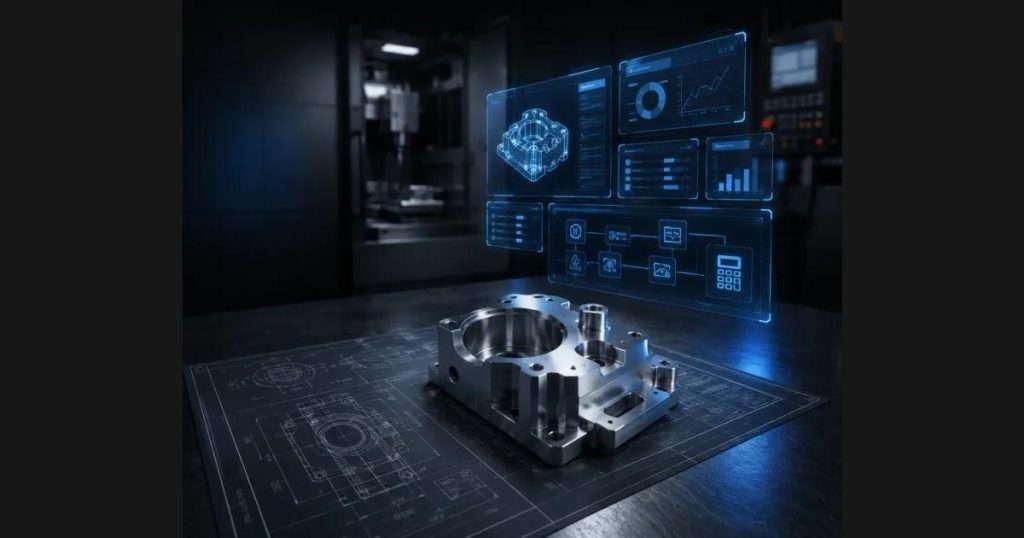
The system can process customer requests for quotation (RFQs), 2D engineering drawings, and 3D CAD models. Based on the submitted information, it evaluates the component and prepares a proposed manufacturing plan.
Its assessment can include:
- Manufacturing process recommendations
- Estimated routing and machining times
- Material cost estimates
- Post-processing cost estimates
- Manufacturing risk identification
- Inspection and quality requirements
- Design for Manufacture (DFM) feedback
Rather than simply generating a price, Quote Agent attempts to understand how a component could be produced and what resources may be required.
This distinction is important. A useful CNC quotation is not just a calculation based on material weight and machine time. It requires an understanding of the manufacturing route, production constraints, quality requirements, and the capabilities of the specific machine shop.
How Does the AI Quotation Process Work?
CloudNC has designed Quote Agent around a workflow that connects customer requirements with manufacturing knowledge.
1. Uploading Customer Requirements
The process begins when a manufacturer receives a new RFQ.
Users can forward the customer’s request by email or upload 2D technical drawings, 3D models, or both. The system can also extract quantity breaks from the submitted information.
This allows the AI agent to begin evaluating the job without requiring the estimator to manually transfer every piece of information into a separate quotation system.
2. Understanding the Component
The next stage involves analysing the geometry and technical information.
The AI agent assesses the component for manufacturing risks and evaluates the operations that may be required to produce it. This is particularly relevant for precision-machined parts involving milling, turning, and complex five-axis machining.
At this stage, the system attempts to identify the manufacturing requirements that influence cost and production feasibility.
Missing, incomplete, or contradictory information can trigger additional questions. This helps the estimator resolve uncertainties before moving forward with the quotation.
3. Creating a Manufacturing Plan
Based on its assessment, Quote Agent prepares a proposed manufacturing plan.
The plan can include the expected production route, estimated operation times, material requirements, post-processing costs, and inspection requirements.
This gives the estimator an initial technical and commercial framework to evaluate.
However, the proposed manufacturing route should not be confused with a validated CNC machining strategy or a production-ready NC program. The purpose of Quote Agent is to support the quotation stage, not to replace the subsequent CAM programming and machine verification processes.
4. Estimating Costs
Cost estimation is one of the most important parts of the system.
Quote Agent combines CloudNC’s proprietary physics-based manufacturing models with large language models to analyse manufacturing requirements and prepare estimates.
Material and post-processing estimates can initially use average prices available online. Manufacturers can replace these values with their own supplier prices.
The platform also allows users to configure their workshop information through a dedicated area called Myshop.
This information can include:
- Available CNC machines and equipment
- Manufacturing capabilities
- Internal production costs
- Stocked materials
- Workshop-specific preferences
By considering these details, the system can tailor its estimates to the individual machine shop rather than relying exclusively on generic manufacturing assumptions.
5. Human Review and Customer Quotation
The final stage remains under the control of the estimator.
The user reviews the proposed manufacturing plan, checks the estimated times and costs, makes adjustments where necessary, decides whether to accept the job, and determines the final selling price.
Once approved, the quotation can be generated as a PDF and sent to the customer.
This human-in-the-loop approach is essential. AI can accelerate technical assessment and cost preparation, but the commercial responsibility for the final quotation remains with the manufacturer.
Beyond Cost Estimation: DFM and Quality Documentation
One of the more interesting aspects of Quote Agent is that its functionality extends beyond preparing quotations.
The platform can also generate additional manufacturing and quality-related documents.
Design for Manufacture (DFM) Reports
DFM analysis helps identify design characteristics that may create manufacturing difficulties, increase production costs, or introduce unnecessary complexity.
By identifying potential issues before production begins, manufacturers can discuss design improvements with customers at an earlier stage.
Ballooned Drawings
The system can generate drawings with numbered inspection callouts. These markers help connect drawing characteristics with the corresponding inspection requirements.
First Article Inspection Reports
Quote Agent can prepare First Article Inspection (FAI) reports in PDF and Excel formats. CloudNC states that these reports support the AS9102 reporting standard.
It is important to distinguish document preparation from physical inspection: generating an FAI report does not replace measuring the manufactured component or verifying its actual conformity.
Together, these capabilities position Quote Agent as more than a quotation calculator. It becomes a tool for preparing the technical documentation that supports the early stages of a manufacturing project.
Quote Agent and CAM Assist: Two Different Roles
CloudNC is already known for CAM Assist, its AI-powered solution for CNC programming workflows.
Although both products use artificial intelligence to support manufacturing, they address different stages of the production process.
| Capability | Quote Agent | CAM Assist |
|---|---|---|
| Main purpose | Quotation and cost estimation | CAM programming assistance |
| Primary workflow | RFQ assessment | Machining strategy and toolpath generation |
| Manufacturing plan | Prepares a proposed plan | Supports machining strategy creation |
| Cost estimation | Yes | Supports cycle-time estimation |
| CNC toolpaths | No | Yes |
| Main benefit | Faster commercial decisions | Faster CAM programming |
The distinction is commercially and technically significant.
Quote Agent helps manufacturers decide whether a job is suitable and how it might be priced. CAM Assist helps CAM programmers develop machining strategies and toolpaths.
Quote Agent is also available as a standalone web application. It does not require users to install CAM Assist or another CAM package.
Together, these technologies illustrate how AI can support different stages of the manufacturing lifecycle, from evaluating a customer request to preparing a component for machining.
What Does This Mean for CNC Manufacturers?
The potential impact of automated quotation systems extends beyond saving time.
Faster Responses to Customers
In competitive manufacturing markets, response time can influence whether a machine shop wins an order.
Preparing an initial estimate in minutes rather than hours could help manufacturers evaluate more opportunities and respond to customers sooner.
More Consistent Estimation
Manual quotations can vary depending on the experience, assumptions, and workload of the person preparing them.
A structured AI-assisted workflow may help standardise the initial assessment process. However, consistency still depends on the quality of the machine shop’s data and the accuracy of the underlying assumptions.
Better Visibility of Manufacturing Risks
A quotation is also an early opportunity to identify technical and commercial risks.
Potential manufacturing difficulties, inspection requirements, and uncertain production assumptions can be examined before a company commits to a job.
More Efficient Use of Engineering Expertise
Experienced estimators and manufacturing engineers often spend significant time on repetitive preparation tasks.
Automating part of this work could allow them to focus on complex components, process optimisation, customer discussions, and decisions that require professional judgement.
The Limitations: AI Cannot Replace Manufacturing Experience
Despite its potential, automated quotation technology should not be treated as a replacement for experienced manufacturing engineers.
Machining costs depend on many variables that can be difficult to capture completely in a digital model.
These include machine condition, fixture design, tool availability, cutting parameters, operator experience, setup complexity, batch size, inspection strategy, and actual shop-floor efficiency.
Even when a CAD model is geometrically complete, it may not contain all the information required to determine a reliable manufacturing cost.
CloudNC’s own guidance makes this distinction clear: routing times and cost estimates are proposals that users must review. Manufacturers should also provide accurate workshop data and replace generic material or post-processing prices with their own supplier information wherever possible.
Data security is another consideration. CloudNC states that uploaded information is stored in an encrypted AWS environment, with encryption in transit and at rest. However, the company currently advises against uploading export-controlled data and says that work requiring FedRAMP authorisation or AWS GovCloud is not yet supported.
For manufacturers working with defence, aerospace, or other sensitive customer projects, checking contractual and security requirements before uploading technical files is essential.
Ultimately, the quality of an AI-generated quotation depends not only on the software but also on the quality of the data, the manufacturing assumptions, and the human review behind it.
Pricing and Availability
CloudNC launched Quote Agent in October 2026 as a standalone product.
According to the company’s launch announcement, its manual quotation workflow is free, with unlimited users and usage. The AI agent can also be tested free before moving to paid usage.
At launch, CloudNC announced AI quotation usage at $2.50 per component, with volume discounts available. The company’s later product guidance describes usage through purchased part allowances, with pricing depending on the selected plan.
Manufacturers should check the official pricing page for current plan details and usage conditions.
More information: CloudNC Quote Agent
The Future of AI in Digital Manufacturing
For years, the discussion around artificial intelligence in manufacturing has focused heavily on automation, robotics, predictive maintenance, and CNC programming.
Quote Agent demonstrates another important direction: applying AI to the commercial and engineering decisions that happen before production even begins.
The ability to interpret technical drawings, evaluate manufacturing requirements, estimate production resources, and prepare structured quotations could make a meaningful difference for machine shops, particularly those managing a high volume of RFQs.
The broader opportunity lies in connecting engineering data with manufacturing intelligence.
A CAD model is no longer just a geometric representation of a component. When combined with manufacturing knowledge, machine capabilities, material information, and cost data, it can become the starting point for a much more connected digital manufacturing workflow.
CloudNC Quote Agent is an example of this evolution. It does not eliminate the need for manufacturing expertise, nor does it guarantee that every estimate will be accurate. Instead, it aims to reduce the repetitive work between receiving a customer request and making an informed production decision.
The future of CNC manufacturing may not be defined only by how quickly a machine can produce a part, but also by how intelligently a manufacturer can evaluate, price, and prepare that part for production.
Editorial Perspective
AI-powered quotation systems represent an important step toward a more connected manufacturing ecosystem. Their real value will depend on how accurately they reflect individual workshop conditions and how effectively experienced engineers validate their recommendations. The goal is not to remove human judgement from manufacturing, but to give engineers better information and more time to make the right decisions.