Connecting Precise 3D Modeling, OpenUSD, and AI-Driven Engineering Workflows
Introduction
The engineering and manufacturing industries are moving toward increasingly connected digital environments. From computer-aided design (CAD) and simulation to digital twins and AI-assisted product development, the ability to exchange accurate engineering data between different software platforms is becoming more important than ever.
However, one fundamental challenge remains: different engineering and visualization applications do not always interpret 3D geometry in the same way.
A mechanical component created in a professional CAD system may contain mathematically precise surfaces, edges, vertices, and solid geometry. When that model is transferred into a visualization or simulation environment, some of its geometric information may be converted into polygonal meshes.
Although meshes are suitable for visualization, they do not necessarily preserve the exact geometric relationships required by engineering applications.
NVIDIA is addressing an important part of this challenge with USD BRep, a standalone geometry library designed to bring Boundary Representation (BRep) solid modeling into the OpenUSD ecosystem.
Released as an open-source project in October 2026, USD BRep provides C++ and Python interfaces for working with NURBS-based solid geometry and exchanging BRep data with OpenUSD.
Its significance goes beyond another geometry library. It creates new opportunities for connecting traditional CAD data with industrial digital twins, advanced visualization, computational workflows, and AI-assisted engineering applications.
1. Understanding the Difference Between Mesh and BRep Geometry
To understand why USD BRep matters, it is important to distinguish between two fundamental approaches to representing 3D objects.
Polygon Mesh Geometry
Polygon meshes represent objects through collections of connected vertices, edges, and polygonal faces.
They are widely used in:
- 3D visualization and rendering.
- Animation and digital content creation.
- Virtual and augmented reality.
- Game development.
- Real-time simulation environments.
Common formats such as STL and OBJ use mesh-based geometry.
Meshes are efficient for displaying complex shapes, but curved surfaces are represented through polygonal approximations. Increasing the number of polygons can improve visual quality, although it also increases data size and processing requirements.
Boundary Representation (BRep)
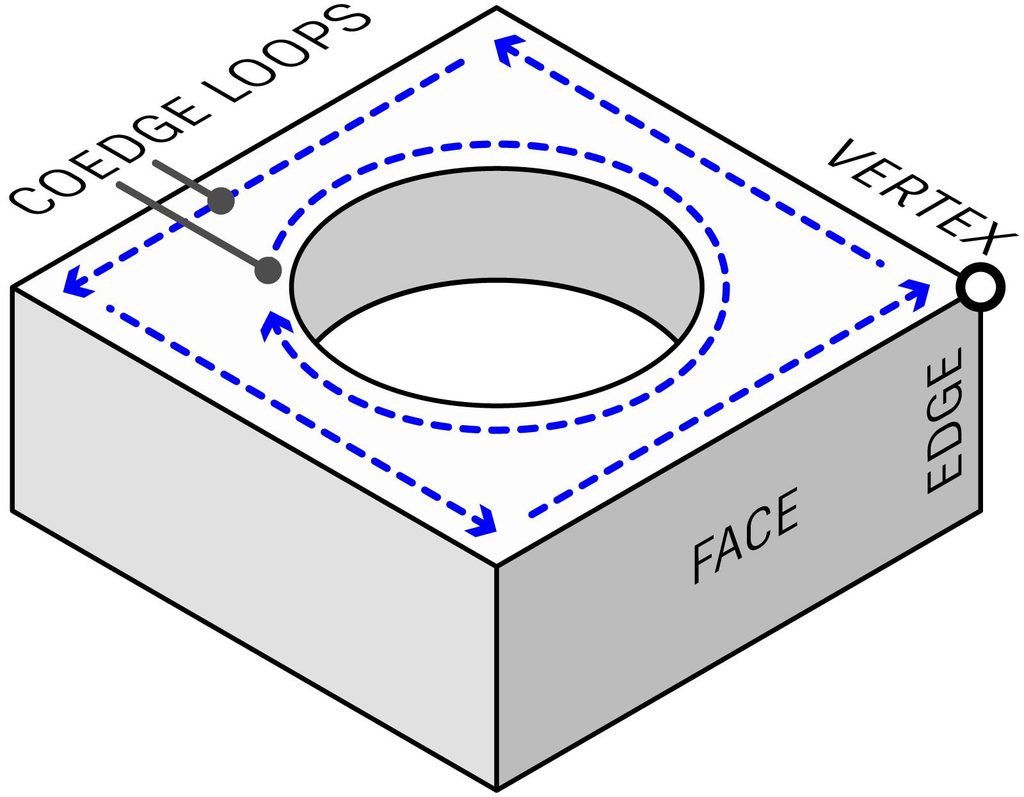
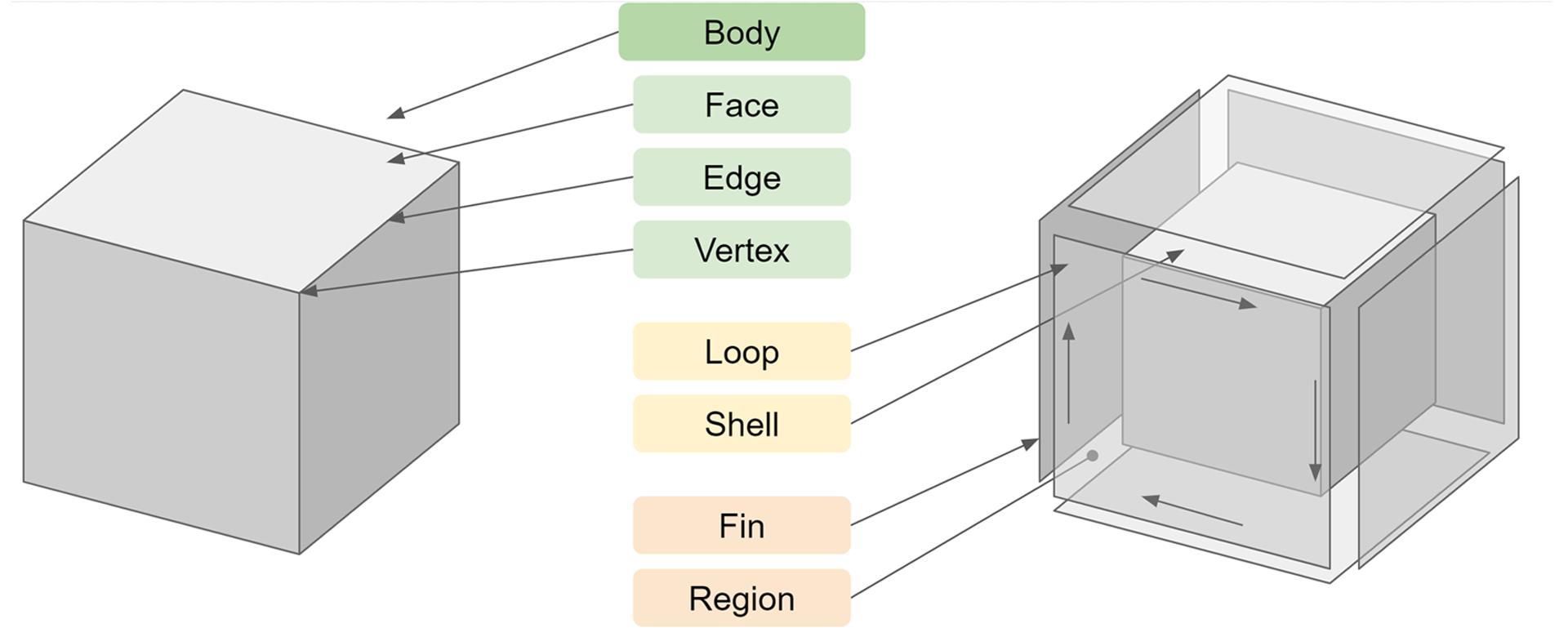
BRep describes a solid through its boundaries and their topological relationships.
A typical BRep model contains:
- Vertices: Points defining geometric boundaries.
- Edges: Curves connecting vertices.
- Faces: Surfaces bounded by connected edges.
- Shells: Connected collections of faces.
- Solids: Closed geometric volumes.
Unlike a polygon mesh, BRep can represent mathematically exact geometric surfaces, including planes, cylinders, cones, and NURBS surfaces.
For example, a cylindrical hole in a mechanical component can be represented as an exact cylindrical surface rather than an approximation made from multiple polygonal faces.
This distinction is particularly important in engineering, where geometric accuracy affects manufacturing, dimensional inspection, assembly, and simulation.
2. What Is NVIDIA USD BRep?
NVIDIA USD BRep is a standalone C++ and Python library for NURBS-based Boundary Representation solid modeling.
The project combines the capabilities of the SMLib solid modeling kernel with an integration layer that allows BRep geometry to be imported into and exported from OpenUSD.
Its primary purpose is to make precise engineering geometry available within USD-based digital content and industrial workflows.
The library provides functionality for creating, inspecting, editing, validating, and converting BRep geometry.
Some of its capabilities include:
- Creating and modifying solid geometry.
- Boolean operations such as union, subtraction, and intersection.
- Fillets, sweeps, offsets, and other geometric operations.
- Geometry healing and validation.
- NURBS surface and curve handling.
- Conversion between BRep and polygon mesh representations.
- Import and export of BRep data through OpenUSD.
The availability of both C++ and Python APIs gives developers flexibility when integrating the library into custom engineering applications and automated geometry-processing pipelines.
An important aspect of the release is its open-source distribution under the Apache 2.0 license, allowing developers to explore, integrate, and extend the technology under the terms of that license.
3. Why OpenUSD Matters for Engineering?
OpenUSD, originally developed by Pixar, has evolved into an important framework for describing, assembling, and exchanging complex 3D scenes.
It is designed to bring together different types of scene information, including geometry, materials, lighting, transformations, and relationships between objects.
NVIDIA has expanded the use of OpenUSD through its Omniverse platform, particularly in industrial digital twins, robotics, simulation, and collaborative 3D environments.
However, traditional USD geometry representations have not provided a complete native solution for the exact BRep topology required by many mechanical engineering workflows.
This creates an important gap between visualization-oriented geometry and engineering-oriented geometry.
USD BRep addresses this gap by introducing a way to carry BRep data through an OpenUSD workflow.
The potential benefit is significant: engineering geometry can be exchanged alongside the other information needed to build complex digital scenes.
Instead of relying exclusively on polygonal representations, developers can work with more precise geometric data when the application requires it.
4. The Role of SMLib in the USD BRep Project
One of the most interesting aspects of NVIDIA’s release is the technology behind the geometry kernel.
USD BRep incorporates SMLib, a solid modeling library originally developed by Solid Modeling Solutions.
NVIDIA acquired Solid Modeling Solutions in 2022, bringing its geometry technology into the NVIDIA ecosystem.
SMLib provides the mathematical and topological foundation for solid modeling operations.
This includes the management of geometric entities, surface definitions, edge relationships, and operations used to construct or modify solid objects.
The technology has an established history in professional geometry processing, rather than being an entirely new modeling engine developed specifically for the 2026 release.
Its integration with OpenUSD makes this geometry technology available to a broader development community.
For CAD developers, this creates an opportunity to investigate how established solid modeling algorithms can be integrated into modern visualization and digital engineering platforms.
5. How USD BRep Could Transform AI-Assisted CAD Development
Artificial intelligence is becoming increasingly important in engineering software.
AI-assisted design tools can generate concepts, automate repetitive modeling operations, interpret engineering instructions, and support design optimization.
However, one major challenge is ensuring that AI-generated geometry is not merely visually convincing but also mathematically valid and suitable for engineering applications.
This is where structured BRep geometry becomes particularly interesting.
A polygon mesh provides information about the visible shape of an object. A BRep model also contains explicit geometric and topological relationships.
These relationships provide a more structured representation for software systems that need to inspect, manipulate, or generate engineering geometry.
With access to BRep data through C++ and Python, developers can investigate new workflows involving:
- AI-assisted geometric recognition.
- Automated solid modeling operations.
- Programmatic CAD generation.
- Geometry validation and repair.
- Integration of language models with modeling tools.
- Generative design and engineering automation.
For example, a developer could build an application in which a user describes a simple mechanical component using natural language. An AI system could interpret the requirements, call geometric modeling functions, generate a BRep solid, and export the result into an OpenUSD scene.
This does not mean USD BRep itself is an autonomous AI design system. Rather, it provides geometry-processing capabilities that developers can use when building such applications.
The distinction is important: AI interprets and generates instructions, while the geometry kernel performs the underlying mathematical modeling operations.
6. Potential Applications in Industrial Digital Twins
Digital twins are becoming an important part of modern manufacturing and industrial engineering.
A digital twin can combine 3D geometry, sensor information, operational data, simulation results, and real-world system behavior into a connected digital environment.
However, the quality of the underlying geometric representation plays an important role in many industrial applications.
USD BRep could contribute to this environment by making precise mechanical geometry available within OpenUSD-based workflows.
Manufacturing and Production Systems
Manufacturers could use accurate geometric representations when assembling digital factory environments and evaluating mechanical components.
For example, a production line digital twin may contain machines, robotic arms, fixtures, and complex mechanical assemblies.
Access to precise geometry can support more reliable spatial relationships and geometric inspection.
Robotics and Automation
Robotic systems often need to understand the geometry of their environment.
Accurate representations of machine components, workpieces, and fixtures can support applications involving collision detection, motion planning, and automated manipulation.
Product Development
Engineering teams could investigate workflows where CAD geometry is transferred into visualization environments without relying exclusively on polygonal approximations.
This could improve the relationship between design data and downstream visualization or engineering applications.
7. Integration with CAD, CAM, and CAE Workflows
The broader importance of USD BRep becomes clearer when viewed through the CAD, CAM, and CAE ecosystem.
CAD: More Flexible Geometry Exchange
CAD developers can use the library to create and manipulate exact solid geometry programmatically.
Its Python and C++ interfaces could support custom modeling applications, geometry converters, and automated design pipelines.
However, BRep geometry should not be confused with a complete parametric CAD feature history. A solid model containing exact surfaces and topology does not automatically preserve the original sketches, constraints, design intent, or modeling sequence of the source CAD system.
CAM: A Potential Bridge to Manufacturing Data
CAM applications depend on accurate geometry when calculating machining strategies and toolpaths.
A more direct exchange of exact geometry could support custom manufacturing pipelines and reduce certain conversion-related limitations.
Nevertheless, USD BRep is not a CAM system. Toolpath generation, machining strategies, cutting conditions, and post-processing still require dedicated manufacturing software.
CAE: Geometry Preparation and Simulation
CAE applications often require accurate geometry as a starting point for simulation.
BRep representations can be useful when preparing solid models for geometric operations, surface extraction, and downstream engineering analysis.
However, a valid BRep solid is not automatically ready for finite element analysis or computational fluid dynamics.
Engineers must still consider geometry simplification, mesh generation, material properties, boundary conditions, and solver requirements.
The real opportunity is a more connected data pipeline between different engineering environments.
8. USD BRep and the Future of Real-Time Engineering Visualization
One of the most promising directions is the integration of precise engineering geometry with real-time 3D visualization.
Traditional workflows often require CAD models to be converted into polygon meshes before they can be used in visualization environments.
This conversion is necessary for many rendering applications, but it can introduce additional processing steps and geometric approximations.
USD BRep provides an alternative approach for applications that need to retain access to exact BRep information within an OpenUSD-based workflow.
This could become particularly valuable when working with large industrial assemblies, complex machinery, and digital factory environments.
For example, engineers could explore a workflow in which a mechanical component is created or imported as BRep geometry, transferred into an OpenUSD scene, and visualized alongside materials, lighting, machine data, and other digital assets.
The geometry could also be accessed by compatible tools for further processing.
It is important to note that visualization systems may still tessellate BRep geometry for rendering. The advantage is that the underlying exact representation can remain available rather than being discarded during conversion.
9. How Does USD BRep Fit Into the Existing CAD Kernel Landscape?
The professional CAD industry already relies on mature geometry kernels.
Technologies such as Siemens Parasolid and Spatial ACIS have played important roles in commercial CAD applications for decades.
These kernels have been developed through years of mathematical research, software engineering, and industrial use.
NVIDIA USD BRep enters a different part of this ecosystem.
Its immediate significance is not that it replaces established commercial CAD kernels or eliminates the need for professional CAD systems.
Instead, it introduces another accessible geometry technology that developers can use to connect precise solid modeling with OpenUSD-based applications.
This creates opportunities for experimentation, custom software development, and more open engineering data pipelines.
The long-term impact will depend on software adoption, interoperability, performance, geometric robustness, and the needs of industrial users.
10. What Comes Next for AI-Driven Engineering?
The release of USD BRep highlights a broader transformation taking place across engineering software.
CAD systems are increasingly expected to work with AI tools, digital twins, simulation platforms, and collaborative visualization environments.
In this context, geometry is no longer just a shape used to manufacture a physical product.
It is becoming a structured source of information that can be interpreted, analyzed, transformed, and reused across multiple digital applications.
OpenUSD provides a framework for connecting complex 3D scenes, while USD BRep adds an important capability for handling precise solid geometry within that ecosystem.
Future developments could lead to more sophisticated workflows in which AI systems interact with exact engineering geometry, developers automate modeling operations, and industrial digital twins combine design data with real-time operational information.
The technology is still developing, and its industrial adoption will depend on how effectively it integrates with existing engineering software and production environments.
Conclusion: Connecting CAD Geometry With the Next Generation of Digital Engineering
NVIDIA USD BRep represents an important development in the relationship between traditional solid modeling and modern 3D data ecosystems.
By providing C++ and Python access to NURBS-based BRep geometry and enabling its exchange through OpenUSD, the project creates new possibilities for developers working across CAD, visualization, digital twins, and AI-assisted engineering.
Its importance is not simply about introducing another geometry kernel.
It is about making precise engineering geometry more accessible within interconnected digital workflows.
For the CAD industry, this could encourage new approaches to software development, data interoperability, and automated design processes.
For manufacturers, it offers another technology to explore when building more connected digital engineering environments.
And for AI-driven product development, it provides a more structured geometric foundation on which future applications can be built.
The next generation of engineering software will not be defined only by how we create 3D models, but by how intelligently we connect, understand, and reuse engineering geometry across the entire product development lifecycle.
References and Further Reading:
- NVIDIA Omniverse – USD BRep Official Documentation.
- NVIDIA-Omniverse – USD BRep Open-Source GitHub Repository.
- DEVELOP3D – NVIDIA Launches USD BRep Geometry Kernel for Solid Modelling (October 13, 2026).
- Alliance for OpenUSD – Boundary Representation Geometry in OpenUSD Proposal.
Editorial note: USD BRep is a geometry-processing library and OpenUSD integration technology, not a complete replacement for established commercial CAD platforms. Its long-term impact will depend on adoption, interoperability, and integration into practical engineering workflows.