The Evolution of Geometry Reconstruction in Modern Product Development
Introduction
Reverse engineering has always been an essential part of product development, particularly in industries where existing components need to be redesigned, modified, analyzed, or reproduced. However, converting scanned physical geometry into editable CAD models has traditionally been a time-consuming engineering task.
With the increasing adoption of 3D scanning technologies, engineers can capture complex physical objects and generate highly detailed polygonal mesh data. Yet, having an accurate digital representation does not necessarily mean having a usable engineering model.
This is where artificial intelligence is beginning to introduce a significant shift: transforming raw mesh geometry into structured, editable, and potentially parametric CAD models.
The Challenge: Why Mesh Geometry Is Not Enough
3D scanners typically generate point clouds or polygonal meshes that represent the external surface of physical objects.
Common formats such as STL and OBJ are widely used to store this information. Although these formats provide detailed geometric representations, they do not inherently contain the design intelligence found in traditional CAD models.
A conventional parametric CAD model includes much more than surface geometry. It can contain:
- Sketches and geometric constraints
- Extrusions, revolutions, and other modeling operations
- Feature trees and construction history
- Parametric dimensions and relationships
- Design intent and editable engineering parameters
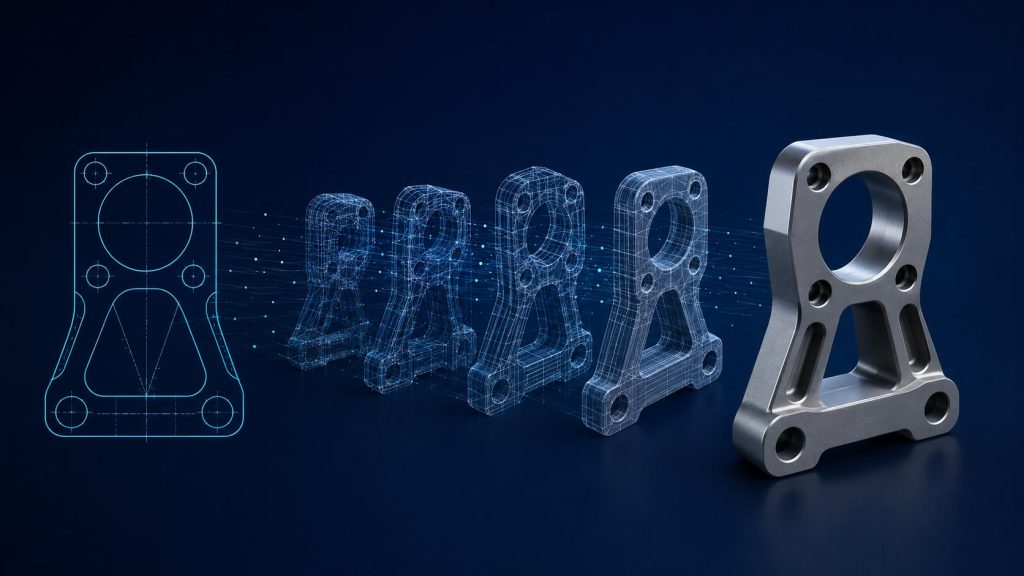
For example, an STL file representing an automotive bracket may accurately describe its shape, but it does not explain how the bracket was designed, which dimensions control its geometry, or how its features relate to one another.
Engineers often need to reconstruct these relationships manually before the geometry can be incorporated into an existing product development workflow.
This reconstruction process can become particularly challenging when dealing with complex industrial components, freeform surfaces, and large assemblies.
AI-Powered Mesh-to-CAD: A Different Approach to Geometry Reconstruction
Artificial intelligence offers a new approach to interpreting scanned geometry.
Instead of treating a mesh as a collection of disconnected triangles, AI-assisted systems can analyze geometric patterns, recognize recurring shapes, identify features, and infer possible modeling operations.
The objective is not simply to reproduce the scanned surface. It is to understand the underlying geometric structure and reconstruct it as an engineering model.
Depending on the geometry and the reconstruction method, this process may involve:
1. Geometric Feature Recognition
AI algorithms can help identify common engineering features such as holes, cylindrical surfaces, planar regions, slots, and curved transitions.
2. Surface and Solid Reconstruction
Recognized geometric regions can be converted into more structured surface representations and, where appropriate, solid geometry.
3. Parametric Feature Generation
The reconstructed geometry can be represented through editable modeling operations, dimensions, and relationships rather than remaining a static polygonal object.
4. CAD Model Validation
The resulting model needs to be evaluated against the original scan to identify geometric deviations, missing features, and reconstruction errors.
The quality of the final model depends on scan accuracy, geometric complexity, algorithm performance, and the assumptions used during reconstruction.
CADFit and the Growing Role of AI in CAD Reconstruction
Research into AI-assisted CAD reconstruction is moving beyond simple surface fitting.
One example highlighted in recent engineering discussions is CADFit, an approach associated with research at MIT that explores the reconstruction of structured CAD representations from mesh geometry.
The broader significance of this research is its focus on recovering engineering structure rather than producing only a visually similar surface.
This distinction is important.
A reconstructed model that looks identical to the scanned component may still be unsuitable for engineering modifications. A useful CAD reconstruction should ideally provide recognizable geometric features and an editable modeling structure.
The long-term opportunity is to make reverse engineering more accessible, repeatable, and integrated with modern digital design environments.
Industrial Applications: Where Could This Technology Make a Difference?
The potential applications extend across several engineering disciplines.
Automotive Engineering
Automotive development frequently involves the inspection, modification, and redesign of existing components.
AI-assisted mesh-to-CAD workflows could help engineers reconstruct brackets, housings, structural components, and complex mechanical interfaces from scanned physical parts.
This could be particularly useful when original CAD data is unavailable or outdated.
Aerospace and Structural Engineering
Aerospace components often involve complex geometries and demanding dimensional requirements.
Reconstructing editable CAD models from physical components could support inspection, design modification, and geometry comparison.
However, aerospace applications would require rigorous dimensional verification and engineering validation before reconstructed models could be used for production.
Manufacturing and Tooling
Manufacturers frequently work with legacy components, molds, dies, and tooling systems.
Converting scanned geometry into editable CAD models could reduce the effort required to reproduce or modify existing tooling.
It could also improve the integration between 3D scanning, CAD modeling, and CNC manufacturing.
Product Development and Design Optimization
One of the most interesting opportunities is the ability to use reconstructed geometry as a starting point for further engineering development.
Instead of simply reproducing an existing component, engineers could modify its dimensions, redesign selected features, or prepare alternative configurations.
This creates a more direct connection between physical products and digital product development environments.
The Connection Between Mesh-to-CAD, CAE, and Digital Twins
The importance of this technology extends beyond CAD modeling.
In a modern engineering workflow, geometry is often shared between CAD, CAM, and CAE applications.
A reconstructed CAD model could provide a more structured starting point for:
- Finite Element Analysis (FEA)
- Computational Fluid Dynamics (CFD)
- Structural optimization
- Manufacturing preparation
- Digital twin development
For example, a scanned mechanical component could first be reconstructed as an editable CAD model, then evaluated through structural simulation, modified according to engineering requirements, and finally prepared for manufacturing.
This creates an opportunity for a more connected digital engineering process.
Nevertheless, reconstructed geometry does not automatically become simulation-ready. Engineers may still need to simplify geometry, repair surfaces, define materials, establish boundary conditions, and validate the model.
What Are the Remaining Technical Challenges?
Despite its potential, AI-based mesh-to-CAD reconstruction still faces several important challenges.
Geometric Accuracy: Small deviations can significantly affect components with tight manufacturing tolerances.
Design Intent Recovery: A geometric reconstruction does not necessarily reveal the original designer’s intentions or engineering constraints.
Complex Freeform Surfaces: Organic and highly irregular geometries remain difficult to represent using conventional parametric modeling operations.
Model Validation: Reconstructed models must be compared with the original scan and independently checked before being used in critical engineering applications.
CAD Interoperability: The ability to export and maintain editable feature structures across different CAD platforms remains an important consideration.
AI can accelerate reconstruction, but engineering judgment and validation remain essential.
Conclusion: Moving From Digital Copies to Engineering Intelligence
The next stage of reverse engineering will not be defined solely by how accurately we can scan a physical object.
It will increasingly depend on how effectively we can transform captured geometry into useful engineering information.
AI-assisted mesh-to-CAD technologies represent an important step in this direction. By connecting 3D scanning with geometric recognition, structured modeling, and parametric design, they have the potential to reduce repetitive modeling work and improve the efficiency of product development.
For engineering organizations, the real opportunity is not simply creating digital copies of existing components. It is making physical geometry part of an intelligent, editable, and reusable digital engineering workflow.
The future of reverse engineering may not be about rebuilding geometry manually, but about teaching software to understand how geometry was designed.
Source and Further Reading:
- Engineering.com – Coverage of AI-assisted mesh-to-CAD research and CADFit.
- MIT research – CADFit and AI-driven geometric reconstruction.
- Additional technical references on 3D scanning, parametric CAD, and reverse engineering.
Editorial note: This article presents an independent engineering perspective on the broader technology. AI-assisted reconstruction capabilities should not be interpreted as fully autonomous or universally production-ready CAD conversion.