Exploring the Latest Developments in Multiphysics Simulation, Meshing, Solver Technology, and Engineering Workflows
The Growing Role of Open-Source CFD in Engineering
Computational Fluid Dynamics (CFD) has become an essential engineering tool for understanding fluid flow, heat transfer, pressure distribution, turbulence, and other complex physical phenomena.
From automotive aerodynamics and aerospace design to energy systems, turbomachinery, marine engineering, and industrial processes, CFD simulations allow engineers to investigate design performance before physical prototypes are manufactured.
However, advanced CFD simulation is not simply a matter of running a solver. Reliable results depend on geometry preparation, mesh quality, physical models, numerical methods, computational resources, and the ability to interpret simulation data.
In this environment, open-source technologies have become increasingly important. They offer flexibility, transparency, and opportunities for customisation, while commercial engineering software providers add specialised interfaces, technical support, and integrated workflows.
One company working in this space is ENGYS, whose HELYX platform combines an open-source simulation engine with an enterprise-oriented CFD environment.
On October 15, 2026, ENGYS announced HELYX 4.6.0, introducing improvements across modelling capabilities, meshing, solver workflows, post-processing, and software usability.
The release also updates the HELYX-Adjoint, HELYX-Coupled, and HELYX-Marine modules.
Rather than focusing on a single new solver, HELYX 4.6.0 represents a broader effort to improve the complete CFD simulation workflow.
What Is ENGYS HELYX?
HELYX is a general-purpose Computational Fluid Dynamics platform developed by ENGYS for industrial and engineering applications.
It is built around HELYX-Core, an open-source CFD simulation engine developed by ENGYS using technologies and libraries that include OpenFOAM.
The platform combines two principal components:
- HELYX-GUI: A graphical environment for preparing, managing, and analysing CFD simulations.
- HELYX-Core: The simulation engine responsible for solving the governing equations of fluid flow and related physical phenomena.
This architecture is an important part of HELYX’s positioning.
HELYX should not be understood simply as a graphical interface for standard OpenFOAM. ENGYS has developed its own simulation framework, solver architecture, and supporting tools around open-source technologies.
There is also an important distinction in its licensing model. HELYX-Core is open source and distributed under the GNU General Public License, while HELYX-GUI is proprietary software. The complete HELYX package is commercially licensed rather than offered as a free, fully open-source application.
This model aims to combine the flexibility of open-source simulation technology with the usability and support expected from enterprise engineering software.
HELYX 4.6.0: What’s New?
The 4.6.0 release introduces several improvements designed to support more complex simulation workflows.
The most notable developments cover five areas:
- Extended Python API
- Expanded physical modelling capabilities
- Improved meshing and geometry preparation
- Enhanced solver workflows
- Advanced post-processing and visualisation
Let’s examine how these developments relate to practical engineering applications.
1. Extended Python API: More Flexible CFD Automation
Automation is becoming increasingly important in engineering simulation.
CFD engineers often perform repetitive tasks involving geometry preparation, boundary conditions, mesh generation, solver configuration, and result extraction.
When these activities are repeated across multiple design configurations, manual workflows can consume significant engineering time.
HELYX 4.6.0 introduces an extended Python API that allows developers to create and deploy user-defined interactive components within the graphical interface.
This provides additional flexibility for engineers who want to customise their simulation environment and automate specialised workflows.
Potential applications include:
- Custom simulation setup tools
- Automated engineering workflows
- Project-specific GUI components
- Repetitive pre-processing tasks
- Integration with external engineering scripts
Python-based customisation can also help organisations establish more consistent simulation procedures across engineering teams.
The important development is not simply the addition of programming functionality. It is the opportunity to make CFD workflows more adaptable to individual engineering requirements.
2. Expanded Physical Modelling Capabilities
Modern engineering problems rarely involve only one physical phenomenon.
A vehicle cooling system, for example, may require the simultaneous evaluation of fluid flow, heat transfer, and temperature distribution.
An industrial chemical process may involve multiple fluid phases, chemical reactions, and energy transfer.
HELYX 4.6.0 expands modelling capabilities in several areas.
Chemistry Modelling
Chemical processes often involve interactions between different species, reaction mechanisms, and transport phenomena.
Enhanced chemistry modelling capabilities expand the range of industrial processes that can be investigated using the platform.
This is relevant to applications such as combustion-related analysis, industrial processing, and reacting flow simulations.
Multiphase Flow
Multiphase CFD is used when more than one physical phase is present within a simulation domain.
Examples include:
- Liquid-gas interactions
- Spray and droplet behaviour
- Free-surface flows
- Industrial mixing processes
- Cavitation-related applications
The expanded modelling capabilities in HELYX 4.6.0 aim to support a broader range of these complex flow problems.
Heat Transfer
Thermal behaviour is an important part of many engineering applications.
Engineers may need to understand how heat moves through fluids, solid structures, and interfaces between different materials.
Improved heat-transfer modelling capabilities support more comprehensive thermal analysis.
Multi-Region Simulations
Multi-region modelling allows engineers to represent systems containing different computational regions with their own physical properties and modelling requirements.
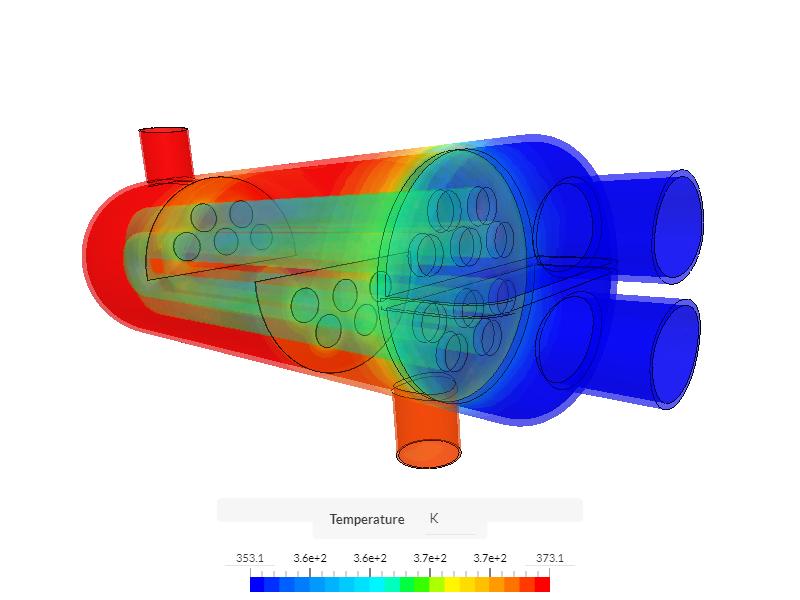
For example, a conjugate heat transfer simulation can combine a solid component with the surrounding fluid domain.
This approach is particularly useful when investigating cooling systems, heat exchangers, electronic enclosures, and thermal management applications.
3. Enhanced Meshing and Geometry Preparation
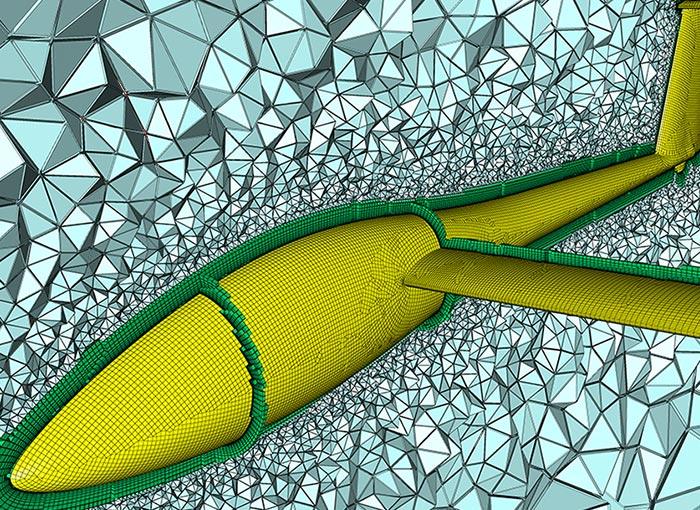
Mesh generation remains one of the most critical stages of CFD simulation.
A computational mesh divides the geometry into smaller elements or control volumes where the governing equations are solved numerically.
The quality of this mesh directly influences numerical stability, convergence behaviour, computational cost, and the reliability of the results.
Preparing a high-quality mesh can become particularly challenging when dealing with complex geometry, narrow passages, sharp edges, and intricate surface details.
HELYX 4.6.0 introduces improvements in three important areas.
New Mesh Controls
Additional mesh controls provide greater flexibility when preparing computational domains.
Engineers can use these capabilities to better manage mesh generation and adapt the computational grid to the requirements of different simulation cases.
Mesh Extrusion
Mesh extrusion capabilities provide additional options for extending computational regions.
This can be useful when creating inlet and outlet extensions, developing structured mesh regions, or preparing computational domains that require specific geometric configurations.
Geometry Inspection Tools
Geometry preparation is not always straightforward.
Imported CAD models may contain small features, gaps, overlapping surfaces, or other geometric issues that complicate mesh generation.
Improved geometry inspection tools help engineers examine imported geometry and identify potential problems before moving into the meshing stage.
These developments are particularly relevant to complex industrial components, where geometry preparation can represent a significant portion of the overall simulation workflow.
4. Improved Solver Capabilities and Numerical Methods
The solver is the computational core of a CFD application.
It uses numerical methods to solve the governing equations describing fluid motion, pressure, energy, and other physical quantities.
A robust solver must handle different physical conditions while maintaining numerical stability and acceptable computational performance.
HELYX 4.6.0 introduces improvements in:
- Solver workflows
- Turbulence modelling
- Region coupling
- Numerical methods
- Simulation robustness and usability
Turbulence Modelling
Turbulent flow is present in many industrial applications, from vehicle aerodynamics to internal pipe flow and turbomachinery.
Accurately predicting turbulent behaviour is essential for understanding pressure losses, flow separation, mixing, and heat transfer.
Enhanced turbulence modelling workflows provide additional capabilities for engineers working with complex flow conditions.
However, selecting an appropriate turbulence model still requires engineering judgement. No single model is universally suitable for every CFD application.
Region Coupling
In multi-region simulations, different computational regions may need to exchange information across their interfaces.
This is particularly important in thermal and multiphysics applications.
Improved region-coupling workflows support the management of these interactions and help engineers establish more integrated simulation models.
Numerical Robustness
A simulation can be computationally expensive and still produce unreliable results if the numerical setup is inappropriate.
Improvements to solver workflows and numerical methods aim to support more robust simulation processes.
Actual convergence and accuracy will continue to depend on mesh quality, physical models, boundary conditions, numerical settings, and validation against appropriate reference data.
5. Expanded Post-Processing and Visualisation
Running a CFD simulation is only part of the engineering process.
Once the solver has completed its calculations, engineers must interpret the results and extract meaningful information.
Typical outputs include:
- Pressure distribution
- Velocity fields
- Temperature distribution
- Turbulence quantities
- Flow streamlines
- Surface forces
- Integrated engineering quantities
HELYX 4.6.0 expands its post-processing capabilities with new field-processing functions, surface statistics, and visualisation tools.
These developments give engineers additional options for examining simulation results and extracting relevant information.
For example, surface statistics can help evaluate engineering quantities over selected surfaces, while improved field-processing functions provide more flexibility when analysing complex simulation data.
Better post-processing workflows can reduce the need for repetitive external data handling and help engineers move more efficiently from numerical results to engineering conclusions.
HELYX Add-On Modules: Extending the Simulation Environment
HELYX is supported by additional modules that address specialised simulation requirements.
The 4.6.0 release also includes updated versions of three important add-ons.
HELYX-Adjoint
HELYX-Adjoint provides continuous adjoint-based optimisation capabilities for engineering design.
Adjoint methods can help engineers understand how changes in design parameters influence a selected performance objective.
Applications include:
- Aerodynamic shape optimisation
- Internal flow optimisation
- Pressure-loss reduction
- Flow distribution improvement
- Design sensitivity analysis
Instead of evaluating every possible design variation independently, adjoint-based methods can provide valuable sensitivity information that guides the optimisation process.
HELYX-Coupled
HELYX-Coupled is designed for block-coupled CFD calculations involving incompressible and compressible single-phase flows.
Its applications include subsonic, transonic, and supersonic flow problems.
Coupled numerical approaches can be particularly useful for engineering cases where pressure and velocity interactions require a more integrated solution strategy.
HELYX-Marine
HELYX-Marine focuses on hydrodynamic simulation and optimisation for naval and marine applications.
Typical engineering challenges include:
- Ship hull resistance
- Calm-water hydrodynamics
- Seakeeping performance
- Fluid-structure-related flow analysis
- Marine design optimisation
The module supports engineers investigating the hydrodynamic behaviour of marine structures and vessels.
The updated add-on modules are aligned with the capabilities introduced in HELYX 4.6.0.
Where Can HELYX Be Used?
The flexibility of CFD technology allows HELYX to address engineering challenges across several industries.
Automotive Engineering
<underline>Vehicle aerodynamics and thermal management</underline> are important factors in modern automotive development.
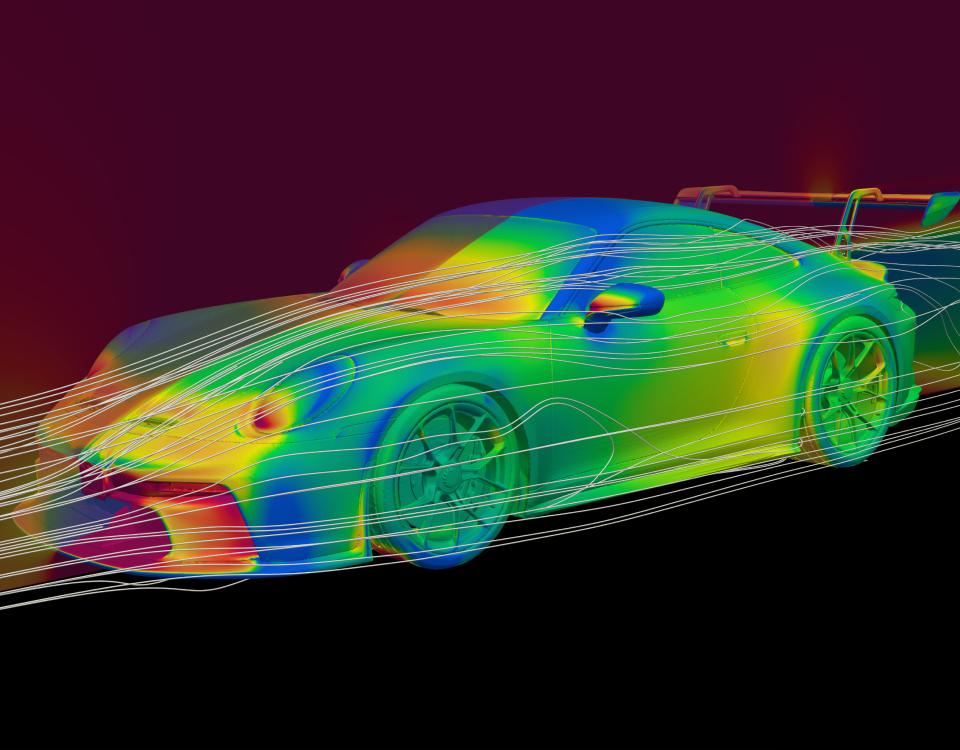
CFD can help engineers investigate airflow around vehicles, cooling performance, underbody aerodynamics, and heat transfer within different vehicle systems.
HELYX is also used in motorsports applications, where aerodynamic performance and cooling efficiency are critical.
Aerospace Engineering
Aerodynamic performance, pressure distribution, and thermal behaviour are important considerations in aircraft and aerospace system development.
CFD can support the evaluation of external aerodynamics, internal flow systems, and complex operating conditions.
Energy and Turbomachinery
Pumps, turbines, compressors, and other rotating machinery depend heavily on fluid dynamics.
CFD simulations can help engineers investigate pressure losses, flow distribution, efficiency, and operating characteristics.
Marine Engineering
Ship resistance, hydrodynamic performance, and seakeeping behaviour are important factors in vessel design.
Specialised CFD tools can support the development and optimisation of marine structures.
Industrial Processes
Chemical processing, wastewater treatment, mixing systems, and industrial ventilation all involve complex fluid flow and heat-transfer phenomena.
CFD provides a way to investigate these processes before implementing physical design changes.
Open-Source CFD vs Traditional Commercial Simulation Software
One of the most interesting aspects of HELYX is its position between open-source simulation technology and commercial engineering software.
Traditional commercial CFD platforms often provide integrated graphical interfaces, specialised solvers, technical support, and established engineering workflows.
Open-source CFD technologies, on the other hand, offer greater transparency and opportunities for customisation.
HELYX combines elements of both approaches.
| Engineering consideration | Traditional commercial CFD | HELYX approach |
|---|---|---|
| Simulation technology | Proprietary or mixed | Open-source HELYX-Core |
| GUI | Commercial interface | Proprietary HELYX-GUI |
| Customisation | Depends on vendor APIs | Access to HELYX-Core source |
| Technical support | Vendor support | ENGYS support services |
| HPC licensing | Depends on licensing model | No additional HPC licensing fees according to ENGYS |
| Software licensing | Commercial | Commercial HELYX package |
The absence of additional HPC licensing fees is an important part of ENGYS’s positioning. It does not mean that computing resources are free: hardware, cloud infrastructure, engineering personnel, and software subscriptions still represent costs.
For organisations running large numbers of CFD simulations, the licensing model may be an important factor when evaluating the total cost of ownership.
However, software selection should never be based on licensing alone. Solver capabilities, validation requirements, workflow compatibility, training, and engineering support are equally important.
HELYX 4.6.0 and the Future of Digital Engineering
The development of HELYX reflects a wider change in engineering simulation.
CFD software is moving toward more flexible, automated, and integrated environments where geometry preparation, meshing, physical modelling, solver execution, and post-processing are increasingly connected.
The extended Python API in HELYX 4.6.0 supports workflow customisation.
Expanded multiphysics capabilities help engineers investigate more complex physical interactions.
Improved meshing and solver workflows address some of the technical challenges involved in preparing and executing simulations.
Enhanced post-processing provides additional tools for understanding the results.
Together, these developments support a more comprehensive simulation environment.
The next stage of CFD development will likely involve even closer integration with CAD, optimisation systems, high-performance computing, and digital twin technologies.
In this environment, simulation will increasingly become part of the continuous engineering decision-making process rather than a separate validation activity performed at the end of product development.
Conclusion: Making Advanced CFD More Accessible
ENGYS HELYX 4.6.0 represents an important development in the evolution of open-source-based enterprise CFD software.
Its latest improvements focus on the complete simulation workflow, from geometry preparation and mesh generation to physical modelling, solver performance, and post-processing.
The extended Python API, enhanced multiphysics capabilities, improved meshing tools, and updated add-on modules provide additional flexibility for engineers working across a wide range of industries.
HELYX also demonstrates that open-source simulation technology does not have to mean a limited or unsupported engineering environment. With a commercial interface, specialised development, and professional support, open-source foundations can be used to build enterprise-oriented simulation platforms.
The future of engineering simulation will not be defined only by faster solvers, but by how effectively engineers can connect physics, computation, and design decisions within a unified digital workflow.
Editorial Perspective
HELYX 4.6.0 is not simply a collection of interface updates. Its significance lies in the continued development of an integrated CFD environment built around an open-source simulation engine. For engineering organisations, the combination of source-code transparency, customisation, commercial support, and flexible computational scaling makes HELYX an interesting alternative to evaluate alongside established commercial CFD platforms.
The suitability of the software for a specific project will still depend on solver validation, engineering requirements, available expertise, and the quality of the simulation workflow.