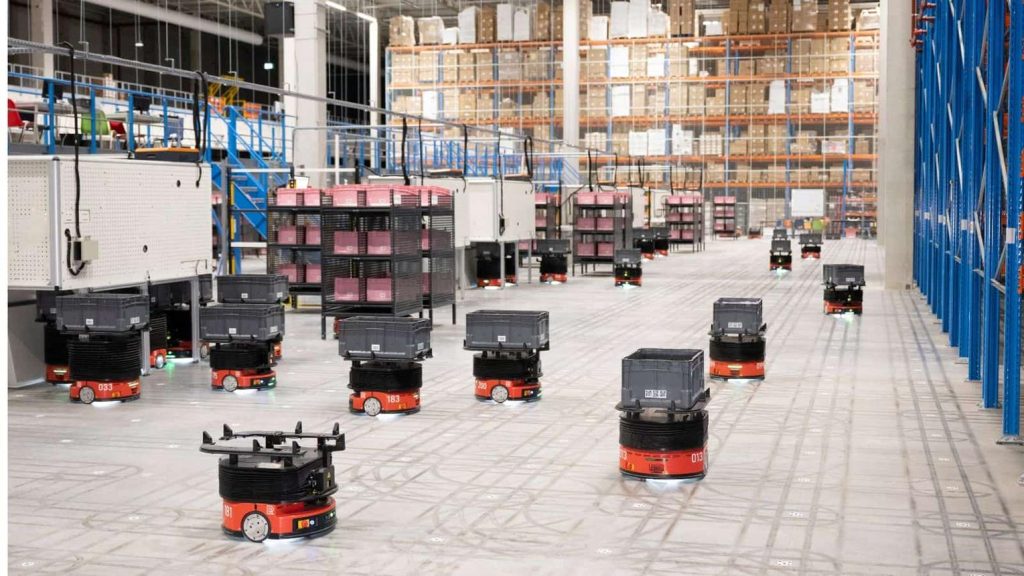
Warehouse automation is moving beyond isolated robotic systems toward integrated operations in which enterprise software can directly coordinate physical machines. Intel and SAP have demonstrated a proof of concept that connects SAP Extended Warehouse Management (EWM) with autonomous mobile robots through Intel’s edge AI and robotics technologies.
The demonstration, conducted at Intel’s Chengdu facility in China, converts warehouse transport requests into robot missions. Once a task is completed, execution status and operational information are returned to SAP EWM. This creates a communication loop between business-level warehouse planning and the physical execution layer.
From Warehouse Instructions to Physical Execution
Traditional warehouse automation often relies on separate systems for inventory management, task allocation and robot control. Integrating these layers can reduce manual coordination and provide better visibility into material movement.
In the demonstrated workflow, SAP EWM provides the operational context and transport requirements, while the robotics layer executes the assigned missions. Edge computing supports the interaction between software instructions and physical equipment.
Why This Matters for Smart Manufacturing
The concept illustrates a broader transition toward Physical AI: artificial intelligence that interacts with real-world equipment, environments and operational constraints.
For manufacturers, the potential benefits include improved material-flow visibility, more flexible intralogistics and closer integration between production planning and warehouse execution. However, the demonstration is a proof of concept, not evidence that every warehouse can immediately deploy the same architecture without integration work.
The next challenge will be scaling these systems across mixed fleets, existing warehouse infrastructure and different enterprise platforms. Reliable communication, safety validation and interoperability will remain essential.
The Intel–SAP demonstration shows how the boundary between enterprise software and autonomous industrial equipment is becoming increasingly connected.