Metal additive manufacturing is increasingly being used to produce large and complex engineering components. However, maintaining consistent deposition quality remains a challenge because thermal conditions change continuously as a part is built.
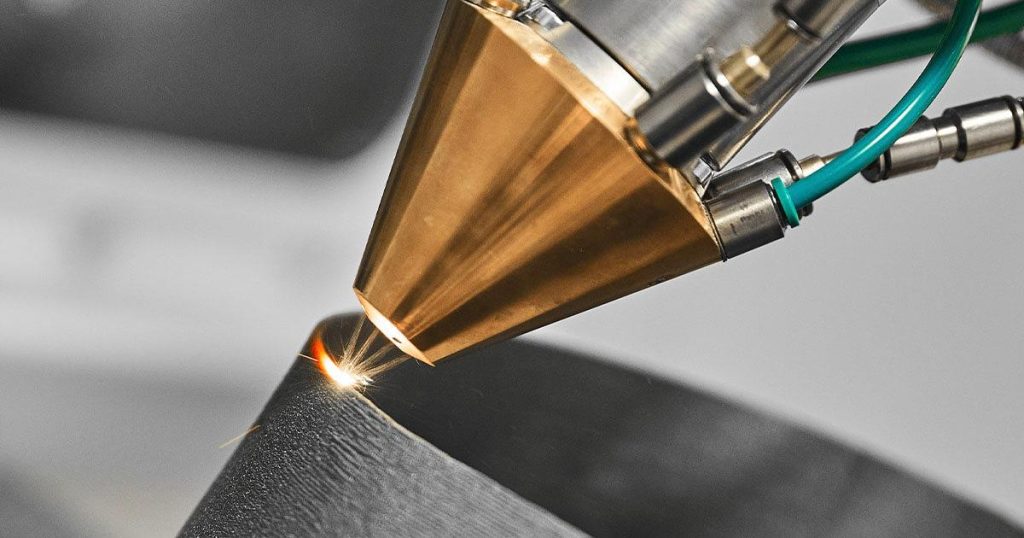
Nidec Machine Tool has developed an autonomous learning-based control system for its LAMDA series of powder-fed Directed Energy Deposition (DED) metal 3D printers. The system is designed to learn from changing build conditions and automatically adjust laser power and travel speed during fabrication.
Adapting to Thermal Changes During Deposition
In conventional processes, fixed parameters or traditional feedback control methods may struggle when geometry, heat accumulation and deposition conditions change. Thin walls and toolpath intersections are particularly sensitive because localized heat can influence melt-pool behavior and dimensional stability.
Nidec’s system combines a proprietary learning algorithm with image-processing technology. A coaxial camera monitors brightness associated with melt-pool temperature and measures the distance between the deposition nozzle and the workpiece.
The system uses this information to adjust laser power and travel speed in response to the observed build condition.
Implications for Process Stability
The approach is intended to reduce the risk of build collapse and improve consistency in geometrically challenging regions. Nidec also states that the system does not require large volumes of pre-collected training data, because it learns during the build process.
The technology is patent-pending and will be demonstrated using the LAMDA500 five-axis metal 3D printer at JIMTOF 2026.
For manufacturers, adaptive control could help reduce dependence on manual parameter tuning and make DED processes more repeatable. However, industrial adoption will require validation across different materials, geometries and production conditions.
The development illustrates how real-time sensing and machine learning are moving from process monitoring toward direct control of metal additive manufacturing.