How the Latest Hot Fix Strengthens ANSA, META, and Enterprise Simulation Data Management
Reliability Is as Important as Simulation Performance
In modern engineering, simulation software plays a critical role in product development. Automotive manufacturers, aerospace companies, and industrial engineering organisations rely on Computer-Aided Engineering (CAE) tools to evaluate structural performance, crashworthiness, durability, aerodynamics, noise and vibration, and other complex engineering requirements.
However, successful simulation is not determined by solver performance alone.
Before an engineering team can obtain meaningful simulation results, it must prepare accurate computational models, generate appropriate meshes, define connections and boundary conditions, manage simulation data, and evaluate the results.
Any instability or inconsistency in these stages can interrupt the engineering workflow and potentially affect project schedules.
This is why software maintenance releases are important in professional CAE environments.
On September 22, 2026, BETA CAE Systems announced the release of 2025.2 HF3, the third Hot Fix update for its 2025.2 software suite.
The update focuses primarily on resolving critical software issues across ANSA, EPILYSIS, META, FATIQ, KOMVOS, and SPDRM. It also introduces significant performance improvements to SPDRM, the company’s simulation process and data management platform.
Rather than introducing a completely new set of engineering capabilities, this release focuses on improving the reliability and scalability of existing CAE workflows.
Understanding the BETA CAE Software Ecosystem
BETA CAE Systems develops specialised software for engineering simulation, model preparation, post-processing, optimisation, and simulation data management.
Its product ecosystem supports different stages of the CAE lifecycle.
The most recognised applications include:
ANSA – Pre-Processing
ANSA is used to prepare engineering models for numerical simulation. Its capabilities include geometry preparation, surface and volume meshing, connection modelling, assembly management, and solver deck preparation.
It supports workflows involving several major simulation technologies, including Nastran, LS-DYNA, Abaqus, and other engineering solvers.
EPILYSIS – Finite Element Analysis Solver
EPILYSIS is BETA CAE’s structural analysis solver, designed for finite element analysis applications.
It supports engineering calculations involving structural response, modal analysis, contacts, and other numerical simulation requirements.
META – Post-Processing
META provides tools for analysing and visualising simulation results.
Engineers use it to evaluate deformation, stress, strain, fatigue-related quantities, crash behaviour, NVH results, and other engineering outputs.
FATIQ – Fatigue Analysis
FATIQ focuses on fatigue assessment and durability engineering. It helps engineers investigate component life and fatigue performance under different loading conditions.
KOMVOS – Simulation Data and Process Management
KOMVOS provides capabilities for managing simulation information, engineering data, and connected processes.
SPDRM – Simulation Process and Data Management
SPDRM supports the management of simulation data and processes across engineering organisations, helping teams coordinate large-scale CAE activities.
The 2025.2 HF3 update addresses selected issues across this ecosystem.
ANSA 2025.2 HF3: Improving Model Preparation and Meshing Reliability
ANSA is one of the most important stages in a typical CAE workflow.
Before a structural or CFD solver can perform calculations, the geometry and computational model must be prepared correctly.
This includes cleaning imported geometry, generating meshes, defining connections, assigning material properties, and preparing the model for the selected solver.
The HF3 release resolves several issues affecting these operations.
Geometry and Thickness Handling
One of the resolved issues involved the Isolate Flanges Proximity functionality.
Under certain conditions, the thickness of unmeshed faces could be incorrectly disregarded, with the solid thickness value being used instead.
This type of inconsistency can affect geometry interpretation and model preparation.
The correction improves the reliability of thickness-related operations within the geometry workflow.
Batch Meshing and CFD Applications
The release also addresses an issue affecting certain CFD anisotropic meshing cases.
When specific meshing operations were configured through ANSA Parameters, the software could occasionally terminate unexpectedly.
For engineers working with complex CFD geometries, stability during automated or batch meshing is particularly important.
Resolving this issue helps make the relevant workflow more dependable.
Volume Meshing and Layer Quality
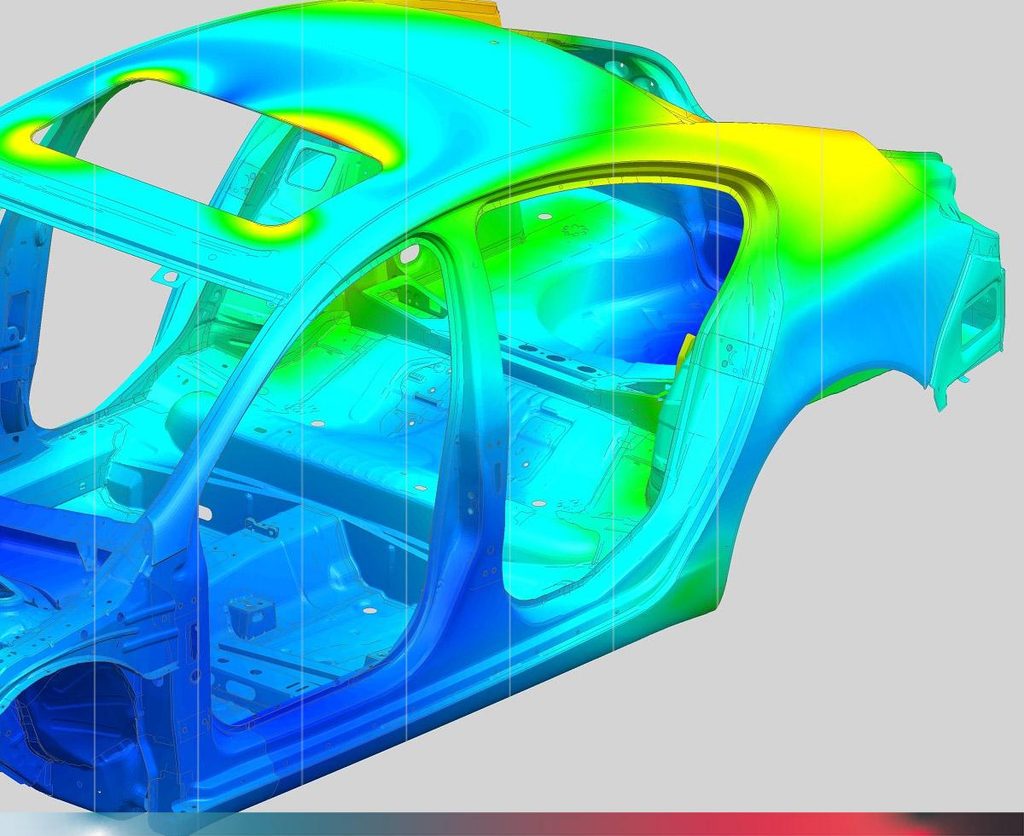
Another correction concerns abrupt changes in layer heights near corners where mesh layers connect to inclined surfaces.
Layer generation is particularly important in CFD because near-wall mesh resolution can influence the accuracy of turbulence and boundary-layer calculations.
Improved behaviour in these situations helps reduce unexpected meshing problems during model preparation.
Connections and Assembly
The update also resolves issues involving Y-JOINT-SHELL connections and SPIDER2 connection operations.
These functions are important when building complex finite element assemblies.
Incorrect connection realisation or unexpected changes to mesh entities can introduce additional model preparation work.
The corrections in HF3 aim to make these operations more reliable.
META 2025.2 HF3: More Dependable Simulation Result Evaluation
After the solver completes its calculations, engineers must interpret the results and determine whether the component or system meets its performance requirements.
META provides tools for this process, including visualisation, curve analysis, result extraction, and reporting.
The HF3 release addresses several issues affecting result handling and post-processing.
More Reliable Result Reading
The update resolves problems involving results from different solver formats.
Examples include:
- Curves from Nastran HDF5 files not being read correctly.
- Incorrect display of thickness and material identification information in LS-DYNA results.
- Issues recognising distinct subcases in H3D result files.
- Incorrect handling of certain transformed include results.
These corrections are relevant to engineering teams working with multiple solvers and different simulation data formats.
Improvements to Mathematical Operations
META includes mathematical tools for processing simulation results.
These operations are useful when engineers need to evaluate derived quantities, compare datasets, or investigate specific physical responses.
One issue resolved in HF3 involved tensor calculations for strain gauge results.
Large translations and rotations were not being properly considered in certain calculations.
Correct handling of coordinate transformations is particularly important when analysing strain and other tensor-based engineering quantities.
Reporting and Visualisation
The release also addresses issues involving:
- Spreadsheet calculations and report generation.
- Image and video handling.
- Annotations and measurement presentation.
- Curve management.
- Result visualisation.
Although these may appear to be relatively small corrections, they can have a practical impact on daily engineering work.
Post-processing is often a repetitive activity involving numerous datasets, curves, and reports. Reliable operation helps reduce interruptions and unnecessary manual corrections.
SPDRM: A Significant Step in Enterprise Simulation Performance
One of the most notable aspects of the 2025.2 HF3 announcement is the performance improvement reported for SPDRM.
Large engineering organisations may manage thousands of simulation models, datasets, files, and associated metadata.
As the number of engineers and simulation activities increases, data management infrastructure must handle a growing volume of concurrent operations.
These operations include:
- Uploading simulation files.
- Searching engineering datasets.
- Retrieving simulation information.
- Exporting results and reports.
- Managing concurrent engineering activities.
According to BETA CAE Systems, the HF3 release improves the efficiency of processing rapid concurrent uploads, queries, and exports by up to 50%.
The company also published several performance figures from its stress-testing scenarios.
| Performance indicator | Reported result |
|---|---|
| Structured CAE objects saved | 40,000+ |
| Time required | 15 minutes |
| Concurrent workers | 350 |
| Equivalent active-user scenario | 1,000+ |
| Processing efficiency improvement | Up to 50% |
These figures demonstrate the focus on enterprise-scale simulation data management.
It is important to understand that these are vendor-reported stress-test results, not a guarantee that every customer installation will achieve identical performance.
Actual results depend on server infrastructure, storage performance, network configuration, data characteristics, and workload distribution.
Nevertheless, the improvements highlight the growing importance of simulation data management in large engineering organisations.
Why Hot Fix Releases Matter in CAE Engineering
Software updates are often associated with new features, improved interfaces, and additional capabilities.
However, in engineering simulation, software reliability is equally important.
Consider a typical automotive development programme.
A single vehicle project may involve thousands of components and numerous simulation activities, including:
- Structural stiffness analysis.
- Crash and safety simulations.
- Durability and fatigue assessment.
- Noise, vibration, and harshness analysis.
- Aerodynamic simulation.
- Thermal performance evaluation.
These activities generate large amounts of engineering data and require continuous collaboration between different departments.
An unexpected software termination, incorrect result interpretation, or model preparation issue can create additional engineering work.
Hot Fix releases help address these problems by correcting identified defects and improving the stability of established workflows.
For organisations running complex CAE projects, even relatively small software corrections can contribute to more predictable engineering operations.
The Role of CAE Software in Digital Engineering
The importance of engineering simulation continues to increase as product development becomes more digital.
Traditional product development often depended heavily on physical prototypes and experimental testing.
Today, CAE tools allow engineers to evaluate many design alternatives virtually before committing to physical manufacturing.
This approach supports:
- Earlier identification of design problems.
- Reduced dependence on physical prototypes.
- Faster engineering iterations.
- Better understanding of product behaviour.
- More efficient collaboration between engineering teams.
However, the growing use of simulation also creates new challenges.
Simulation models, solver configurations, material definitions, results, and reports must be managed consistently throughout the product lifecycle.
This is where platforms such as SPDRM and KOMVOS become increasingly relevant.
The future of CAE is not only about solving complex physical equations faster. It is also about managing engineering knowledge and simulation data more effectively.
Looking Ahead: The Evolution of Engineering Simulation Workflows
BETA CAE Systems 2025.2 HF3 is a maintenance-focused release, but its improvements reflect broader trends in the CAE industry.
The industry is moving toward more integrated engineering environments in which pre-processing, simulation, post-processing, optimisation, and data management work together.
Automation, artificial intelligence, high-performance computing, and connected simulation workflows are becoming increasingly important.
BETA CAE’s wider product ecosystem is also evolving in this direction, particularly through developments in KOMVOS and SPDRM.
As simulation workloads grow, software reliability and infrastructure scalability will become increasingly important competitive factors for engineering organisations.
Conclusion: Engineering Productivity Starts with Reliable Workflows
BETA CAE Systems 2025.2 HF3 demonstrates that progress in engineering software is not always measured by the number of new features introduced.
The release focuses on resolving critical issues across ANSA, META, EPILYSIS, FATIQ, KOMVOS, and SPDRM while improving enterprise simulation data management performance.
For CAE engineers, the corrections to geometry preparation, meshing, solver data handling, and post-processing support more dependable daily workflows.
For large engineering organisations, the reported SPDRM performance improvements highlight the importance of scalable infrastructure for managing increasingly complex simulation environments.
As engineering simulation becomes more integrated and data-intensive, reliable software workflows are becoming just as important as computational power.
Editorial Perspective
The 2025.2 HF3 release should be viewed as a stability and performance update rather than a major feature release. Its importance lies in strengthening established CAE workflows and improving the ability of enterprise engineering teams to manage simulation data at scale. For organisations using the BETA CAE ecosystem, these improvements may contribute to more dependable model preparation, result evaluation, and simulation process management.