
ENGYS, RBF Morph Collaborate to Combine rbfCAE with HELYX, ELEMENTS
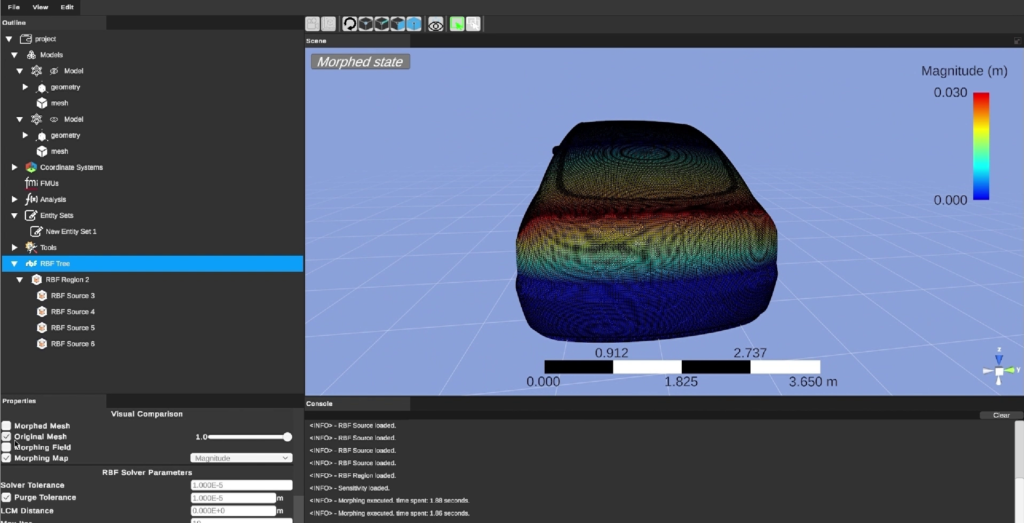
ENGYS and RBF Morph have partnered to offer rbfCAE alongside HELYX and ELEMENTS. The announcement connects mesh morphing with CFD design exploration, optimisation and related workflows. Its central proposition is to modify an existing simulation mesh for certain shape changes instead of rebuilding the geometry and mesh at every iteration. That can remove repetitive preparation, but the usefulness of a morphed model still depends on whether it remains a suitable representation of the intended design.
A faster geometry change has a defined range
Mesh morphing can make a previously fixed simulation model respond to selected design parameters. This is useful when engineers want to investigate a controlled family of changes. However, not every geometric change is equally suitable for the same representation. The team should establish which regions move, which remain fixed and what range of movement preserves the intended relationships.
Large changes can create conditions that require additional review or a different preparation route. An automated study should have checks that identify when its assumptions are no longer satisfied. The ability to generate another mesh state does not, by itself, establish that the state is valid for analysis. Speed is valuable when it produces interpretable alternatives rather than simply more alternatives.
Preserve the meaning of the design variables
The parameters used in a morphing study should correspond to engineering questions that the team can explain. A numerical movement of mesh points is not necessarily a practical product change. Designers need to understand how the proposed shape would be represented in the authoritative CAD model and whether it can be manufactured within the relevant constraints.
That connection also helps control the scope of optimisation. If an objective improves while a packaging or manufacturing requirement is violated, the result may not be useful. Constraints should therefore be considered at the study’s definition stage. The best-performing numerical candidate is only an engineering candidate when it remains within the allowed design space.
Consistency helps compare alternatives
Reusing an underlying mesh can support a more controlled comparison because some preparation choices remain common. It does not remove the need to assess numerical sensitivity. Engineers should still determine whether the mesh quality and local resolution remain appropriate as the geometry changes. A study that begins with an adequate model can move outside that condition.
The record should connect each result with its parameter values and model state. This becomes important when several automated evaluations run without continuous manual supervision. A promising output should be reproducible and inspectable, with enough information to explain how it was obtained. Otherwise, the speed of exploration can outpace the team’s ability to evaluate it.
Reduced models need their own boundaries
The announcement also refers to reduced-order modelling and interactive applications. These can make established simulation information easier to explore, but their applicability depends on the data and conditions represented. Engineers should avoid treating a rapid response outside that range as equivalent to a fully assessed simulation. The interface should make the relevant limits understandable.
For The CAD Verse’s simulation audience, this partnership is relevant as an attempt to reduce the preparation burden between design iterations. Its value will depend on disciplined parameterisation, quality checks and a clear route back to the product definition. Mesh morphing can accelerate useful exploration when the team preserves the connection between numerical change, physical meaning and a design that can actually be released.
Source — dailycadcam.com. Source publication date 2026-06-30. Engineering analysis: The CAD Verse.
Report an image

 MEMBERS · ONE ENGINEERING COMMUNITY
Discussion
0 CommentsShare your thoughts and engineering insights with the community.
Comments are closed for this article.
No comments yet. Be the first to share your thoughts.