Introduction
Electromagnetic simulation is an essential tool in the development of advanced sensors, antennas, microwave components, and photonic devices.
However, optimizing complex geometries often requires extensive full-wave electromagnetic simulations. When thousands of design configurations must be evaluated, computational requirements can become substantial.
A recent study published in Scientific Reports demonstrates how deep-learning surrogate models can accelerate the design of high-sensitivity terahertz metasurface sensors.
Replacing Repeated Simulations with Surrogate Models
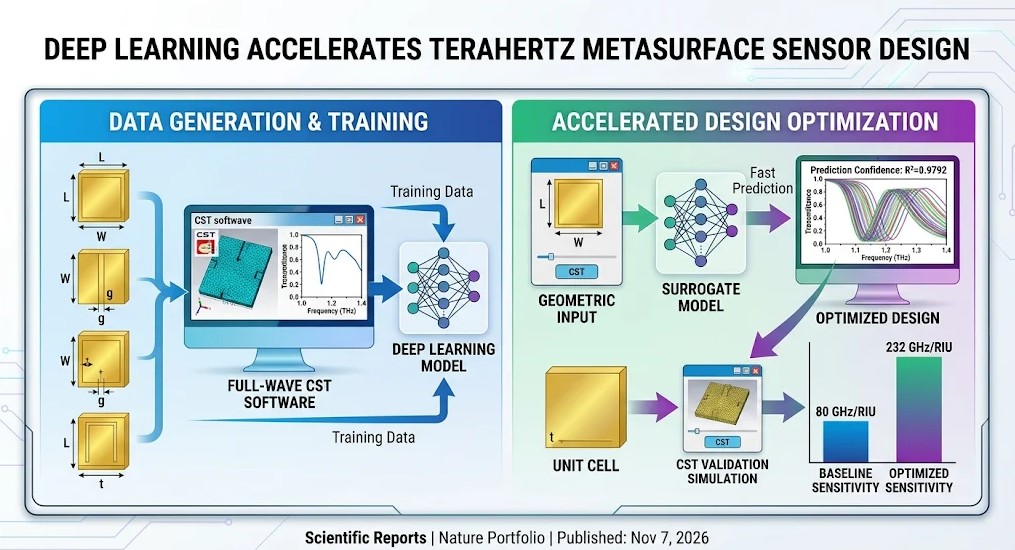
The researchers developed a neural-network-based framework trained using electromagnetic simulation results generated with CST software.
The dataset contained 2,048 different metasurface configurations across a frequency range of 1.0 to 1.4 THz.
Each configuration was evaluated at 1,001 frequency points, producing more than two million input-output samples.
The neural network learned to predict the real and imaginary components of the electromagnetic transmission response based on geometric parameters, operating frequency, and analyte refractive index.
Once trained, the model could evaluate candidate designs without requiring a new full-wave simulation for every configuration.
Prediction Accuracy and Design Optimization
The trained model achieved a coefficient of determination of R² = 0.9792 on an independent test dataset.
Its mean squared error was 4.12 × 10⁻³.
The researchers used the surrogate model to screen thousands of candidate geometries and identify promising sensor designs.
Selected configurations were subsequently validated using full-wave CST simulations.
The best-performing design achieved a refractive-index sensitivity of approximately 232 GHz/RIU, compared with a baseline value of 80 GHz/RIU reported for closely related geometries.
Engineering Implications
The study illustrates an important development in computational engineering: combining conventional numerical simulation with machine learning.
Instead of replacing physics-based simulation entirely, surrogate models can be used to reduce the number of expensive numerical evaluations required during design exploration.
Similar approaches can be valuable in:
- Antenna geometry optimization
- Electromagnetic component design
- Metamaterial development
- Photonic device optimization
- Multi-parameter engineering design studies
The reliability of the approach depends on the quality and coverage of the training data. Final designs should still be validated using appropriate physics-based simulation methods.
Conclusion
Deep-learning surrogate modeling provides a promising way to accelerate computationally intensive electromagnetic design workflows.
By combining neural-network predictions with full-wave simulation validation, engineers can explore larger design spaces while reducing repeated computational effort.
This approach represents an increasingly important connection between artificial intelligence, numerical simulation, and advanced product development.
Source: Scientific Reports, Nature Portfolio, published November 7, 2026.