Introduction
Manufacturing complex metal components often requires multiple production technologies. Additive manufacturing provides geometric flexibility, while CNC machining delivers the dimensional accuracy and surface quality required for functional components.
HORKOS and Meltio have introduced a hybrid manufacturing configuration that combines both processes within a single machine.
A Combined Additive and Subtractive Manufacturing Platform
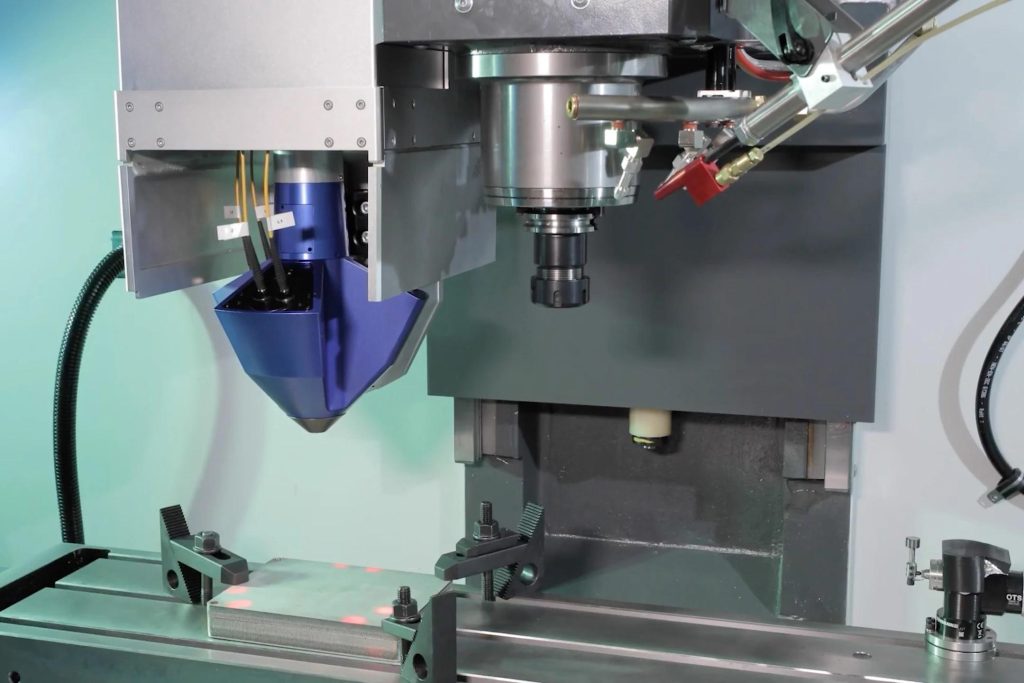
The NX70 DUO version AM is a twin-head machining center based on HORKOS’ NX70 platform.
The system integrates Meltio’s wire-based Directed Energy Deposition (Wire-DED) technology with high-precision cutting capabilities.
During operation, metal wire is delivered into a laser-generated melt pool, allowing material to be deposited selectively onto a component. Machining operations can then remove excess material and achieve the required geometry.
This approach enables additive and subtractive operations to be performed within the same machine setup.
Why Hybrid Manufacturing Matters
Conventional production routes often require components to be transferred between additive manufacturing equipment and CNC machining centers.
These transfers introduce additional handling, positioning requirements, and potential alignment errors.
By combining both processes, the NX70 DUO can reduce intermediate handling and simplify manufacturing workflows.
The approach is particularly interesting for:
- Complex aerospace components
- Closed impellers
- Repair and remanufacturing
- Heavy industrial components
- Functional prototypes
Wire-DED Technology
Meltio’s technology uses welding wire as the metal feedstock and laser energy to deposit material where required.
Compared with producing an entire component through subtractive machining, this process can reduce unnecessary material removal in applications where significant material would otherwise be machined away.
The integration also supports component repair and remanufacturing.
Engineering Considerations
Hybrid manufacturing introduces several engineering challenges.
Thermal distortion, residual stress, material compatibility, deposition strategy, and machining allowances must be considered during process planning.
The transition between deposition and machining also requires accurate coordinate management and process sequencing.
For CAM engineers, this creates opportunities to develop integrated toolpaths that consider both material deposition and material removal.
Conclusion
The HORKOS NX70 DUO demonstrates how additive manufacturing and CNC machining can be combined into a single production environment.
Rather than treating these technologies as separate manufacturing operations, hybrid platforms bring them together to support complex component production, repair, and remanufacturing.
Source: HORKOS, Meltio and DEVELOP3D.