Introduction
Machining large industrial components traditionally requires substantial machine tools, extensive floor space, and significant capital investment.
However, not every large component requires the high precision and rigidity associated with a large CNC machining center.
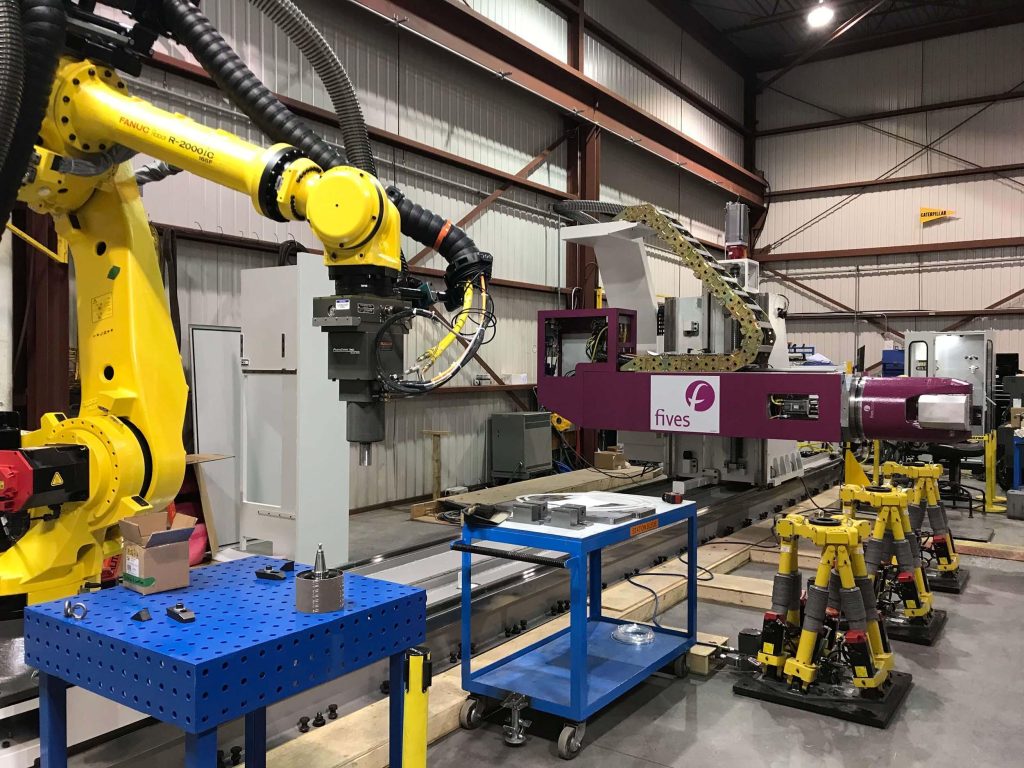
FIVES High Precision Machines is promoting an alternative approach through its Liné Machines RoboTDM robotic machining solution.
Robotic Machining with Industrial Robots
The RoboTDM system uses an industrial robot equipped with a specialized machining end effector.
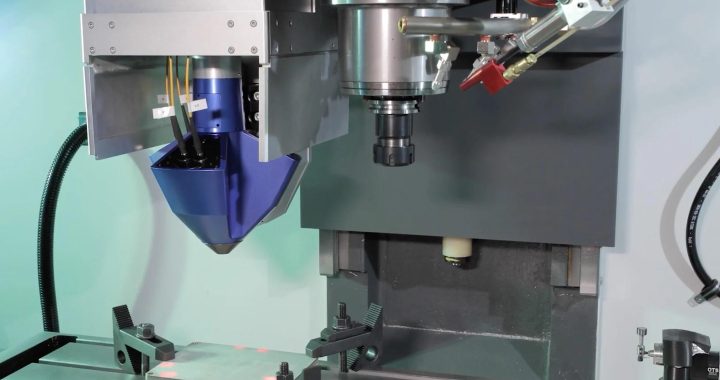
The end effector incorporates a spindle, toolholder, and cutting tool, enabling the robot to perform material removal directly on large workpieces.
Instead of positioning a massive component inside a large machining center, the robotic system can access different areas of the workpiece through programmed robot movements.
This approach is particularly relevant for applications where the required dimensional tolerance is approximately 0.1 mm rather than ultra-high-precision machining requirements.
Manufacturing Applications
Potential operations include:
- Milling large metal surfaces
- Removing casting burrs
- Trimming excess weld material
- Drilling pilot holes
- Edge contouring
- Routing composite components
- Machining large thermoplastic structures
These applications can be found in aerospace, automotive, heavy industry, and large-scale fabrication.
Potential Production Advantages
A conventional large machining center can represent a significant investment in terms of machine cost, installation, foundation requirements, and factory floor space.
Robotic machining offers an alternative for operations where the required accuracy and process characteristics are compatible with robot-based material removal.
The approach can also provide greater flexibility when dealing with components that have complex geometries or large dimensions.
However, robotic machining requires careful consideration of structural stiffness, robot positioning accuracy, cutting forces, vibration, and tool deflection.
Engineering Challenges
Unlike conventional CNC machining centers, industrial robots have more complex structural compliance characteristics.
Their stiffness changes depending on robot configuration, joint position, and working direction.
Consequently, engineers must consider robot kinematics, workspace accessibility, cutting force direction, tool-center-point accuracy, and process stability during programming.
For CAM engineers, generating a toolpath is only one part of the challenge. The robot’s mechanical behavior must also be considered when planning machining operations.
Conclusion
FIVES HPM’s RoboTDM concept demonstrates how industrial robotics can provide an alternative to conventional large-scale machining equipment.
For selected applications, robotic machining may reduce equipment requirements while offering flexible access to large components.
Its success ultimately depends on matching the robot’s capabilities with the dimensional accuracy, cutting forces, and production requirements of the component.
Source: FIVES HPM and Shop Metalworking Technology.