A More Integrated Workflow from 3D Geometry to Flow Simulation
Turbomachinery development depends on a close relationship between geometric design and fluid-flow analysis. Compressor and turbine performance is strongly influenced by blade geometry, flow passages, operating conditions, and the interaction between aerodynamic and mechanical requirements.
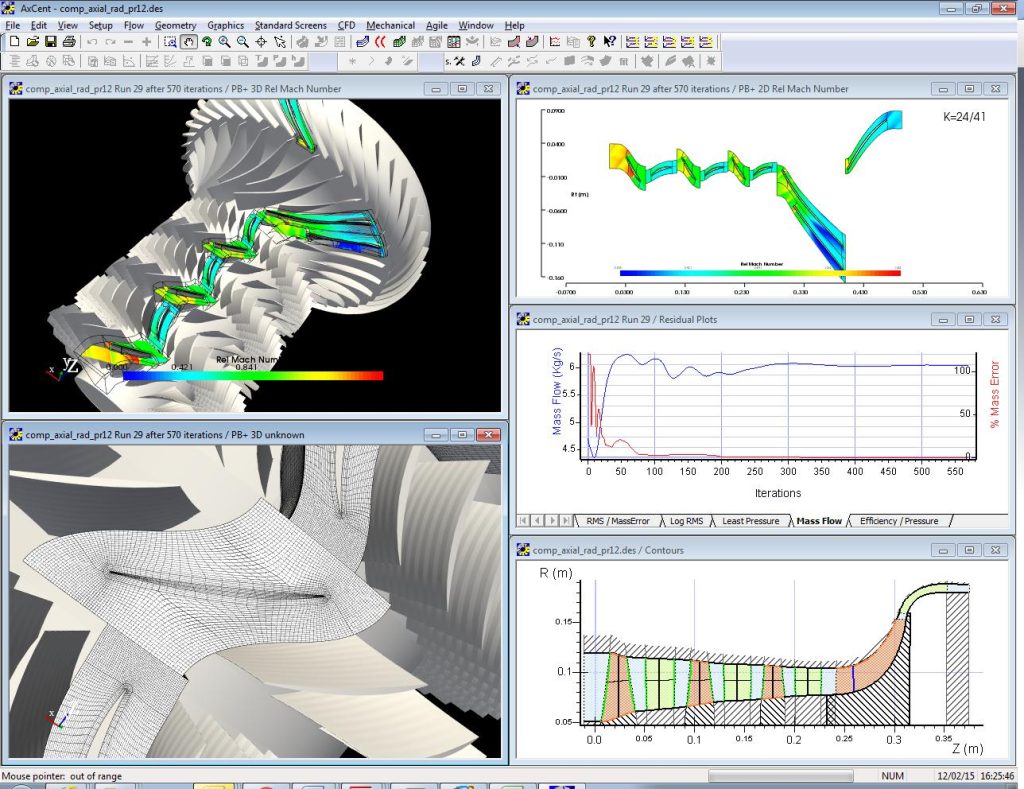
Concepts NREC and Siemens have announced a technical partnership to integrate Siemens Simcenter STAR-CCM+ computational fluid dynamics capabilities with Concepts NREC’s AxCent software, part of its Agile Engineering Design System.
Announced on October 27, 2026, the integration is intended to allow engineers to transfer detailed three-dimensional geometry, meshing parameters, and boundary-condition inputs from AxCent into STAR-CCM+ without rebuilding the analysis model manually.
The alpha release is planned for Concepts NREC’s 2026.2 software release on November 10, 2026. The initial integration is intended to support all axial machine types and selected radial machines.
Why Turbomachinery Needs Specialized CFD
Turbomachinery includes equipment such as compressors, turbines, pumps, and other machines that exchange energy with a moving fluid.
The flow field inside these machines can be highly complex. Engineers may need to evaluate pressure distribution, velocity, temperature, turbulence, separation, and losses across rotating and stationary components.
Small geometric changes can affect the overall performance of a machine. Blade angles, passage areas, clearances, and local surface features all influence the flow.
CFD allows engineers to investigate these effects before committing to expensive prototypes or physical testing. However, the value of simulation depends heavily on the quality of the geometry, mesh, boundary conditions, and numerical setup.
The Integration: AxCent and Simcenter STAR-CCM+
AxCent is part of the Agile Engineering Design System, a software environment developed for turbomachinery design and engineering.
Simcenter STAR-CCM+ is Siemens’ multiphysics simulation platform, widely used for computational fluid dynamics and related engineering analyses.
The announced integration aims to connect these environments more directly.
The workflow is intended to transfer:
- Detailed 3D geometry generated in AxCent.
- Meshing parameters.
- Boundary-condition inputs.
- Model information required to prepare the CFD analysis.
The main engineering benefit is a reduction in repetitive model preparation. Instead of reconstructing geometry and manually re-entering analysis information, engineers can move more directly from design to simulation.
This can help maintain consistency between the design model and the analysis model, particularly during iterative development.
Why Reducing Model Preparation Matters
In conventional engineering workflows, CAD and CAE models are not always identical.
Design geometry may contain details that are unnecessary for CFD, while simulation models may require specific simplifications, fluid-domain extraction, and surface preparation.
Every manual transfer introduces opportunities for errors. Geometry can be modified unintentionally, boundary conditions can be entered inconsistently, and changes made in the design environment may not be reflected correctly in the simulation model.
A more connected workflow can reduce these problems, although it does not eliminate the need for engineering judgment.
Engineers must still determine whether the mesh is sufficiently refined, whether the boundary conditions represent the real operating environment, and whether the selected physical models are appropriate.
Applications in Compressor and Turbine Development
The initial integration targets axial turbomachinery and selected radial machines.
Potential engineering applications include:
Axial compressors: Evaluating blade-row performance, pressure rise, flow distribution, and aerodynamic losses.
Gas turbines: Investigating flow behaviour in compressor and turbine stages under different operating conditions.
Radial turbomachinery: Analysing flow through selected centrifugal or radial machine configurations.
Design optimisation: Comparing alternative geometries and operating conditions to identify performance improvements.
The integration can be especially useful when engineers need to evaluate multiple design iterations within a controlled development process.
The Role of CAD, CAM, and CAE
The announcement illustrates how the three major digital engineering disciplines work together.
CAD provides the geometric definition of blades, passages, housings, and related components.
CAE evaluates the behaviour of the design under simulated operating conditions. CFD is particularly important because fluid behaviour is central to turbomachinery performance.
CAM becomes relevant when the validated geometry moves toward manufacturing. Concepts NREC’s broader engineering environment also includes MAX-PAC, its CAM software for developing machining strategies.
This creates a potential digital chain from preliminary design through simulation and manufacturing preparation.
What Engineers Should Watch
The announced integration is an important workflow development, but it should not be interpreted as a replacement for CFD expertise.
Simulation accuracy still depends on mesh quality, turbulence modelling, convergence, boundary conditions, and validation against experimental or operational data.
The initial release will also define the practical scope of supported machine types and transfer capabilities. Engineers should evaluate the integration against their own modelling requirements and software configurations.
The broader direction is clear: engineering software is moving toward more connected workflows in which design geometry, simulation setup, and manufacturing data can be reused with less manual reconstruction.
For turbomachinery developers, reducing the distance between design and CFD analysis can help shorten iteration cycles and improve engineering productivity.
Source: Concepts NREC and Siemens – Technical Partnership Announcement
Related technology: Turbomachinery, CFD, Simcenter STAR-CCM+, AxCent, digital engineering workflows.