Earthquake-resistant structural design requires engineers to control how buildings respond to different levels of ground motion.
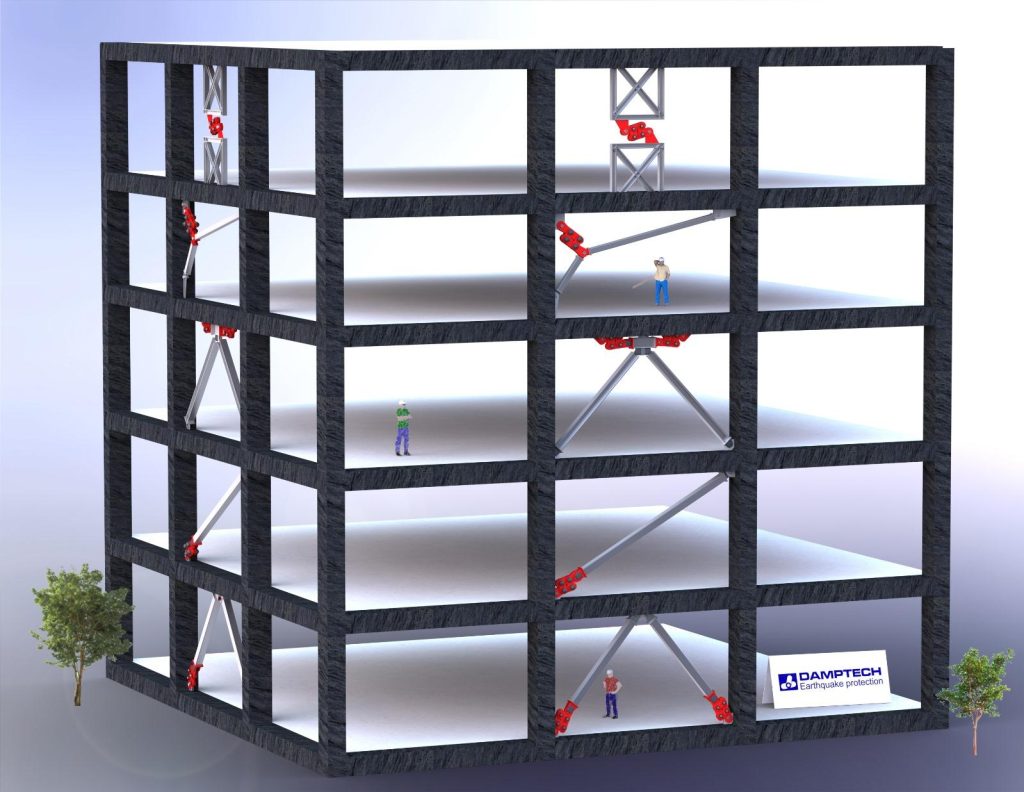
Friction dampers are passive energy-dissipation devices designed to reduce structural response by allowing controlled sliding between mechanical surfaces. During an earthquake, the device dissipates energy through friction instead of transferring all the demand to the primary structural members.
One important design parameter is the slip force: the force level at which the damper begins to slide.
Selecting this parameter is not straightforward. A damper optimised for one earthquake intensity may not provide the same level of performance under a different hazard level.
A study published in Scientific Reports on November 1, 2026, investigates a procedure for determining optimal slip forces for Pall friction dampers across multiple seismic hazard levels.
The researchers used the Endurance Time Method, which applies specially designed increasing-intensity excitation to estimate structural response across a range of hazard levels within a single analysis.
The investigation considered moment-resisting frames with 3, 6, 9 and 12 storeys. Structures with optimised dampers were compared with configurations without dampers.
The researchers also compared the Endurance Time Method with conventional nonlinear time-history analysis using FEMA P695 far-field ground-motion records. The study reports a discrepancy of approximately 10% between the approaches.
Engineering implications
The research is relevant to structural engineers who need to balance seismic performance, structural demand and retrofit cost.
It highlights why damper selection should consider multiple hazard levels rather than relying on a single design scenario.
The Endurance Time Method may reduce computational effort during preliminary optimisation, although detailed project-specific validation remains necessary.
For CAE workflows, the study demonstrates how nonlinear structural analysis and performance-based optimisation can be combined to support more informed seismic design decisions.