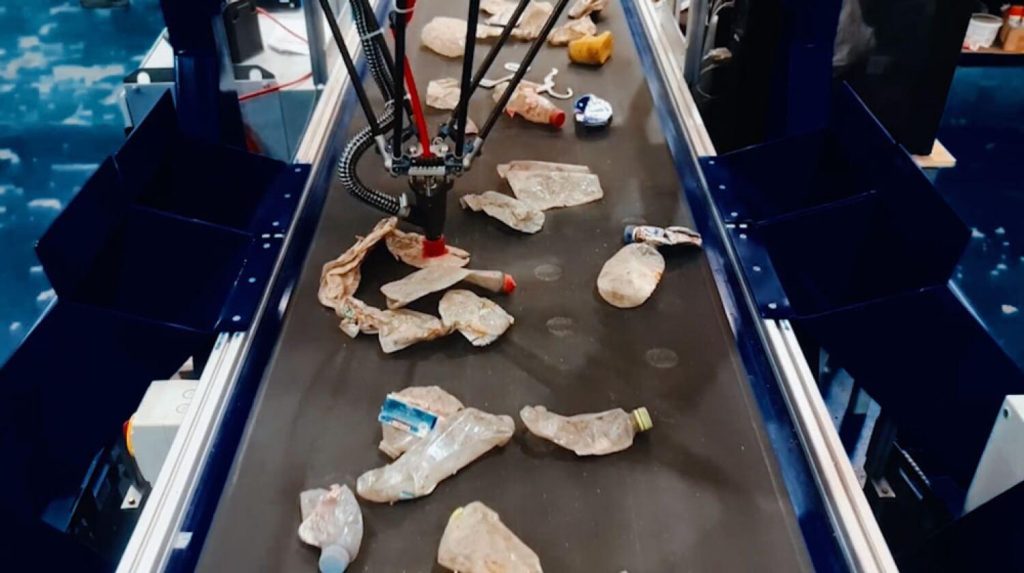
Automated recycling facilities increasingly rely on industrial robots to identify, pick and separate materials moving along conveyor systems.
Traditional robotic sorting algorithms often prioritise throughput: the number of objects a robot can pick within a given period. However, this approach does not necessarily maximise the economic or environmental value of recovered materials.
A research team has introduced a framework called Value-Aware Robotic Sorting (VARS), designed to improve the decision-making process.
The system considers several factors simultaneously, including object classification uncertainty, material value, contamination penalties, robot movement time and the limited time during which an object remains accessible on a moving conveyor.
Instead of automatically selecting the nearest or easiest object, the algorithm estimates the expected utility of each candidate and prioritises objects that contribute more value to the final sorted material streams.
The framework was evaluated through discrete-event simulations and physical deployment on a high-speed industrial Delta robot.
The experimental system used RGB-D sensing for object localisation and hyperspectral sensing for material classification. The research formulated the scheduling problem using an Orienteering Problem with Time Windows approach.
Engineering significance
This work demonstrates that industrial robot optimisation should consider more than movement speed and pick frequency.
For recycling facilities, material purity and the economic value of recovered fractions can be just as important as throughput.
The framework could support more intelligent sorting operations in circular manufacturing systems, where recovered materials must meet increasingly demanding quality requirements.
Future work will need to extend the approach to heavily overlapping objects, multiple robots and more complex material streams.