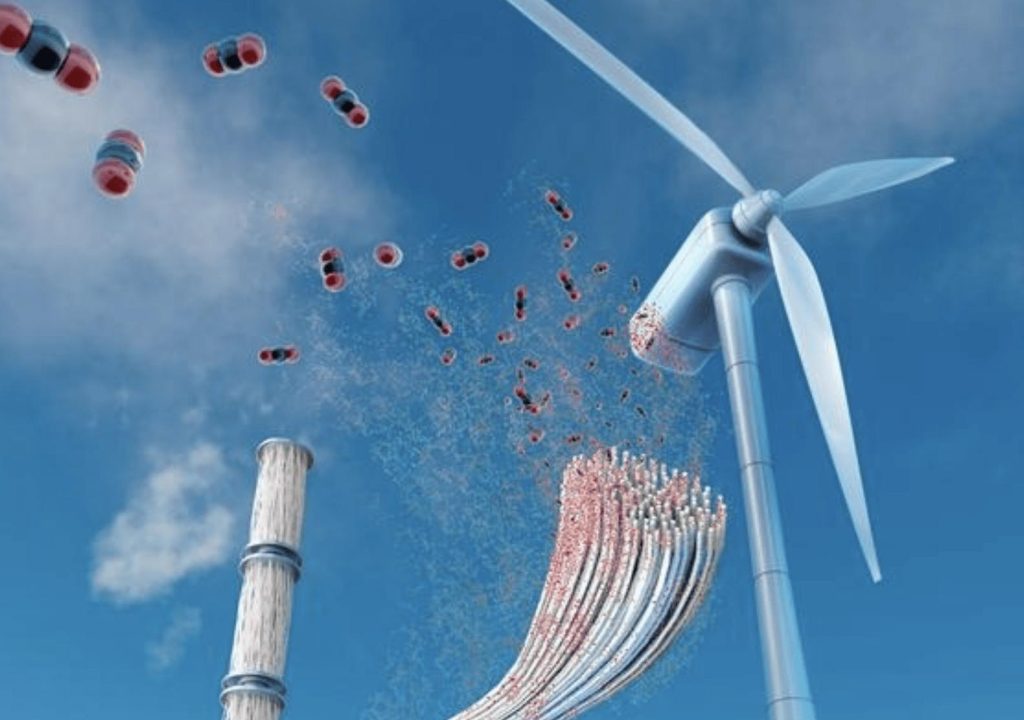
Direct air capture systems remove carbon dioxide directly from ambient air. Although the technology offers an important pathway for carbon removal, its energy requirements and the low concentration of atmospheric CO₂ remain major engineering challenges.
A patented system developed by researchers including Venkatesh Pulletikurthi explores how wind turbine aerodynamics could help address part of this challenge.
Wind turbines generate complex wake regions behind their rotating blades. These regions contain changing airflow velocities and turbulence patterns that influence how air moves through the surrounding environment.
Rather than treating the wake only as an aerodynamic consequence of power generation, the patented system uses wind and carbon dioxide concentration data to guide the positioning and adjustment of direct air capture equipment.
The system combines environmental sensors, computational decision-making and adjustable capture-device placement.
By analysing local wind conditions and CO₂ concentration, the control system can determine where a capture unit should be positioned to improve its exposure to suitable airflow.
The invention was developed through research associated with Purdue University and is covered by U.S. Patent No. 12,746,507 B2.
Engineering implications
The concept connects wind turbine aerodynamics, atmospheric flow modelling, sensor systems and carbon capture engineering.
For energy engineers, it illustrates how the airflow generated by an existing renewable energy installation might be used to support an additional environmental function.
However, a patent does not establish commercial performance. Field testing, energy-balance assessment, capture efficiency measurements and operational cost analysis will be necessary to determine the practical value of the approach.
The wider engineering opportunity lies in integrating multiple functions into existing infrastructure instead of treating energy generation and carbon removal as entirely separate systems.