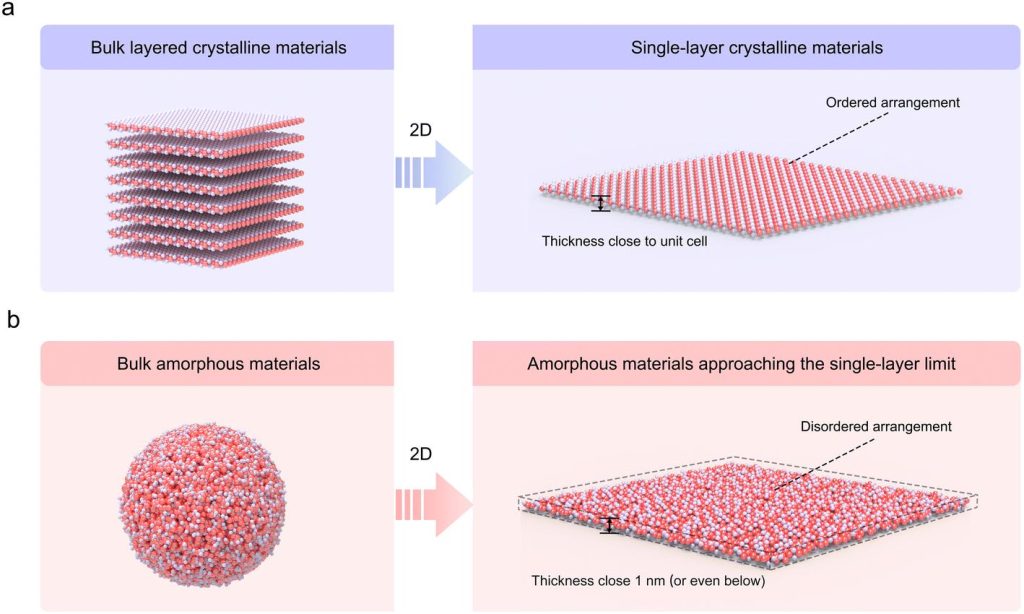
Two-dimensional materials have attracted considerable attention because of their unusual electrical, optical, mechanical and chemical properties. However, many established two-dimensional materials possess highly ordered crystalline structures.
Atomically thin amorphous materials offer a different possibility. They combine extremely small thickness with the absence of long-range in-plane crystalline order.
A review published in Nature Synthesis examines the mechanisms and manufacturing strategies used to produce these materials.
The researchers discuss four principal synthesis approaches: thermodynamic suppression of crystallisation, kinetic freezing, template-induced growth and defect- or ion-driven amorphisation.
Each approach offers a different way to prevent conventional crystalline ordering while maintaining a stable, atomically thin structure.
The review also examines how local atomic disorder can influence functional properties and identifies challenges associated with material stability, standardised performance measurement and large-area manufacturing.
An important focus is the transition from laboratory-scale synthesis to wafer-scale integration.
The authors also discuss the potential role of artificial intelligence in closed-loop synthesis strategies, where experimental results and computational models could help optimise production conditions.
Why it matters for engineering
The ability to manufacture atomically thin amorphous films at scale could influence semiconductor devices, energy storage, sensors and advanced coatings.
For materials engineers, the challenge is not simply creating a new atomic structure. It is establishing repeatable manufacturing methods that deliver predictable performance across larger areas.
The review provides a roadmap for connecting fundamental materials science with scalable fabrication and future industrial applications.