Developing metallic materials that combine high strength with sufficient ductility remains a major challenge in aerospace, energy and high-performance mechanical engineering.
Conventional high-strength alloys often require additional heat treatments or complex processing routes to achieve the desired microstructure. However, these treatments may increase manufacturing time and do not always guarantee stable performance across a wide temperature range.
Researchers have reported a laser-based additive manufacturing approach for producing a multi-principal-element alloy with an engineered cellular microstructure.
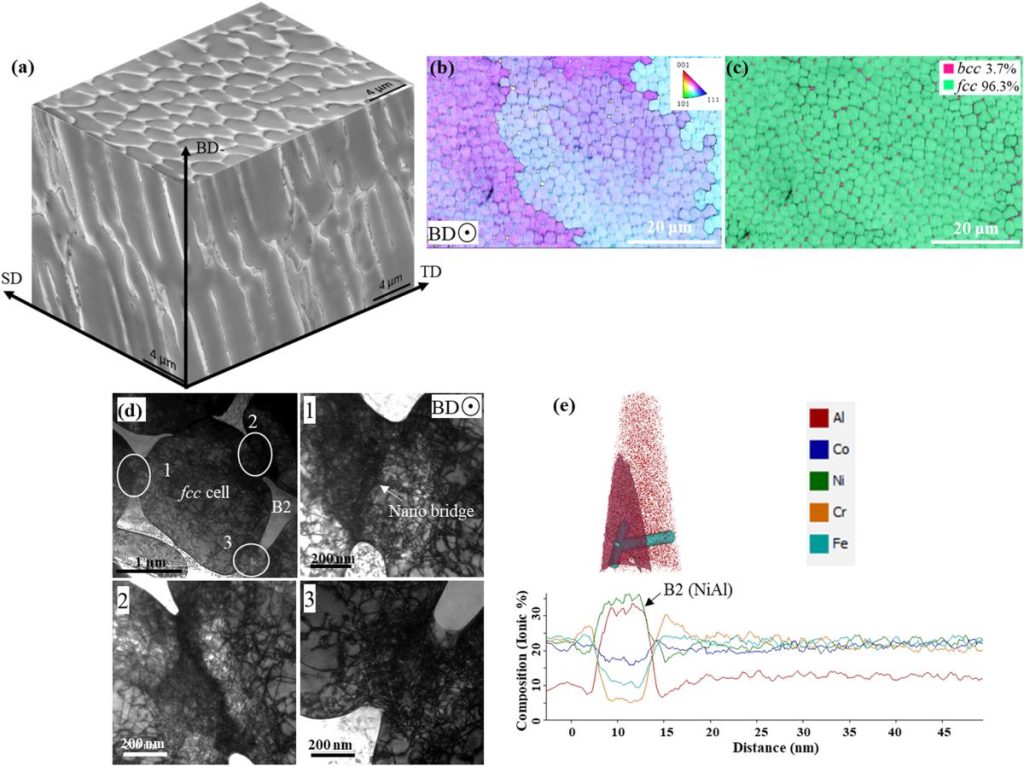
The alloy is based on a chromium-iron-cobalt-nickel-aluminium-titanium composition with additional vanadium and tantalum. During laser-based additive manufacturing, a cellular network of body-centred cubic and L2₁ precipitate phases forms directly within the material.
This process-intrinsic microstructure supports deformation through mechanisms including slip transfer and back-stress hardening.
According to the study published in Nature Materials, the alloy maintained a yield strength above 1 GPa and uniform elongation of approximately 20% across temperatures ranging from 77 K to 873 K.
An important aspect is that the reported performance was achieved without relying on the conventional post-processing route required by many precipitation-strengthened alloys.
Why it matters
A material capable of maintaining both strength and ductility across a broad temperature range could be valuable for components exposed to cryogenic and elevated-temperature environments.
Potential applications include aerospace structures, energy systems and advanced industrial components.
The study also demonstrates how additive manufacturing can influence the internal microstructure of an alloy during the build process itself, making manufacturing strategy an integral part of material design.