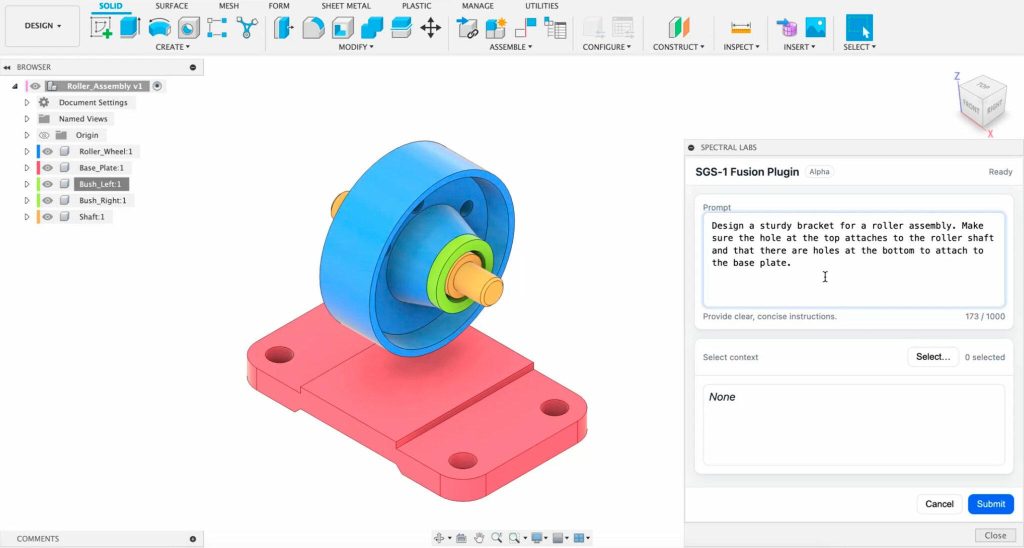
Industrial product development often begins with a functional requirement rather than a clearly defined component. Engineers must translate that requirement into mechanical principles, dimensions, materials, loads, interfaces and manufacturing constraints before a design can be created.
German engineering company kabkin is developing a Prompt-to-Product approach that allows companies to describe what a mechanical component should do using natural language.
The company reports that more than 100 B2B product projects have been initiated through the platform since its launch in early 2026.
From Functional Requirements to Engineering Assessment
Users can describe their requirements and provide supporting information such as sketches, photographs, target prices, quantities, deadlines and performance indicators.
For relevant enquiries, kabkin says its engineers provide an initial feasibility assessment within 24 hours.
The engineering team evaluates factors such as motion, load conditions, installation space, interfaces and safety requirements. Based on this assessment, a solution may involve an existing product, a modified component or a newly developed mechanical assembly.
Engineering Knowledge as a Digital Resource
The platform draws on the company’s accumulated mechanical design experience and a reported library of more than 15,000 hinge and motion solutions.
This is an interesting application of AI-assisted product development: instead of starting with a catalogue search, the user starts with the engineering problem.
The approach could be useful for companies with limited internal design resources or incomplete technical specifications.
What It Means for Product Designers
Natural-language interfaces may make it easier to communicate early-stage product requirements. However, a text prompt cannot replace engineering validation.
Load calculations, material selection, tolerance analysis, manufacturability, safety and testing remain essential before a design can be released for production.
Kabkin’s approach demonstrates how AI-enabled interfaces may change the first stage of mechanical product development, connecting customer needs with engineering expertise more directly.