






Intel Arc Pro B50 Review Explores Entry Workstation Graphics
Intel’s Arc Pro B50 brings 16 gigabytes of memory to a compact professional graphics card, but DEVELOP3D’s review finds that application compatibility is as important as capacity. The tested card is a low profile, dual slot design rated at 70 watts and powered through the PCIe slot. At the reviewed price of roughly £300 excluding VAT, it offers an accessible route to more GPU memory, especially for small workstation configurations.
The hardware proposition is straightforward: memory capacity exceeds that of the Nvidia RTX A1000 used as a comparison in the review. This can matter when a visualisation scene becomes too large to reside entirely on a smaller card. The performance consequences of crossing that limit can be substantial because data may need to move through slower system memory. Capacity is therefore a practical workflow constraint, not simply a specification to compare in isolation.
Memory helped in the tested visualisation scenes
In the review’s Twinmotion project, the B50 outperformed the RTX A1000 by 62 percent in raster rendering and 56 percent in path tracing. The source associates that result with the scene’s memory demands and the smaller card’s need to offload data. These are results for a particular scene and rendering setup, rather than general speed advantages across all visualisation work.
The B50 also showed an advantage in a D5 Render test that fitted within both cards’ memory capacities. That indicates that compute capability contributed as well as capacity. Conversely, the review found strong competition from AMD’s Ryzen AI Max+ Pro integrated graphics in some workloads, though that alternative requires a different system architecture. A graphics card comparison and a complete workstation comparison should therefore be kept distinct.
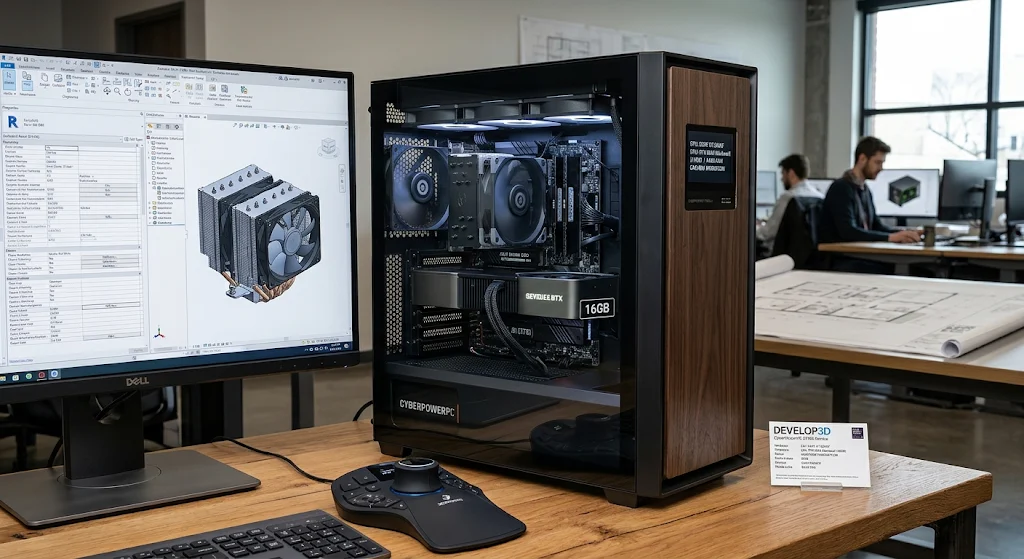
The card’s 70 watt board power, compact dimensions and four Mini DisplayPort outputs make it physically relevant to small systems. The source notes that major compact workstation OEMs did not offer it as a stock option at the time of writing. Physical compatibility does not establish vendor support, cooling approval or software certification for a particular machine, so those details need to be checked separately.
Compatibility can outweigh a memory advantage
The review encountered significant problems in some applications. Lumion 2024 would not launch, while some scenes in the 2025 version rendered incorrectly. In Solidworks, the popular shaded with edges mode performed poorly as model complexity increased. One large telescope assembly dropped to 1.57 frames per second on the tested setup. Those findings are specific to the reviewed software and driver context, but they are material to a purchasing decision.
Other applications behaved differently. Revit performed well in the same review, demonstrating why problems in one CAD package should not be generalised to all professional graphics work. A user should test the exact application version, display mode and project scale expected in production. A small demonstration model may fail to expose a limitation that becomes serious on a large assembly.
The report discusses potential AI uses but does not establish a direct Stable Diffusion comparison with the Nvidia card because the software stacks differ. That boundary matters: additional memory suggests useful capacity, yet it is not a measured performance result. A supported and maintained software route is necessary before nominal hardware resources become productive capability.
The Arc Pro B50 is therefore an interesting option for selected memory heavy workloads, with an unusually strong capacity proposition at its reviewed price. Its suitability rests on verified application behaviour. For engineering teams, the review’s lesson is to treat GPU selection as a compatibility and workload exercise, using representative scenes and interaction modes to confirm that the attractive hardware specification translates into reliable daily use.
Source — develop3d.com. Source publication date 2026-02-05. Engineering analysis: The CAD Verse.

 MEMBERS · ONE ENGINEERING COMMUNITY
 Engineering videos and tutorials
 Engineering marketplace and professional opportunities
 Courses, tutorials and learning paths
 Engineering files and CAD models
 Professional engineering projects
Discussion
0 CommentsShare your thoughts and engineering insights with the community.
Comments are closed for this article.
No comments yet. Be the first to share your thoughts.