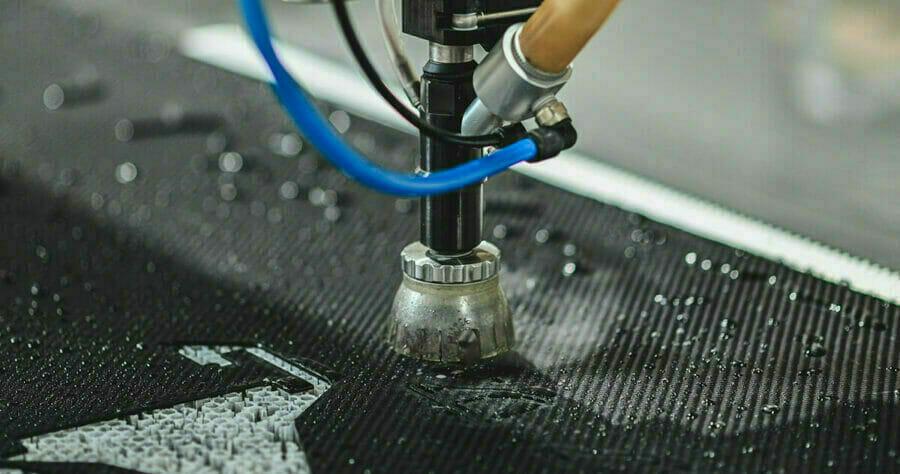
Abrasive waterjet machining is widely used when manufacturers need to cut materials without the heat-affected zones associated with conventional thermal cutting processes. However, achieving consistent surface quality and dimensional accuracy requires careful selection of process parameters.
A study published in Scientific Reports on October 31, 2026, investigates abrasive waterjet machining of an epoxy composite containing 10% areca nut biofiller.
Understanding the Main Process Variables
The research examined four important parameters: waterjet pressure, traverse speed, abrasive flow rate and stand-off distance.
The researchers evaluated how these variables influence surface roughness and kerf angle, two important indicators of machining quality.
The study compared response surface methodology with an Adaptive Neuro-Fuzzy Inference System (ANFIS) model.
The Role of ANFIS in Process Prediction
According to the study, ANFIS achieved lower prediction errors than the compared response-surface models across the reported observations.
The research also identified an optimized parameter combination involving 300 MPa waterjet pressure, 200 mm/min traverse speed, 150 g/min abrasive flow rate and 1.5 mm stand-off distance.
Confirmation experiments reported surface roughness of 3.48 µm and a kerf angle of 3.11° under the selected conditions.
These values relate to the specific composite and experimental setup investigated. They should not be treated as universal machining recommendations.
Implications for Manufacturing
The study demonstrates how machine-learning-based prediction can support parameter selection in non-traditional machining.
For manufacturers working with sustainable composite materials, improved process modeling could help reduce trial-and-error experimentation and improve cutting consistency.
The next step is to test the approach across different composite formulations, thicknesses, machine configurations and industrial production conditions.