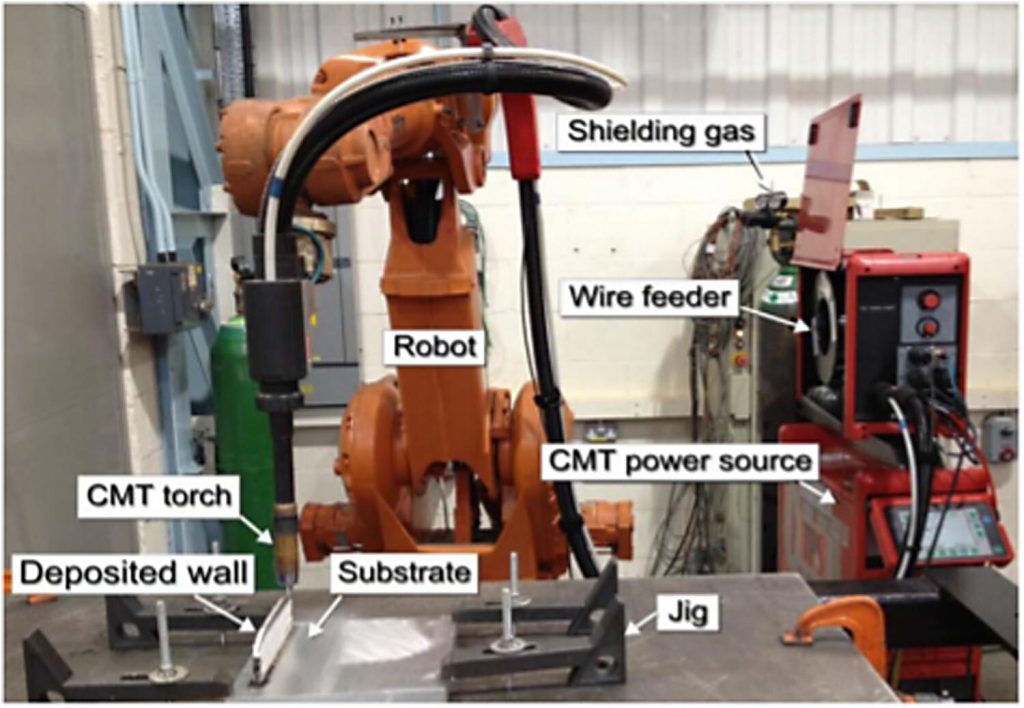
Wire Arc Additive Manufacturing (WAAM) is attractive for producing large metal structures because it combines high deposition rates with relatively flexible robotic equipment. However, process reliability depends on the interaction between wire feed, travel speed, thermal history and shielding conditions.
A study published in Scientific Reports on November 3, 2026, presents a physics-guided machine learning framework for optimizing circular-path Cold Metal Transfer WAAM of ER5356 aluminium alloy.
Combining Manufacturing Knowledge with Machine Learning
The researchers investigated four main process variables: wire feed speed, travel speed, interpass temperature and shielding gas flow rate.
The study used a Taguchi L27 experimental design with three centre-point replications, producing 30 observations. The resulting dataset was used to develop a multi-output learning model that predicts several mechanical responses, including tensile strength, elongation, flexural strength and hardness.
Rather than relying only on raw process variables, the framework also incorporated physics-guided descriptors representing deposition intensity, thermal accumulation, cooling severity and shielding adequacy.
Reported Optimization Results
The model predicted an optimized process condition with an ultimate tensile strength of 295.20 MPa and elongation of 40.10%, alongside predicted flexural strength and hardness values.
A confirmatory experiment produced deviations below 5% from the model’s predicted values.
These results are promising, but the dataset is relatively small and the validation was conducted within the investigated process window. The findings should not be interpreted as proof that the model will generalize to all WAAM machines, alloys or component geometries.
Implications for Digital Manufacturing
The research illustrates how process physics and machine learning can be combined to support parameter selection in metal additive manufacturing.
For industrial users, the next step is to validate such models across larger datasets, independent builds and different production environments.
The long-term opportunity is a more data-driven WAAM workflow in which process parameters can be selected with better understanding of their combined effects on mechanical performance.