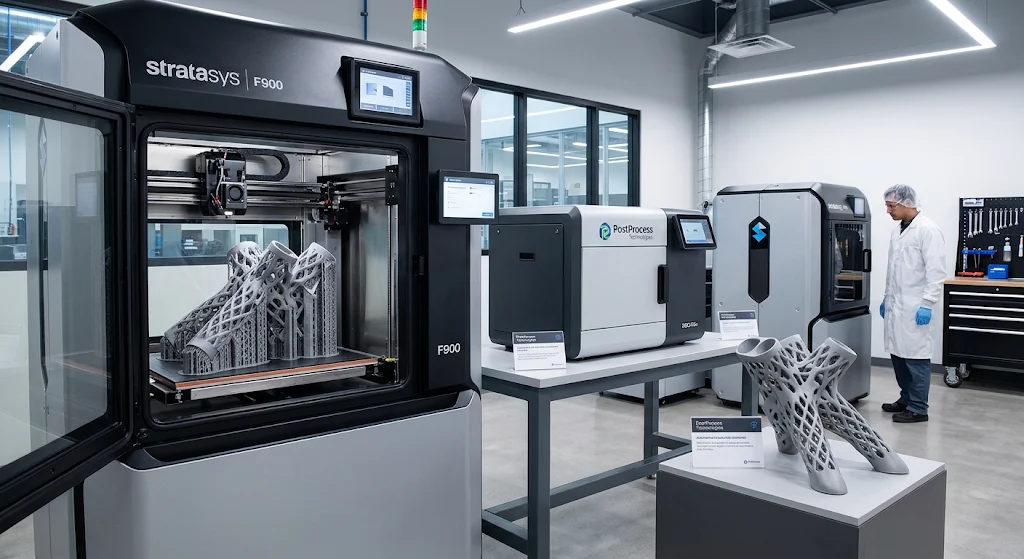
PostProcess Technologies has become the first participant in Stratasys’s new post processing partnership programme. The commercial agreement makes its solutions available through Stratasys’s global sales channels, bringing finishing equipment into a more coordinated additive manufacturing purchase route. The programme is intended to help customers identify validated third party technologies alongside printers, materials, software and services.
This addresses a familiar production gap. A printed component is not necessarily ready to use when it leaves the machine. Depending on the process, it may need cleaning, removal of resin or supports, curing, smoothing or further finishing. Those operations affect labour, lead time and consistency. Evaluating only the printer can therefore leave a substantial portion of the manufacturing route unresolved.
Buying a workflow rather than a print stage
Stratasys says it will curate and validate post processing solutions for compatibility with its systems. The announced PostProcess portfolio supports several Stratasys technologies, including FDM, PolyJet, SLA and P3. That breadth is significant, but it does not mean that one finishing method applies to every material and geometry. A user still needs to match a particular operation to the printed part and its acceptance requirements.
The programme aims to reduce the need for customers to research vendors and make separate purchases without a clear view of integration. A more coordinated procurement route can help establish who supplies which element and what has been assessed together. Engineers should nevertheless ask what validation covers: material compatibility, dimensional effects, surface outcome, throughput or some combination of these. The source does not publish a single universal test protocol for all participating equipment.
PostProcess links the agreement to growing part complexity and production volumes, arguing that manual finishing does not scale readily. That is a supplier assessment rather than a quantified labour comparison in the announcement. In practice, the relevant benchmark is the complete workload, including loading, consumables, equipment cleaning and any remaining manual work. Automating one finishing stage can move the bottleneck rather than remove it entirely.
Geometry influences finishing effort
Design engineers can have a direct effect on downstream workload. Enclosed passages, closely spaced features and difficult support access may complicate cleaning and removal operations. A feature that prints successfully may still be awkward to finish or inspect. These concerns should be reviewed while selecting the build orientation and material, rather than after the printer purchase has been completed.
A useful production trial would therefore follow representative parts from the build through their final accepted condition. Measurements before and after post processing can reveal dimensional or surface changes relevant to the application. The trial should also record the time and handling needed between stages. That evidence is more informative than comparing nominal equipment capacities that may have been measured under different assumptions.
The source identifies automotive, aerospace, dental and consumer goods as important application areas. Their acceptance requirements can differ substantially, so a shared sales channel does not replace industry specific process qualification. The value of the programme is that it creates a clearer starting point for assembling a compatible route, with a closer commercial relationship between the printing and finishing suppliers.
For manufacturers expanding additive production, the announcement signals increased attention to work beyond the build chamber. Printer capability remains essential, but usable throughput depends on all the operations needed to deliver an acceptable part. A validated post processing choice can help make that route more predictable, provided the engineering team evaluates the actual geometry, material and production volume rather than assuming compatibility alone establishes readiness for manufacture.
Source — develop3d.com. Source publication date 2026-02-19. Engineering analysis: The CAD Verse.