Introduction
Dimensional variation is one of the most important factors influencing product quality, assembly performance, and manufacturing cost.
Even when individual components comply with their specified dimensions, accumulated tolerances can create assembly interference, excessive clearances, or functional performance problems.
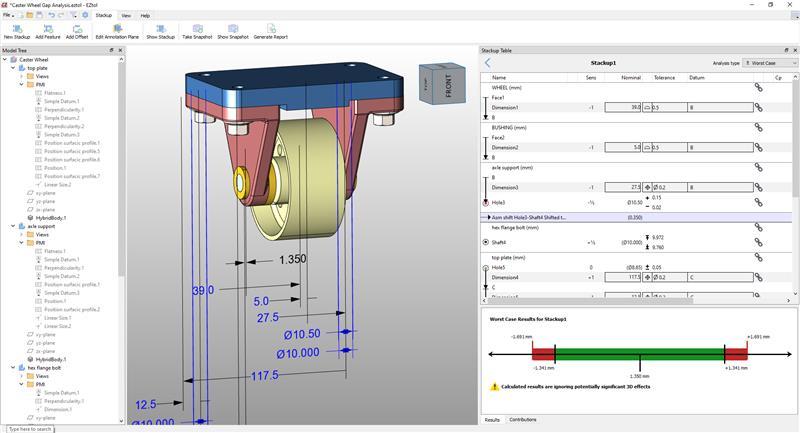
Sigmetrix has announced CETOL 6σ version 12.4, introducing enhancements intended to simplify three-dimensional tolerance analysis and improve assembly validation workflows.
Improved Virtual Fastener Modeling
One of the major enhancements concerns virtual fastener definitions.
The new version allows engineers to define a single joint specification for patterns of repeated features using one virtual fastener definition.
This can reduce repetitive modeling operations in assemblies containing multiple fasteners and repeated connection patterns.
For large mechanical assemblies, simplifying these definitions can improve model management and reduce preparation time.
Enhanced Fit Check Capabilities
CETOL 6σ v12.4 also expands Fit Check functionality.
The updated capability considers not only feature size but also location and orientation tolerances.
Engineers can additionally assign position tolerances intended to achieve worst-case fit directly through the Fit Check interface.
This is particularly useful when evaluating complex mechanical interfaces where dimensional and geometric tolerances influence assembly behavior together.
Assembly Variation Analysis
The release introduces further improvements to sensitivity and contribution analysis.
Engineers can group or ungroup sensitivity and contribution results for the same dimension across multiple instances of a component.
Profile tolerances can also be applied to width features of size, allowing size, location, and orientation requirements to be considered within a single specification.
The software also introduces improvements to assembly-state management, including the ability to clone multiple joints together.
Reporting and Engineering Productivity
Additional reporting enhancements include:
- Fit assessments for calculated virtual fasteners
- Improved visibility of unresolved advisor messages
- Measurement limits based on specified quality levels
- Part-level temperature difference reporting
- Improved result visualization
- More readable measurement data layouts
These features aim to make engineering analysis results easier to interpret and communicate across design and manufacturing teams.
Engineering Implications
Three-dimensional tolerance analysis is particularly important in automotive, aerospace, medical device, and precision machinery development.
By identifying variation-related problems before production, engineers can evaluate alternative dimensioning strategies, improve assembly robustness, and reduce the risk of costly manufacturing changes.
CETOL 6σ v12.4 is scheduled to become available on November 19, 2026.
Conclusion
The latest CETOL 6σ release focuses on improving the efficiency and usability of model-based tolerance analysis.
Its enhancements to virtual fastener modeling, fit validation, and reporting support more effective dimensional engineering throughout the product development process.
Source: Sigmetrix and DailyCADCAM.