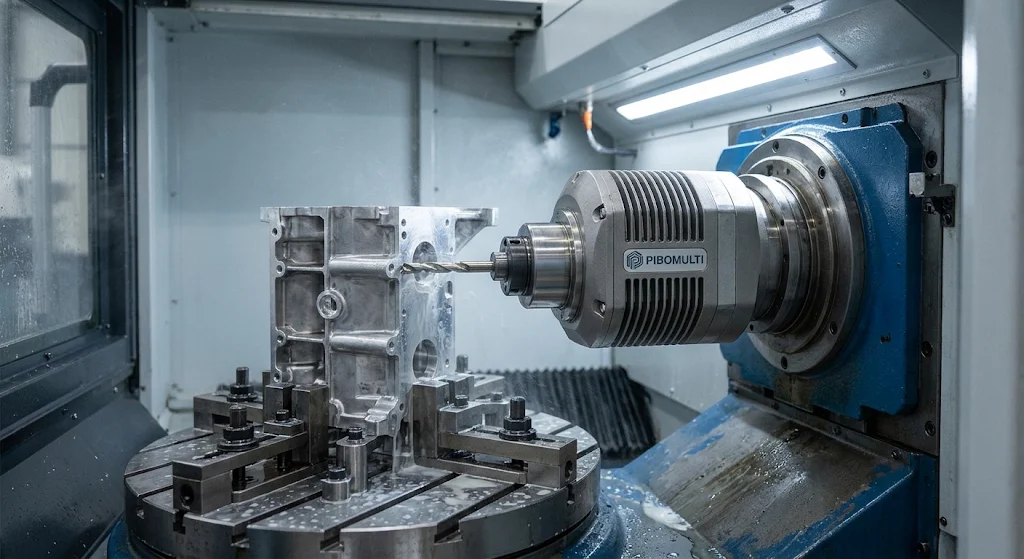
Pibomulti has introduced CEP-NG right angle heads for milling and drilling perpendicular to a machine spindle’s normal orientation. The Swiss manufacturer’s products are supplied in Britain and Ireland by Gewefa UK. The new heads are intended for machining centres as well as suitable B axis spindles and live turret stations, providing another route to features that would otherwise require a different workpiece orientation or machine setup.
A right angle head changes the direction of tool rotation through an additional mechanical assembly. That can improve access, but it also introduces new dimensions, clearances and performance limits into the process. The announcement is therefore relevant to both programming and production planning. A feature that is reachable with such a head may be machinable in the existing setup, provided the surrounding geometry allows the complete assembly to approach safely.
Transmitting motion around the corner
The CEP-NG design uses hardened and ground bevel gears with ABEC 9 angular contact bearings. Pibomulti reports higher rotational speed capability at a 1:1 ratio than its previous models. The intended benefits include greater removal rate during roughing and improved finish capability, although the source does not provide a comparative machining test for a specific component.
For the CEP-NG 17, the reported maximum speed is 5,000 revolutions per minute, with 6,000 available as an option. It uses ER25 tool clamping and has a maximum torque of 50 newton metres. Across the wider range, clamping extends from ER8 to ER50 or ISO40, with the largest stated option able to use a 36 millimetre tool and transmit 210 newton metres. These are different configurations, so their limits should not be combined into a single assumed operating point.
The new generation is also described as producing less vibration, particularly with long tool overhang. That is relevant because a right angle arrangement can place the cutting edge some distance from the machine spindle. The resulting structural chain affects deflection and stability. A shorter cutter or a better supported workpiece may still be necessary even when the head itself has improved dynamic behaviour.
Automation adds handling constraints
Pibomulti has reduced the weight of the heads. The supplier links that change to lower loads on spindle bearings, machine structure and automatic tool change equipment. Lighter tooling can be helpful during acceleration and exchange, but compatibility must still be checked against the machine’s limits. Tool magazine capacity includes restrictions on mass and geometry, not merely the number of available pockets.
A programme using an automatically exchanged head also needs the correct assembly definition. The tool tip, head body and any locating or reaction features can occupy space beyond the cutter’s swept path. Simulation should represent those elements, and setup procedures should confirm the intended orientation. These are general integration needs rather than additional capabilities claimed in the source.
For designers, the technology can make side features accessible without adding a separate setup, which may help preserve relationships between machined surfaces. It can also reveal where a small geometry change would simplify access. Moving a hole or increasing clearance around it may allow a shorter and more stable assembly. Such choices should be reviewed with the manufacturing team before assuming that an angle head resolves every access problem.
The CEP-NG range develops an established way of extending a machine’s reach through changes in speed capability, vibration and mass. The decisive application evidence will be the complete operation: safe automatic handling, collision free access and a stable cut that produces the required feature. The head’s specification is a starting point for that process, rather than a replacement for component specific verification.
Source — mtimagazine.com. Source publication date 2026-02-06. Engineering analysis: The CAD Verse.