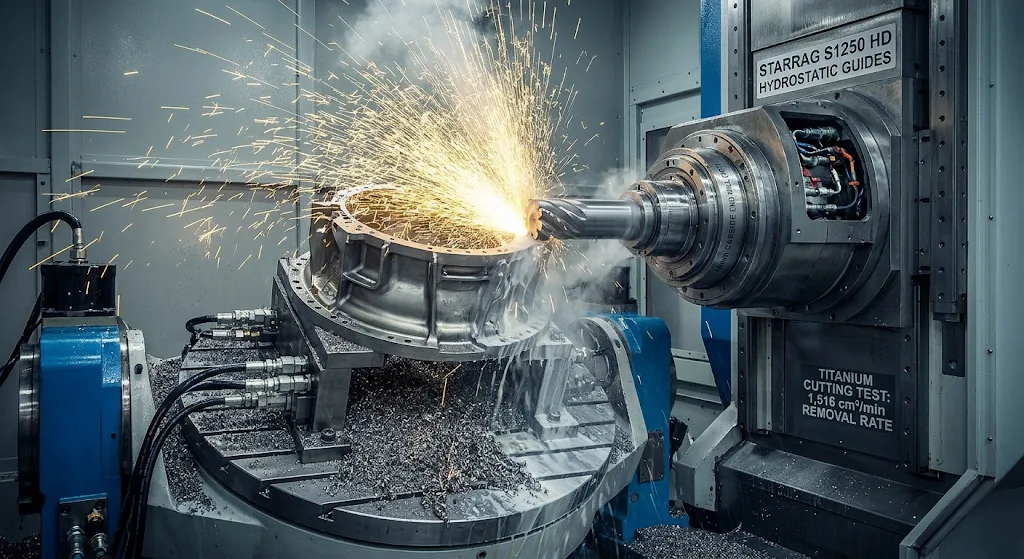
Starrag reports that its S1250 HD five axis machining centre achieved a metal removal rate of 1,516 cubic centimetres per minute during titanium cutting tests at its Rorschacherberg facility. The test used a 40 millimetre carbide cylindrical end mill with 18 teeth. Starrag suggests that the result could represent a world record, although the source does not present an independent comparison establishing that status.
The more informative engineering story is how the company describes the machine’s development. The S1250 HD uses hydrostatic guides, and Starrag attributes the performance to rigidity, damping and dynamic behaviour. Earlier prototype roughing tests reportedly reached as much as three times the removal rate of an STC 1250 version using roller bearings. That is a supplier comparison under its test conditions, rather than a general ratio that can be applied to every titanium part.
Supporting the cut through the whole structure
For the production machine, Starrag strengthened the machine and column structure. The rotary table now uses a gearbox arrangement with reported torque of 25,000 newton metres and clamping torque of 32,000 newton metres. The swivel head was enlarged on one side to accommodate a stronger A axis while retaining access. Starrag gives that axis torque as 12,000 newton metres and clamping torque as 20,000 newton metres.
These changes highlight the load path behind a high removal rate. Cutting forces act through the tool, spindle, head, axes, workpiece and fixture. Improving only one element can leave another as the limiting source of deflection or vibration. The reported modifications address several parts of that path, which is consistent with treating heavy titanium machining as a system problem rather than a spindle power problem alone.
The machine also introduces an HSK-B160 spindle interface, which Starrag associates with tool rigidity at large cutting depths. The tool connection is one link in the same structural chain. A demanding roughing operation must hold the cutter securely while preserving predictable behaviour at the cutting edge. Tool overhang and holder selection remain relevant even when the machine interface is designed for heavy duty use.
Removal rate needs a production context
A high metal removal rate can shorten a roughing stage, particularly for components made from substantial starting stock. It does not directly specify the total cycle time of a finished part. Tool changes, positioning, remaining stock strategy, finishing and inspection all contribute to the manufacturing route. Engineers comparing machines should therefore distinguish the demonstrated cutting rate from the time needed to produce a conforming component.
Tool wear is similarly central. Starrag says the production revisions sought both higher removal and reduced wear, but the report does not publish a complete tool life curve or cost per component. A useful application trial would track the removal rate alongside edge condition and surface integrity over a representative sequence. That would show whether the aggressive cut remains economical and predictable beyond a short demonstration.
The source reports an order for five S1250 HD machines for Airbus’s Varel site in Germany. This indicates a specific industrial commitment, while leaving the details of the customer’s processes and acceptance results unstated. It should not be interpreted as proof that every prospective titanium application will reproduce the test figure.
For manufacturing engineers, the announcement supplies a striking benchmark and a clear description of the structural changes behind it. The appropriate next step is to translate that capability into the geometry, tool engagement and fixture conditions of a real component. The measure of success is sustained, acceptable production, with the impressive roughing rate contributing to a balanced and dependable machining process.
Source — mtimagazine.com. Source publication date 2026-02-20. Engineering analysis: The CAD Verse.