
New digital pressure scanner suits testing in tiny spaces
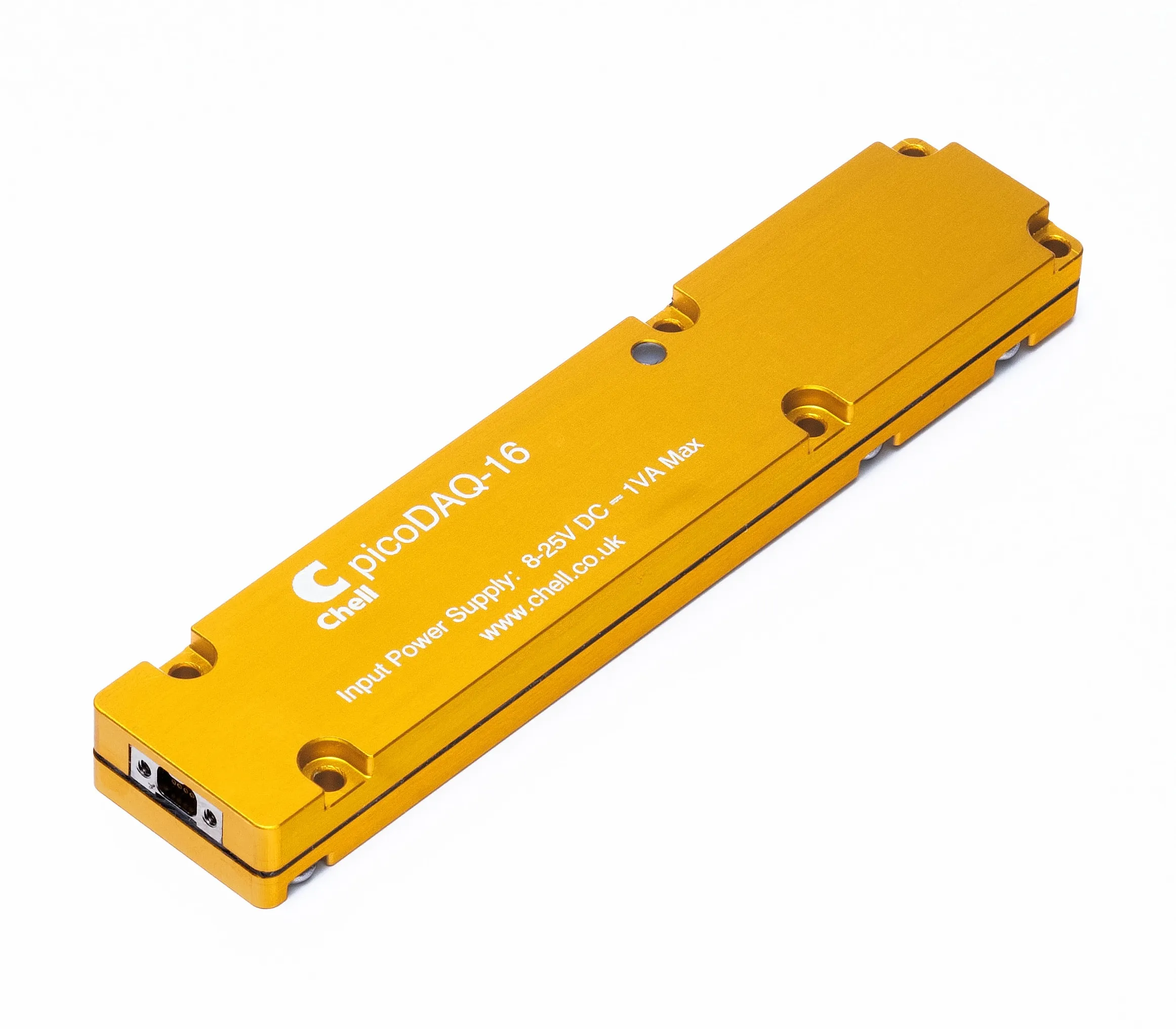
Chell Instruments has launched picoDAQ, a digital pressure scanner measuring 83.4 by 14.8 by 9.6 millimetres. The company describes it as its smallest scanner to date, aimed at testing locations where installation space is tightly constrained. Automotive, motorsport and aerospace applications are highlighted, including wind tunnel, track and flight work. The development addresses not only measurement performance but the practical problem of placing instrumentation where the test requires it.
The device uses 17 absolute transducers to provide 16 measurements relative to one reference port. These can be configured as absolute or differential measurements, according to the source. This architecture matters when interpreting the channels: the reference arrangement is part of the measurement definition, not simply an extra connection. A test engineer must understand how it relates to the pressure quantities being compared.
Small packaging changes installation choices
A compact scanner may allow shorter or more practical routing between pressure taps and the instrument. That can be valuable in a crowded test article, where larger equipment may require awkward mounting. The source does not quantify the dynamic improvement of any particular installation, so size should not be converted into an unsupported response time claim. The full pressure path remains part of the test system.
Chell reports accuracy output up to 0.03 percent of full scale. The full scale basis is important: it is not the same as a percentage of every reading, especially when the measured pressure is small relative to the selected range. Engineers should choose the range and uncertainty budget with the expected signals in mind. The announcement does not publish a complete calibration table or all operating conditions behind the headline accuracy.
The transducers are thermally compensated and conditioned. That is relevant because test environments can change temperature during operation, potentially affecting a pressure measurement. Compensation is part of controlling that influence, but the complete installation still needs to consider the environment experienced by the scanner and its connections. The source gives no basis for assuming identical performance under every thermal transient.
Data interfaces belong in the test plan
picoDAQ outputs engineering unit data over Ethernet and CAN, supporting both CAN-FD and classic CAN. Those options can help integrate the scanner with existing acquisition systems. The useful question is how channel data will be synchronised, recorded and associated with the rest of the experiment. A compatible physical interface alone does not establish that a test system captures every signal at the required rate or timing relationship.
The casing and sealed components are rated IP67, according to Chell. This is a specific enclosure protection statement rather than a general claim of immunity to all test conditions. Mounting, connectors and the pressure lines should be reviewed for the intended environment. A small protected instrument still needs an installation that preserves its measurement function and can be checked before a run.
For aerodynamic development, pressure data is valuable only when its location and reference are traceable to the geometry and test condition. Designers and test engineers should therefore coordinate tap placement, instrument access and data identification early. Instrument packaging can open new measurement positions, but the results must remain interpretable when they return to the design team.
picoDAQ’s announcement offers a compact option for distributed pressure testing with several communication routes. Its engineering value will depend on range selection, calibration and integration into the complete test chain. The small dimensions solve a real packaging constraint; a well defined measurement plan determines whether that access produces reliable evidence for the next design decision.
Source — mtimagazine.com. Source publication date 2026-01-16. Engineering analysis: The CAD Verse.
Report an image


 MEMBERS · ONE ENGINEERING COMMUNITY
Discussion
0 CommentsShare your thoughts and engineering insights with the community.
Comments are closed for this article.
No comments yet. Be the first to share your thoughts.