1. The Function of Paint and Its Engineering Significance
Paint is a critical coating process that provides both protection and aesthetic appeal to surfaces. By adhering to the substrate, it shields the material from mechanical and chemical effects. From an engineering standpoint, paint is a surface engineering solution: corrosion resistance, wear resistance, and visual quality are combined in a single system.
Paint components:
| Component | Function | Engineering Note |
|---|---|---|
| Solvent (water or chemical-based) | Viscosity control, applicability | Evaporates during drying; critical for VOC and emissions |
| Resin (binder) | Adhesion, crack resistance, durability | Paint is named after this component (e.g., epoxy, acrylic, alkyd) |
| Pigment | Color, opacity | Classified as organic, inorganic, or special |
| Additive | Flow, drying, stability | Keeping it minimal is a quality indicator |
| Filler | Volume, cost, mechanical properties | Excessive filler reduces quality |
Quality rule: High-quality paints are formulated with high adhesive and pigment content and minimal additives.
2. Classification of Painting Systems
Industrial painting systems fall into two main groups:
- Powder Coating — solvent-free, applied via electrostatic charging, cured in an oven.
- Liquid Paint
- Solvent-based — high performance, but with VOC and explosion risks
- Water-based — low emissions, environmentally friendly
Every system consists of three fundamental stages: surface preparation → painting → drying/curing.
3. Surface Preparation: The Foundation of Adhesion
Surface preparation is essential for optimal adhesion. Dirt, grease, and moisture are removed, and the method is selected according to the material:
| Material | Method | Engineering Rationale |
|---|---|---|
| Steel | Sandblasting | Increases surface profile and surface energy, providing mechanical keying |
| Aluminum | Brushing | Removes the natural oxide layer |
| Plastics | Flame treatment | Raises low surface energy, improving wetting |
Surface preparation can determine up to 70% of total coating quality; it is the most frequently skipped yet most critical step.
4. Painting Techniques
There are four primary methods:
- Brush painting — traditional, dependent on operator skill.
- Dip method — parts are submerged in paint, and excess drains off.
- Curtain flow — a curtain-like flow of paint coats surfaces passing underneath.
- Spray method — with air, airless, and electrostatic sub-methods.
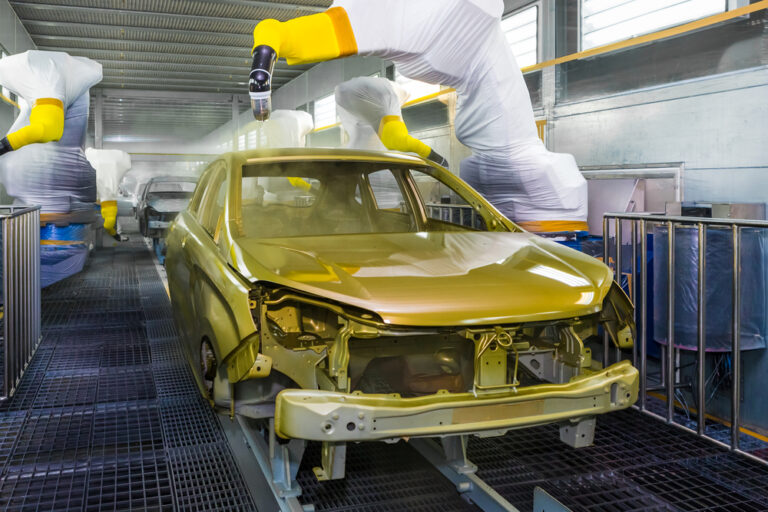
Spray painting, whether manual or automated, is the most versatile and widely used method. Manual application relies on visual inspection, while robotic systems deliver consistent results with pre-set parameters.
5. Parameters Affecting Painting Quality
| Parameter | Effect | Engineering Note |
|---|---|---|
| Paint pressure | Spray pattern and flow rate | The pump must provide pressure/flow matching system requirements |
| Viscosity | Adhesion and flow | High viscosity → rough application; low viscosity → dripping |
| Density | Uniform coating | Consistent density is essential for homogeneous quality |
6. Environmental and Equipment Factors
- Temperature and humidity: Relative humidity above 80% degrades paint quality (condensation, loss of adhesion).
- Ventilation: Proper airflow prevents defects caused by overspray accumulation.
- Equipment: Explosion-proof (ex-proof) systems are required for solvent-based paints; abrasion-resistant equipment is necessary for enamel spraying.
7. Common Painting Defects and Root Causes
| Defect | Cause | Solution Direction |
|---|---|---|
| Running / excessive accumulation | Low viscosity or high material flow | Adjust viscosity and flow rate |
| Orange peel | Improper atomization pressure or high viscosity | Optimize atomization pressure |
| Overspray | Rapid drying or inadequate wetting | Balance solvent and improve wetting |
| Cratering | High surface tension or contamination | Surface cleaning and additive adjustment |
8. Advancements in Robotic Applications
Advantages of robotic painting systems:
- Uniform coating thickness
- Reduced material and air consumption
- Shorter processing times
- Minimized operator health risks (solvent exposure)
Robots continuously monitor and adjust paint pressure, viscosity, and cabin conditions, ensuring consistent quality while reducing defects and waste.
9. Conclusion
Industrial painting systems represent a complex integration of chemistry, engineering, and environmental control. Understanding and optimizing paint characteristics, application parameters, and environmental conditions is vital for superior surface quality. With advancements in automation and robotics, industry can now achieve precision, reduced costs, and enhanced safety together, making painting systems an indispensable part of modern manufacturing.