The Economic Consequences of Europe’s New Industrial Strategy, the Historical Roots of Türkiye’s Position, and the Political Decisions That Shaped the Relationship
Europe is redefining the meaning of industrial production.
As global competition intensifies, the European Union is attempting to protect its manufacturing base, reduce strategic dependencies and strengthen its technological independence. The growing emphasis on producing within Europe is becoming a central element of this strategy.
One of the most important developments is the proposed Industrial Accelerator Act (IAA), introduced by the European Commission on 4 March 2026. The initiative aims to strengthen industrial capacity, accelerate decarbonisation and encourage investment in strategic manufacturing sectors.
However, this new industrial direction has raised a difficult question for Türkiye:
How can a country that has been deeply integrated into European manufacturing for more than three decades risk being treated differently from other European industrial partners?
Türkiye is not an ordinary trading partner of the European Union. Its automotive factories, component suppliers, machinery manufacturers, steel producers and industrial facilities are closely connected to European production networks.
Yet, the political relationship between Ankara and Brussels has deteriorated over many years. The consequences are now becoming increasingly visible in industrial policy.
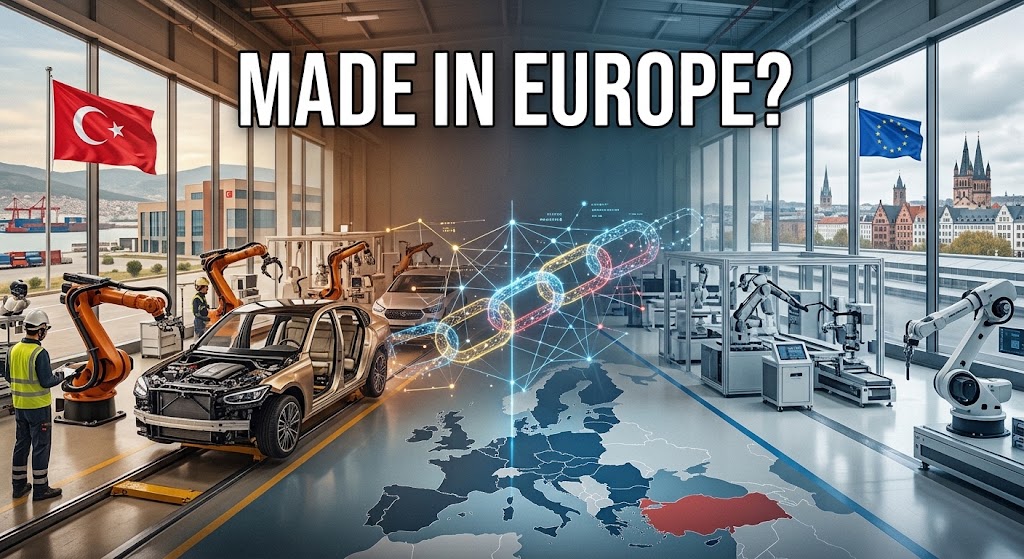
The debate surrounding “Made in Europe” is therefore about much more than the geographical origin of a product. It concerns economic influence, political trust, industrial competitiveness and the future position of Türkiye within the European manufacturing ecosystem.
1. What Does “Made in Europe” Actually Mean?
The expression “Made in Europe” is increasingly being used to describe policies that prioritise European manufacturing in public procurement, industrial subsidies, financial support schemes and strategic investment programmes.
The objective is relatively straightforward: European public money and industrial incentives should contribute more directly to strengthening Europe’s own manufacturing capabilities.
The European Union is facing several structural challenges:
- Increasing competition from Chinese industrial manufacturers.
- Dependence on external suppliers for critical technologies and components.
- High energy and production costs.
- Pressure on traditional automotive manufacturing.
- The need to accelerate the transition towards electric mobility.
- Growing geopolitical uncertainty and supply-chain vulnerabilities.
The EU’s Industrial Accelerator Act seeks to address these challenges by encouraging industrial investment and production within Europe.
The proposal identifies strategic areas including energy-intensive industries, net-zero technologies and automotive manufacturing.
The Commission’s broader ambition is to increase manufacturing’s contribution to EU GDP to 20% by 2035, compared with 14.3% in 2024.
However, “Made in Europe” should not be confused with a universal trade restriction or a new customs border.
The proposal primarily concerns eligibility for certain public procurement procedures and public support mechanisms. It does not automatically mean that products manufactured outside the EU will be prohibited from entering European markets.
This distinction is essential when evaluating the potential consequences for Türkiye.
2. The Legal Question: Is Türkiye Included or Excluded?
The current debate involves two important developments that should not be treated as identical.
The European Commission’s Industrial Accelerator Act proposal
The original Commission proposal, published on 4 March 2026, contains provisions that are particularly important for countries with customs union agreements with the EU.
Under Articles 8, 9 and 10, products originating in countries with which the EU has established a customs union, including Türkiye, are deemed equivalent to Union-origin products for the purposes of certain proposed origin requirements.
However, this equivalence is not unconditional.
The proposal also gives the European Commission the power to adopt delegated acts that could exclude a third country, wholly or partially, from this treatment. Criteria include a lack of reciprocity and the avoidance of strategic dependencies.
In other words, the original proposal provides a legal route for recognising Türkiye’s customs union relationship, but it also contains a mechanism that could limit that recognition.
The Franco-German automotive agreement
A separate development has made the debate more complicated.
On 16 October 2026, France and Germany announced a joint approach to the future of the European automotive industry.
Their proposal seeks to strengthen European vehicle production, investment and supply-chain resilience.
The discussions have included a narrower interpretation of European origin for automotive-related incentives, potentially allowing certain countries that participated in the EU single market on 1 January 2020 to qualify under specific conditions.
The United Kingdom and Norway have been discussed in this context.
Türkiye, despite its customs union relationship with the EU, risks being left outside this narrower automotive framework.
This creates a significant inconsistency from Türkiye’s perspective: a country deeply integrated into European automotive production could receive less favourable treatment than some countries with different forms of economic integration.
Nevertheless, the Franco-German position is not the final EU-wide legislation. The Industrial Accelerator Act remains subject to the ordinary legislative process involving the European Parliament and the Council.
The final legal outcome may therefore differ from the current political proposals.
3. How Did Türkiye Become So Closely Connected to European Industry?
To understand the current situation, it is necessary to look back at the historical development of EU–Türkiye relations.
The relationship did not begin with the current automotive industry or the latest trade agreements. It developed through several decades of economic and political integration.
1963: The Ankara Agreement
Türkiye and the European Economic Community signed the Ankara Agreement in 1963.
The agreement established a framework for closer economic cooperation and the gradual development of a customs union.
It also reflected Türkiye’s long-term objective of becoming part of the European integration process.
1987: Application for European Community membership
Türkiye formally applied for membership of the European Economic Community in 1987.
The application represented a major political and economic commitment to European integration.
However, membership remained a long-term objective rather than an immediate possibility.
1995–1996: The Customs Union
The Customs Union became a reality through Decision 1/95 and entered into force on 31 December 1995.
It established free circulation for covered industrial goods and required Türkiye to align with relevant parts of the EU’s commercial and technical regulatory framework.
The arrangement helped create a much closer relationship between Turkish manufacturers and European industrial companies.
Automotive production, machinery, electrical equipment, textiles and numerous other manufacturing activities benefited from this integration.
1999: Türkiye becomes an EU candidate country
At the Helsinki European Council in December 1999, Türkiye was officially recognised as a candidate country for EU membership.
This created expectations of deeper political, legal and economic integration.
2005: Accession negotiations begin
Formal membership negotiations began in October 2005.
During the early years of the process, Türkiye introduced several reforms related to the judiciary, public administration, human rights and economic governance.
European integration became an important reference point for domestic reforms and international investment expectations.
However, the process gradually lost momentum.
2016–2018: A major political turning point
The attempted coup in July 2016 and the subsequent state of emergency marked a major turning point in Türkiye’s domestic political environment.
The European Union raised serious concerns about the independence of the judiciary, fundamental rights, democratic institutions and the concentration of executive power.
In June 2018, the Council of the European Union concluded that Türkiye’s accession negotiations had effectively come to a standstill.
The modernisation of the Customs Union also lost political momentum.
This was one of the most important turning points in the relationship.
Türkiye continued to trade extensively with the EU, but the political framework that had supported deeper integration became increasingly inactive.
4. Erdoğan’s Political Approach and Its Impact on European Relations
It is difficult to analyse Türkiye’s current position in Europe without examining the political approach adopted under President Recep Tayyip Erdoğan.
This is not an argument that all difficulties in EU–Türkiye relations were created by one political leader. The relationship has also been shaped by European political resistance, the Cyprus dispute, competing national interests and changing geopolitical priorities.
Nevertheless, the transformation of Türkiye’s domestic political system under Erdoğan has played a significant role in the deterioration of mutual trust.
From European integration to centralised political power
During the early years of Erdoğan’s leadership, European Union membership was presented as an important strategic objective.
Reforms aimed at meeting EU membership criteria contributed to changes in the legal system, public administration and economic environment.
Over time, however, the political direction changed.
The transition to the presidential system in 2018 concentrated executive authority and weakened several traditional mechanisms of institutional oversight.
Concerns about judicial independence, the separation of powers, media freedom and the treatment of political opposition became increasingly prominent in European assessments.
The European Commission’s 2025 Türkiye Report continued to identify serious shortcomings in the independence of the judiciary and the rule of law.
The European Parliament also stated in June 2026 that the accession process could not be restarted without tangible progress on democratic standards and the rule of law.
For European policymakers, this is not simply an ideological disagreement. It affects the question of whether Türkiye can be considered a predictable and trusted long-term partner.
Industrial investment depends on more than labour costs, infrastructure and geographical location. Investors also evaluate legal certainty, regulatory stability, contract enforcement and institutional independence.
A transactional approach to foreign policy
Another important characteristic of Erdoğan’s political approach has been the use of Türkiye’s geopolitical position as a source of negotiating leverage.
Türkiye occupies a strategically important position between Europe, the Middle East, the Black Sea and the Caucasus.
Its role in NATO, migration management, regional security, energy transportation and the conflict surrounding Ukraine gives Ankara considerable geopolitical importance.
The Turkish government has frequently pursued a foreign policy that seeks to maintain relationships with several competing international actors simultaneously.
This approach can provide diplomatic flexibility. However, it can also create uncertainty among European partners when strategic interests and political expectations diverge.
The relationship with Russia, disagreements over Syria, the Eastern Mediterranean and the Cyprus question have all contributed to the wider trust problem.
Rather than building a consistently institutionalised relationship with the EU, cooperation has increasingly become dependent on individual negotiations and short-term political interests.
This transactional approach has consequences.
Geopolitical importance can help a country negotiate with powerful partners, but it cannot permanently replace institutional trust, predictable legislation and economic alignment.
The cost of postponing institutional reforms
One of the most significant consequences of political centralisation is that economic policy and institutional confidence become more closely associated with political decisions.
For international manufacturers, long-term investment decisions require confidence that regulations, judicial processes and economic policies will remain predictable.
The problem is not limited to European companies.
Any international investor considering a major manufacturing facility, research centre or technology development programme must evaluate these conditions.
Türkiye’s industrial infrastructure remains valuable, but institutional uncertainty can reduce the attractiveness of that infrastructure.
The European relationship therefore involves two different questions:
Can Türkiye remain an important manufacturing partner?
And can Türkiye become a sufficiently trusted strategic partner to receive the same long-term industrial advantages as Europe’s closest economic partners?
The first question has largely been answered by decades of industrial cooperation. The second remains politically unresolved.
5. The European Union Also Has Responsibility
A balanced analysis must also examine the decisions made by the European Union.
It would be inaccurate to describe the current situation as the result of Turkish domestic politics alone.
European governments have also made decisions that have limited the development of the relationship.
The Cyprus dispute
The Cyprus question remains one of the most significant obstacles to Türkiye’s EU accession process.
Türkiye does not recognise the Republic of Cyprus, which is an EU member state.
The EU has repeatedly stated that Türkiye must fulfil its obligations under the Additional Protocol to the Ankara Agreement concerning the Republic of Cyprus.
The European Commission states that eight accession chapters cannot be opened and no chapter can be provisionally closed until this issue is addressed.
This creates a structural political obstacle that cannot be resolved through industrial cooperation alone.
The lack of Customs Union modernisation
The existing Customs Union has become increasingly outdated.
It does not cover important areas such as services and public procurement, and it was not designed for the current global environment of digital trade, electric mobility, advanced manufacturing and strategic supply chains.
Modernisation discussions have been delayed for years.
The EU has also used progress in bilateral political relations as a condition for advancing the process.
At the same time, the existing Customs Union creates an asymmetry.
Türkiye aligns with important elements of EU commercial policy but does not participate in EU decision-making as a member state.
When the EU negotiates trade agreements with third countries, Türkiye can face commercial consequences without having an equivalent role in shaping the negotiations.
This is an important structural weakness of the current arrangement.
Strategic protectionism and European competitiveness
The EU has legitimate reasons to strengthen its industrial base.
However, industrial protection policies can also create unintended consequences.
If European manufacturers are encouraged to relocate production from closely integrated partner countries into the EU, the result may be higher costs, duplicated investment and fragmented supply chains.
A policy designed to strengthen European competitiveness could therefore weaken the wider European industrial ecosystem.
This is particularly important in sectors where production networks have developed over several decades.
6. Why Türkiye’s Automotive Industry Is Particularly Exposed
The automotive industry is perhaps the clearest example of the economic relationship between Türkiye and Europe.
Türkiye has become a major manufacturing base for international automotive companies.
European brands and suppliers operate production facilities, engineering centres and supplier networks throughout the country.
The industry includes vehicle assembly, engines, transmissions, chassis systems, electronics, interior components, safety systems and advanced manufacturing technologies.
According to the Turkish Investment Office, the automotive ecosystem includes approximately 1,100 component suppliers. Vehicle manufacturers have localisation rates ranging from 50% to 70%, depending on the company and production operation.
Around 75% of Türkiye’s vehicle production was destined for international markets in 2025.
The European market is therefore not simply an export destination. It is a central part of the industry’s production model.
The European Policy Centre reported that 73.7% of Türkiye’s automotive exports went to the EU during the first nine months of 2026.
This concentration creates a substantial exposure to changes in European industrial policy.
What could happen if Türkiye is excluded from automotive preferences?
The most immediate risk is not the introduction of a new customs tariff.
The greater concern is the potential loss of equal access to specific incentives, public support mechanisms and procurement opportunities.
For example, imagine a European automotive manufacturer evaluating two possible production investments.
One facility is located in an EU member state. The other is located in Türkiye.
If a future incentive programme rewards European-origin production and the Turkish facility is not recognised as eligible, the EU-based facility could receive a financial advantage.
Even if the Turkish factory has competitive labour costs, experienced workers and an established supplier network, the incentive structure could influence the final investment decision.
This could gradually affect:
- New vehicle production allocations.
- Electric vehicle and battery investments.
- Supplier contracts.
- Engineering and research activities.
- Local component production.
- Future factory expansion decisions.
The effects may not appear immediately.
However, automotive investment decisions often influence production capacity for ten to twenty years.
A policy that changes the economics of new investment today could influence the geographical distribution of manufacturing throughout the next decade.
7. The Economic Consequences Could Extend Beyond Automotive Manufacturing
Although automotive manufacturing has become the centre of the current debate, the Industrial Accelerator Act covers a broader range of strategic industrial sectors.
These include energy-intensive industries and technologies associated with Europe’s industrial transformation.
Türkiye could therefore face wider challenges if similar origin requirements become more restrictive in other sectors.
Steel and aluminium
Steel and aluminium are essential materials for automotive production, construction, machinery and infrastructure.
If European public support or procurement programmes favour European-origin materials, Turkish producers could face disadvantages when competing for certain contracts.
This would be particularly important for manufacturers supplying European automotive and industrial customers.
Cement and construction materials
Cement production is energy-intensive and increasingly affected by carbon-related regulation.
As the EU strengthens its decarbonisation policies, the relationship between carbon performance, product origin and eligibility for public support could become increasingly important.
Türkiye’s cement industry would need to remain competitive not only on price, but also on emissions performance and regulatory compliance.
Chemicals and industrial materials
Chemical manufacturers supply essential inputs to automotive, electronics, machinery, construction and other industries.
If strategic industrial policies begin favouring locally produced materials, companies outside the preferred origin framework could experience changes in investment and procurement opportunities.
Machinery and industrial equipment
Türkiye has a strong manufacturing base in machinery and industrial equipment.
The sector is particularly sensitive to European investment decisions because machine manufacturers often operate through integrated supplier and customer relationships.
If European industrial incentives increasingly favour production within the EU, future machinery investments could be directed towards alternative locations.
8. The Financial Impact: Trade, Investment and Employment
The scale of the economic relationship explains why the issue is so important.
According to the Council of the European Union, bilateral trade in goods exceeded €217 billion in 2025.
The EU remains Türkiye’s largest trading partner, accounting for approximately 42.7% of Turkish goods exports in 2025 according to European Commission trade statistics.
Türkiye is also the EU’s fifth-largest trading partner in goods.
These figures demonstrate that the relationship is not a minor regional trade arrangement.
It is one of the most important industrial and commercial relationships between the EU and a neighbouring economy.
The possible consequences of a restrictive “Made in Europe” framework include several interconnected effects.
1. Reduced attractiveness for new foreign investment
International companies compare production locations based on total operating costs, market access, logistics, productivity, skilled labour, taxation and regulatory conditions.
If production within the EU receives additional financial support, Türkiye could become relatively less attractive for certain investment projects.
This does not mean that companies will immediately leave Türkiye.
Existing factories, established suppliers, trained workers and production infrastructure represent significant investments that cannot easily be replaced.
The greater risk concerns future investment decisions.
2. Pressure on supplier networks
Thousands of Turkish manufacturers supply components to European industrial companies.
If European customers begin changing sourcing strategies to satisfy new origin requirements, Turkish suppliers could face pressure to relocate part of their production, establish EU facilities or lose certain contracts.
Smaller suppliers would be particularly vulnerable because they often have less financial capacity to establish production facilities in multiple countries.
3. Employment and regional industrial development
Automotive and manufacturing activities support employment well beyond the factories themselves.
They generate demand for logistics, maintenance, tooling, industrial software, engineering services, packaging, metal processing and technical education.
A reduction in new manufacturing investment could therefore affect regional industrial ecosystems.
The impact would not necessarily be limited to direct factory employment.
4. Reduced technological development
Manufacturing investment is closely connected to research and development.
When companies establish new production facilities, they frequently invest in process engineering, automation, product development, testing and digital manufacturing technologies.
If future investment increasingly favours other countries, Türkiye could lose opportunities to participate in the next generation of industrial technologies.
This is particularly important in electric vehicles, battery systems, power electronics, robotics and advanced materials.
9. Türkiye’s Industrial Strength Is Not the Problem
Türkiye has several important advantages that make it a valuable European manufacturing partner.
These include:
- Geographical proximity to major European industrial centres.
- Established automotive and machinery production infrastructure.
- A large network of component manufacturers.
- Experienced engineering and manufacturing personnel.
- Existing supplier relationships with international OEMs.
- Developed logistics connections with European markets.
- Experience in European technical standards and industrial requirements.
Türkiye’s industrial ecosystem did not develop independently of Europe.
It developed through decades of cooperation, investment and technology transfer.
This is why excluding Türkiye from certain industrial preferences could create problems for European manufacturers as well.
European companies have invested in Türkiye, established factories and built supply chains around its manufacturing capabilities.
If Turkish production is treated less favourably, European companies could also face higher costs and additional supply-chain complexity.
The question is therefore not simply whether Türkiye benefits from European industrial policy.
It is also whether Europe benefits from maintaining the industrial relationship it has already built with Türkiye.
10. What Should Türkiye Do Now?
The current debate should not be approached solely as a diplomatic disagreement.
Türkiye needs a comprehensive strategy that addresses both its immediate industrial interests and the deeper political issues affecting its relationship with Europe.
1. Secure recognition of the Customs Union
Türkiye should seek explicit recognition of its Customs Union status in the final Industrial Accelerator Act and any related automotive legislation.
The objective should be clear, predictable and legally enforceable treatment.
Temporary political assurances are not sufficient for companies making long-term investment decisions.
2. Modernise the Customs Union
The existing Customs Union needs to reflect the structure of the modern economy.
A modern agreement should address services, digital trade, public procurement, industrial standards, sustainable manufacturing and the changing structure of global supply chains.
It should also provide Türkiye with a more effective mechanism for participating in discussions that directly affect its commercial interests.
3. Rebuild institutional confidence
Türkiye must address concerns regarding judicial independence, legal predictability, institutional transparency and democratic governance.
These issues are not only relevant to EU membership.
They are directly connected to international investment, financing costs and long-term industrial competitiveness.
4. Develop a long-term industrial diplomacy strategy
Turkish diplomacy should work more closely with European manufacturers, industry associations, regional governments and policymakers.
The strongest argument for Türkiye is not simply that it wants to be included.
It is that European production networks have already become dependent on Turkish manufacturing capabilities.
This argument should be supported by measurable evidence, investment data and sector-specific economic analysis.
5. Accelerate industrial transformation
Türkiye should not depend exclusively on its current cost and production advantages.
The next generation of industrial competition will increasingly be determined by:
- Electric vehicle technologies.
- Battery manufacturing.
- Semiconductor and power electronics supply chains.
- Artificial intelligence in manufacturing.
- Industrial robotics and automation.
- Digital twins and advanced simulation.
- Low-carbon steel and aluminium.
- Energy efficiency and renewable electricity.
The country needs to move towards higher-value engineering and technology development rather than relying primarily on traditional manufacturing capacity.
11. Three Possible Scenarios for the Future
The final shape of the European industrial framework remains uncertain. However, three broad scenarios can help explain the potential consequences.
Scenario A: Türkiye receives equal treatment
The EU recognises Türkiye’s Customs Union status and allows eligible Turkish production to qualify under the relevant European industrial preference mechanisms.
This would preserve much of the existing automotive and manufacturing integration.
It would also provide greater certainty for European companies considering future investment in Türkiye.
Scenario B: Partial inclusion with sector-specific restrictions
Türkiye receives recognition in some industrial areas but faces restrictions in others, particularly in automotive-related incentive programmes.
This could create a fragmented industrial relationship.
Manufacturers would need to evaluate production locations and investment decisions separately for each sector and support scheme.
Scenario C: A restrictive European-origin framework
The EU adopts a narrower approach that excludes Türkiye from important industrial preference mechanisms.
This would increase the risk of investment diversion, supplier restructuring and reduced competitiveness in selected European markets.
The consequences could extend beyond automotive manufacturing if similar policies are applied to other strategic industries.
However, even under this scenario, Türkiye would not automatically lose its existing Customs Union relationship or its general ability to export industrial goods to the EU.
The distinction between market access and eligibility for industrial preferences would remain important.
12. The Bigger Question: Is Türkiye Still Part of Europe’s Industrial Future?
The “Made in Europe” debate exposes a contradiction at the heart of EU–Türkiye relations.
For more than thirty years, European companies have treated Türkiye as an important manufacturing location.
Factories have been established, supplier networks have developed, products have been engineered and industrial capabilities have grown around this relationship.
Yet, political trust has weakened.
Türkiye’s domestic political transformation under Erdoğan has contributed to the deterioration of relations, particularly through concerns about democratic institutions, judicial independence and the concentration of executive authority.
At the same time, the European Union has not successfully developed a long-term framework that fully reflects the economic integration already achieved.
The result is a relationship in which economic cooperation remains substantial while political cooperation is increasingly limited.
This situation is not sustainable in the long term.
Europe wants to strengthen its industrial independence, but industrial independence does not necessarily require excluding reliable manufacturing partners.
Türkiye wants to remain part of Europe’s industrial future, but geographical proximity and existing trade relationships cannot permanently compensate for a lack of institutional trust.
The future of the relationship will depend on decisions made in both Ankara and Brussels.
Conclusion: Industrial Competitiveness Requires More Than Geographical Borders
The future of European manufacturing will not be determined only by where products are assembled.
It will also depend on engineering expertise, technological innovation, reliable supply chains, industrial investment, skilled labour and the ability to develop competitive products.
Türkiye has spent decades becoming part of Europe’s manufacturing ecosystem.
Losing access to the advantages associated with this relationship would be economically damaging for Turkish industry, but it could also create additional costs and supply-chain risks for European manufacturers.
The responsibility for avoiding this outcome is shared.
Türkiye needs stronger institutions, predictable economic governance and a more consistent long-term European strategy.
The EU needs to recognise that strategic autonomy and industrial competitiveness cannot be achieved by ignoring the economic relationships that already exist.
The most important question is no longer whether Türkiye is geographically part of Europe. It is whether Türkiye will remain economically and strategically part of Europe’s industrial future.
Research and analysis prepared for The CAD Verse. This article reflects the policy and legislative situation as of 3 November 2026. The Industrial Accelerator Act and the automotive-related European-origin proposals remain subject to legislative negotiations.
Sources and Further Reading
- European Commission – Industrial Accelerator Act, COM(2026)100, 4 March 2026.
- European Parliament – Commission answer on EU-origin status for Turkish products, E-000926/2026, 24 April 2026.
- European Parliament Research Service – Industrial Accelerator Act, PE 789.300, May 2026.
- European Commission – Türkiye: EU relations and accession process.
- Council of the European Union – EU–Türkiye Trade: Facts and Figures, 2025 data.
- European Commission – Türkiye Report 2025.
- European Policy Centre – “Made in Europe”: Is the EU leaving Turkey out of its ambitions for strategic autonomy?, 22 October 2026.
- Centre for European Reform – The EU and Türkiye: Can shared threats overcome mutual suspicion?, 3 July 2026.
- Reuters – France and Germany’s proposed approach to automotive emissions and European-origin status, October 2026.
- European Automobile Manufacturers’ Association (ACEA) – EU–Türkiye Vehicle Trade, July 2026.