How Hybrid Manufacturing Connects Additive and Subtractive Production
Industrial manufacturing is increasingly moving toward production strategies that combine different technologies rather than relying on a single manufacturing process.
Metal additive manufacturing can produce complex geometries and application-specific components, while CNC machining provides the dimensional accuracy and surface finish required for many precision applications.
Eplus3D and Hofmann CNC have announced a collaboration designed to combine these capabilities within an integrated manufacturing workflow.
Connecting Metal Powder Bed Fusion and CNC Machining
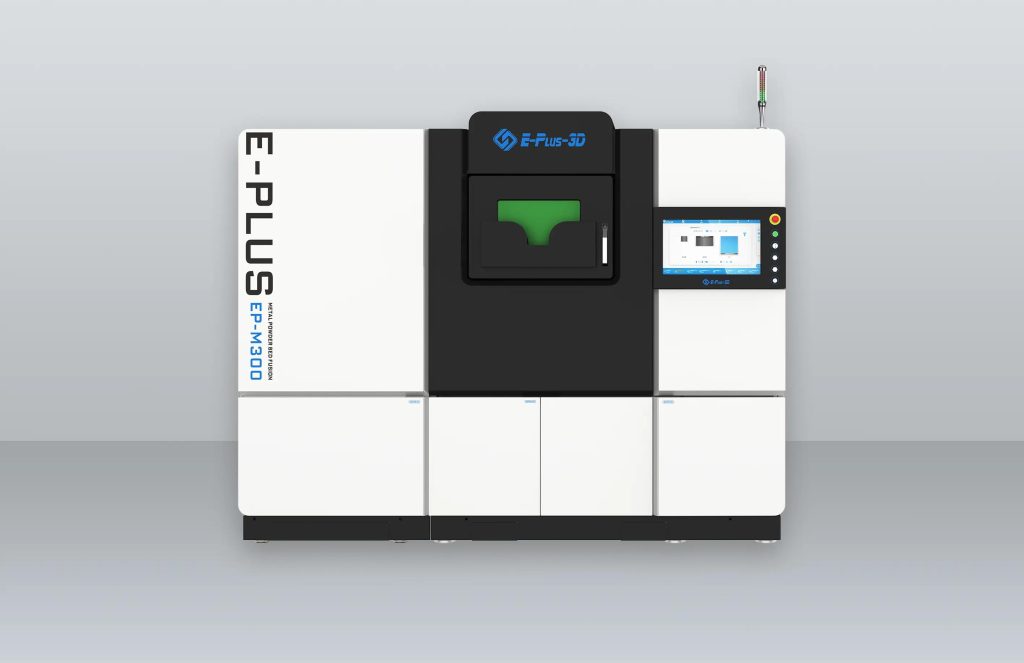
As part of the collaboration, Hofmann CNC has invested in an Eplus3D EP-M300 dual-laser metal powder bed fusion system.
The investment establishes local metal additive manufacturing and application capabilities alongside Hofmann CNC’s existing precision machining expertise in Germany.
The partnership focuses on combining metal powder bed fusion (PBF) with conventional machining to support more complete component production.
Why Combine Additive and Subtractive Manufacturing?
Additive manufacturing builds components layer by layer. This approach provides significant geometric freedom and can support features that would be difficult or expensive to produce using conventional machining alone.
However, many industrial components still require precision finishing after printing.
Typical post-processing requirements may include:
- Machining of critical interfaces
- Precision hole and bore finishing
- Surface finishing
- Datum and reference surface preparation
- Dimensional correction
- Removal of support structures
CNC machining can address these requirements after the additive manufacturing process.
The combination allows engineers to use additive manufacturing for geometric complexity while retaining subtractive machining for precision-critical features.
The Role of the EP-M300 System
The EP-M300 is a dual-laser metal powder bed fusion system from Eplus3D.
The system is intended for industrial metal additive manufacturing applications where process productivity and component complexity are important considerations.
By adding the system to its existing production capabilities, Hofmann CNC can combine printed component geometry with its established machining operations.
This creates opportunities for producing components that benefit from both processes.
Engineering Considerations in Hybrid Manufacturing
Combining additive manufacturing and CNC machining requires careful planning.
The component must be designed with both manufacturing processes in mind.
Engineers need to consider:
- Build orientation and support strategy
- Material selection and process parameters
- Allowances for machining stock
- Datum and fixture design
- Thermal distortion and residual stress
- Accessibility of machining features
- Inspection and dimensional verification
For example, a printed component may contain complex internal passages that cannot be machined conventionally, while its mounting faces and bearing interfaces can be finished using CNC machining.
This approach can provide a practical balance between design freedom and precision.
Potential Industrial Applications
Hybrid additive and subtractive manufacturing can be useful in applications where complex geometry and precision interfaces are both required.
Potential areas include:
- Aerospace components
- Industrial machinery
- Energy equipment
- Tooling and mould components
- Specialised production equipment
- High-value replacement parts
The economic benefits depend on component geometry, material, production volume, machine utilisation and post-processing requirements.
Metal 3D printing is not automatically more cost-effective than conventional manufacturing. The strongest applications are usually those where geometric complexity, material utilisation or production flexibility provides a measurable advantage.
Toward More Integrated Manufacturing Workflows
The collaboration between Eplus3D and Hofmann CNC reflects a broader industrial trend: connecting additive manufacturing with established machining processes.
Rather than treating 3D printing as a replacement for CNC machining, manufacturers can use both technologies as complementary stages within a single production strategy.
For engineers, this creates new opportunities to design components around the strengths of each process.
The future of hybrid manufacturing will depend on how effectively companies integrate digital design, build preparation, simulation, machining and inspection into one coordinated workflow.
Source: Eplus3D and Hofmann CNC collaboration announcement, October 2026.