Higher Light Intensity and Improved Resolution Expand the Possibilities of Lithography-Based Ceramic Manufacturing
Introduction
Additive manufacturing is widely associated with polymer and metal components. However, advanced ceramic 3D printing is becoming increasingly important in industries where high-temperature resistance, electrical insulation, wear resistance, and thermal performance are essential.
Ceramic components are used in aerospace, medical technology, electronics, energy systems, and industrial manufacturing. Producing complex ceramic geometries through conventional methods can be challenging, particularly when intricate internal channels or specialized structures are required.
On October 28, 2026, Lithoz announced a new optional upgrade for its CeraFab System S65 and S65 Medical printers: the CeraFab S65 Performance Pack.
Based on a 4K projection system, the upgrade is designed to increase light intensity and improve printing resolution in Lithography-based Ceramic Manufacturing (LCM).
1. What Is Lithography-Based Ceramic Manufacturing?
Lithography-based Ceramic Manufacturing, or LCM, is an additive manufacturing process developed for producing high-precision ceramic components.
The process uses a light-sensitive ceramic suspension, commonly called a ceramic slurry.
This suspension contains ceramic particles distributed within a photosensitive material. During printing, projected light selectively hardens specific regions of the material.
The component is built layer by layer.
After printing, the green part undergoes additional processing, typically including cleaning, debinding, and sintering.
During sintering, the component is heated under controlled conditions to remove the remaining binder and consolidate the ceramic material.
The final result is a dense ceramic component with properties determined by the selected material, printing parameters, and post-processing conditions.
LCM is particularly useful for manufacturing complex ceramic geometries that are difficult or expensive to produce using conventional machining and forming processes.
2. What Is the CeraFab S65 Performance Pack?
Lithoz introduced the Performance Pack as an optional upgrade based on a 4K projection system.
The first announced compatibility covers:
- CeraFab System S65.
- CeraFab System S65 Medical.
The upgrade focuses on two main technical improvements: increased light intensity and improved optical resolution.
According to Lithoz, the Performance Pack provides the following changes:
| Parameter | Previous specification | With Performance Pack |
|---|---|---|
| Light intensity | 60 mW/cm² | Approximately 120 mW/cm² |
| Resolution | 40 µm | 25 µm |
| Projection system | Previous configuration | 4K system |
These changes are intended to expand the capabilities of the LCM process, particularly when working with demanding ceramic materials.
3. Why Does Higher Light Intensity Matter?
In light-based additive manufacturing, the material must receive sufficient optical energy to cure correctly.
This becomes particularly challenging when processing dark ceramic materials.
Some ceramic suspensions absorb or scatter more light than others. As a result, achieving consistent curing through the required layer thickness can become difficult.
Increasing light intensity can help deliver more optical energy to the material and reduce some of these processing challenges.
Lithoz states that the Performance Pack doubles the light intensity from 60 to approximately 120 mW/cm².
This improvement is particularly relevant to the processing of dark ceramic suspensions, where light penetration and curing behavior can limit manufacturing performance.
However, higher light intensity does not automatically mean that every material can be printed twice as fast. Actual process performance depends on material composition, layer thickness, exposure settings, geometry, and post-processing requirements.
4. What Does Improving Resolution from 40 µm to 25 µm Mean?
Resolution is another important factor in ceramic additive manufacturing.
The announced upgrade improves the CeraFab S65 resolution from 40 µm to 25 µm.
In practical terms, this means the projected image can represent smaller features across the printing area.
A smaller pixel size can help reproduce finer geometric details and improve the definition of complex structures.
This can be particularly relevant for:
- Fine channels and internal features.
- Thin ceramic walls.
- Detailed surface geometries.
- Small precision components.
- Complex lattice structures.
Lithoz describes this change as a 60% increase in dpi, from 635 dpi to 1,016 dpi.
It is important to distinguish optical resolution from final dimensional accuracy. The final component is also influenced by material behavior, shrinkage during sintering, exposure conditions, and process calibration.
5. Why Is Advanced Ceramic 3D Printing Important?
Technical ceramics offer material properties that are difficult to achieve with conventional polymers and many metals.
Depending on the material, ceramic components can provide:
- High-temperature resistance.
- Electrical insulation.
- Wear and corrosion resistance.
- High hardness.
- Thermal stability.
- Specialized dielectric properties.
- Biocompatibility in selected medical applications.
These properties make ceramic additive manufacturing relevant to several industries.
Aerospace
Ceramic components can support demanding thermal and mechanical applications. Complex ceramic geometries may also be useful in specialized propulsion and thermal management systems.
Medical Technology
Bioceramics are used in selected medical and dental applications, including implant-related components and structures requiring controlled material properties.
Electronics and Semiconductor Manufacturing
Advanced ceramics can be used in electrical insulation, thermal management, and specialized semiconductor equipment components.
Energy
Ceramic structures are relevant to high-temperature energy systems, fuel cells, and other applications where thermal and chemical stability are important.
6. Industrial Applications Demonstrated by Lithoz
Alongside the Performance Pack announcement, Lithoz highlighted several ceramic manufacturing applications planned for presentation at Formnext 2026.
These examples illustrate the range of geometries and material systems being explored through LCM technology.
Aluminium Nitride Cooling Plates
Lithoz highlighted the production of 116 aluminium nitride cooling plates on a single CeraFab S320 platform.
Aluminium nitride is particularly relevant to thermal management because of its high thermal conductivity combined with electrical insulation properties.
Ceramic Turbine Casting Cores
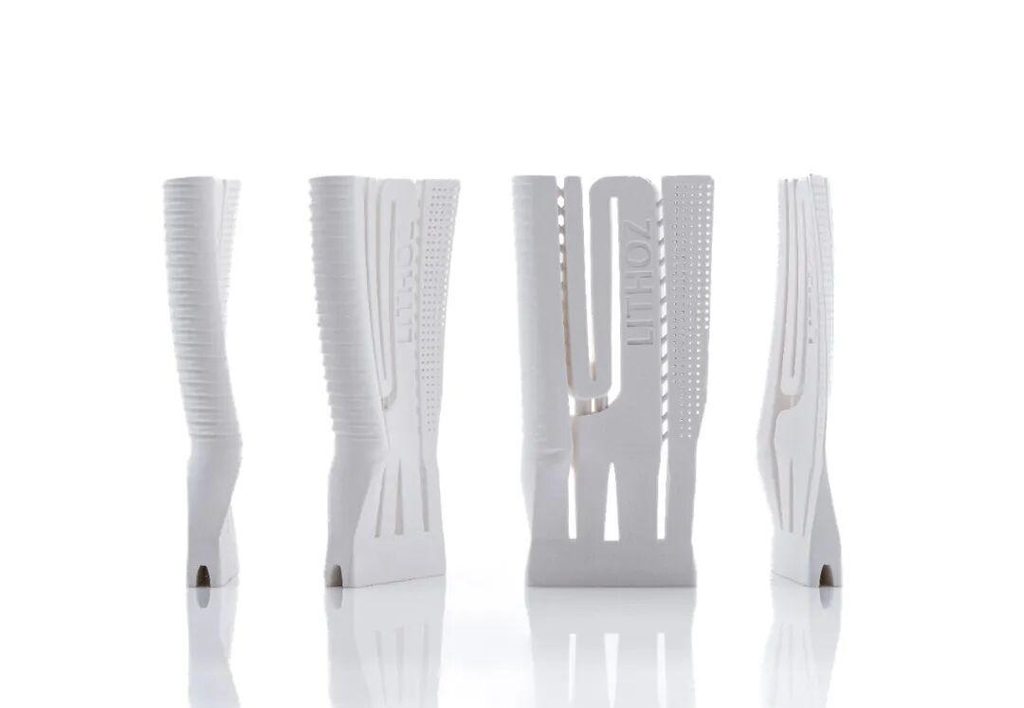
A casting core demonstrated by German Access e.V. illustrates how ceramic additive manufacturing can support the production of complex internal geometries in turbine components.
Such cores can help create intricate cooling passages that would be difficult to manufacture through conventional processes.
Alumina Cooling Plates
Lithoz also presented alumina cooling plates featuring molybdenum-manganese metallization developed with Sigma Advanced Materials.
This demonstrates the combination of ceramic manufacturing and additional surface or functional processing.
Patient-Specific Bioceramics
Hydroxyapatite spinal cages developed with Spherene illustrate the potential of advanced ceramic geometries in patient-specific medical applications.
These examples are application demonstrations, not evidence that every geometry or material is already available as a standardized production solution.
7. What Does the Upgrade Mean for Manufacturing?
The CeraFab S65 Performance Pack is important because it addresses two process parameters that directly influence light-based ceramic manufacturing: optical intensity and resolution.
Higher light intensity can expand the range of ceramic suspensions that can be processed effectively.
Improved resolution can support finer geometric features.
Together, these improvements may help manufacturers explore applications that require more demanding combinations of material behavior and geometric complexity.
Nevertheless, production performance must be evaluated for each material and component.
Print quality, dimensional accuracy, shrinkage, mechanical properties, and post-processing results remain essential validation criteria.
8. Limitations and Technical Considerations
The Performance Pack is an optional upgrade, not a universal improvement applicable to every ceramic 3D printer.
Its initial availability is announced for the CeraFab System S65 and S65 Medical.
Manufacturers should also consider:
- Compatibility with the selected ceramic material.
- Exposure parameters and layer thickness.
- Optical calibration.
- Green-part handling.
- Debinding and sintering conditions.
- Final dimensional tolerances.
- Mechanical and thermal validation.
A higher-resolution projection system does not remove the dimensional changes that can occur during debinding and sintering.
Likewise, improved light intensity does not eliminate the need for material-specific process development.
Conclusion
The CeraFab S65 Performance Pack demonstrates how improvements in optical technology can expand the capabilities of ceramic additive manufacturing.
By increasing light intensity from 60 to approximately 120 mW/cm² and improving resolution from 40 µm to 25 µm, Lithoz aims to support more demanding ceramic processing applications.
The development is particularly relevant to dark ceramic materials and components requiring fine geometric details.
As advanced ceramics become increasingly important in aerospace, medical technology, electronics, and energy systems, improvements in additive manufacturing processes could help engineers produce components with geometries that are difficult to achieve through conventional methods.
The future of ceramic additive manufacturing will depend not only on new materials, but also on more precise and controllable ways of processing them.
References