How AWS and NVIDIA Are Building an Integrated Development Environment for the Next Generation of Intelligent Robots
Introduction
Artificial intelligence is moving beyond computers, smartphones, and digital applications. It is increasingly being developed for systems that interact with the physical world.
Robots, autonomous machines, industrial automation systems, and intelligent vehicles must do more than process information. They need to perceive their surroundings, understand physical conditions, make decisions, and perform actions safely.
This emerging field is commonly described as Physical AI.
On October 7, 2026, Amazon Web Services (AWS) introduced the Physical AI Toolchain, a collection of reference architectures, infrastructure-as-code resources, and deployment automation designed to support the complete development lifecycle of physical AI systems.
The toolchain integrates AWS cloud services with NVIDIA’s robotics software ecosystem, connecting simulation, synthetic data generation, AI training, validation, and deployment.
1. What Is Physical AI?
Traditional artificial intelligence often works with digital information such as text, images, audio, and structured data.
Physical AI extends this concept to systems that operate in the real world.
A robot in a manufacturing facility, for example, must:
- Receive information from cameras and sensors.
- Recognize objects and understand their environment.
- Calculate how to move.
- Interact with physical components.
- Respond to changing conditions.
- Operate within safety and timing constraints.
Unlike a conventional software application, a physical AI system must continuously interact with its environment.
A robot may perform well in a controlled laboratory test but fail when lighting conditions change, an object is positioned differently, or an unexpected obstacle appears.
This makes development, simulation, and validation particularly important.
2. Why Does Physical AI Need a Dedicated Toolchain?
Developing an intelligent robot requires several different technologies.
A typical workflow may include collecting real-world data, generating synthetic training environments, training AI models, testing behavior in simulation, and deploying optimized models to physical hardware.
These stages often require different software tools and computing resources.
AWS identifies five major challenges.
Compute Heterogeneity
Physical AI development requires different types of computing resources.
Large GPU clusters may be needed for model training, while simulation requires substantial GPU capacity and physical robots need efficient edge computing hardware for real-time operation.
Artifact Management
A robotics project contains more than AI model files.
It may include datasets, simulation environments, robot descriptions, calibration information, training containers, evaluation results, and deployment packages.
Managing these assets consistently is important for reproducibility.
Validation Depth
A robot must be tested progressively, from simulation to supervised real-world operation and controlled production deployment.
A successful simulation does not automatically guarantee safe real-world performance.
Data Economics
Collecting real-world robot data can be expensive and time-consuming.
Synthetic data and simulation can help expand training scenarios without requiring every situation to be reproduced physically.
Control Path Placement
Cloud computing is useful for training and coordinating large workflows. However, real-time robot control must respect latency, power, and safety requirements.
For safety-critical physical actions, the control loop must operate on suitable local hardware rather than depending on a remote cloud response.
3. What Is Included in the AWS Physical AI Toolchain?
The toolchain brings together several technologies from NVIDIA and AWS.
Instead of requiring engineering teams to build every infrastructure connection independently, it provides reference architectures and reusable deployment components.
The main NVIDIA technologies include:
NVIDIA Isaac Sim
Isaac Sim provides a physics-based simulation environment for robotics.
It can be used to create virtual scenes, represent robots and objects, and test robot behavior before deployment.
NVIDIA Isaac Lab
Isaac Lab supports robot learning and reinforcement learning workflows at scale.
It allows developers to train and evaluate robotic policies across many simulated environments.
NVIDIA GR00T
NVIDIA GR00T is part of the Physical AI ecosystem for developing vision-language-action models.
These models are intended to connect visual and language-based understanding with robotic actions.
NVIDIA Cosmos
Cosmos supports world-model development and synthetic data generation.
It can help create additional visual and environmental data for AI development.
NVIDIA OSMO
OSMO provides workflow orchestration across different computing environments, including cloud, on-premises, and edge resources.
Together, these technologies form the NVIDIA software layer within the AWS toolchain.
4. How AWS Services Support the Development Process
AWS provides the cloud infrastructure and managed services required to run the different stages of the workflow.
| AWS service | Role in the toolchain |
|---|---|
| Amazon S3 | Storage for datasets and recordings |
| Amazon EC2 | GPU computing and simulation |
| AWS Batch | Managing large training and computing jobs |
| Amazon SageMaker | Model training and fine-tuning |
| Amazon EKS | Container orchestration and scalable workloads |
| AWS IoT Greengrass | Supporting edge deployment |
| Amazon ECR | Container image storage |
The toolchain connects these services with NVIDIA’s robotics software.
For example, robot recordings can be stored in Amazon S3, synthetic data can be generated using NVIDIA Cosmos, training can run through SageMaker or AWS Batch, and simulation-based validation can be performed using Isaac Sim on EC2.
After validation, optimized models can be prepared for deployment to NVIDIA Jetson hardware.
The architecture is designed to make these transitions more repeatable.
5. The Role of Simulation in Robotics Development
Simulation is one of the most important components of Physical AI development.
Training a robot entirely through real-world experiments can be expensive and potentially unsafe.
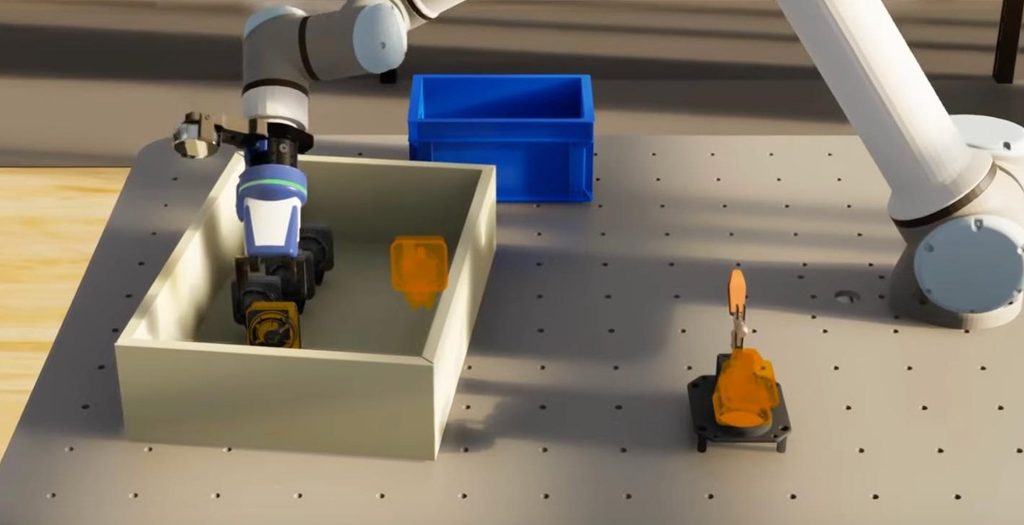
A robot arm learning to pick and place objects, for example, may require thousands of attempts to understand how different object positions, shapes, and environmental conditions affect its movements.
Repeating all these experiments with physical hardware can consume significant time and resources.
A virtual environment provides an alternative.
Using a robotics simulation platform, engineers can create virtual machines, robot arms, objects, sensors, and working environments.
They can then test different scenarios and generate additional training data.
Simulation can also help identify problems before physical deployment.
However, virtual environments are approximations of reality. Differences in friction, sensor behavior, material properties, contact dynamics, and environmental conditions can create a gap between simulated and real-world performance.
This is commonly known as the sim-to-real gap.
The development process therefore requires progressive validation using real hardware.
6. Synthetic Data and Reinforcement Learning
Synthetic data is particularly valuable when real-world data is limited.
Instead of collecting every possible robot interaction physically, developers can generate additional scenarios in simulation.
For example, a warehouse robot can be trained with different:
- Object positions.
- Lighting conditions.
- Obstacle configurations.
- Camera viewpoints.
- Environmental layouts.
- Picking and placing scenarios.
Reinforcement learning can then be used to improve the robot’s behavior through repeated simulated interactions.
Isaac Lab supports large-scale reinforcement learning environments, while Cosmos can contribute to synthetic world and visual data generation.
The objective is to create more diverse training scenarios and improve the ability of a robotic system to handle unfamiliar conditions.
7. Open Standards and Flexible Architecture
An important characteristic of the AWS Physical AI Toolchain is its use of established robotics and machine-learning formats.
The architecture includes:
- Zarr for data storage.
- LeRobot format for standardized robotics datasets.
- PyTorch for model development.
- Gymnasium for reinforcement learning environments.
- URDF for robot descriptions.
- ONNX for portable model deployment.
- ROS 2 for robot software integration.
This approach can help engineering teams work with familiar tools rather than being restricted to a completely proprietary development environment.
AWS also describes the architecture as modular.
Individual components can be adopted separately or connected into a larger development workflow.
The project provides publicly available reference architectures and Infrastructure as Code resources, including Terraform modules and working examples. This should not be confused with every underlying AWS or NVIDIA service being open-source software.
8. What Does This Mean for Manufacturing and Engineering?
Physical AI has applications across several industrial sectors.
Automotive Manufacturing
Robotic assembly, material handling, inspection, and adaptive manufacturing operations can benefit from improved simulation and AI training workflows.
Warehousing and Logistics
Intelligent robots can be developed to handle changing object positions, navigate environments, and perform complex picking tasks.
Aerospace
Robotic inspection, maintenance, material handling, and specialized manufacturing processes are potential application areas.
Construction and Mining
Robotic systems may support operations in environments where conditions are difficult, repetitive, or potentially hazardous for human workers.
Healthcare
Physical AI can contribute to the development of specialized robotic systems, although medical applications require additional safety and regulatory validation.
The AWS toolchain provides infrastructure patterns for developing these systems. It does not deliver ready-made robotic behavior for every industry.
9. Limitations and Implementation Considerations
The availability of a complete development toolchain does not remove the engineering challenges of robotics.
Developers must still address:
- Accurate robot and environment models.
- Sensor calibration.
- Simulation fidelity.
- Real-time control requirements.
- Hardware compatibility.
- Model performance and generalization.
- Safety and reliability testing.
- Cloud computing costs and resource management.
AWS also lists prerequisites for its workshop, including an AWS account with approved GPU quotas and relevant NVIDIA and Hugging Face credentials.
The company specifically advises users to follow resource teardown procedures to avoid unnecessary cloud charges.
For production robotics, simulation must be combined with controlled physical testing and appropriate safety procedures.
Conclusion
The AWS Physical AI Toolchain reflects a growing convergence between cloud computing, robotics simulation, AI model training, and industrial automation.
By connecting AWS infrastructure with NVIDIA Isaac Sim, Isaac Lab, GR00T, Cosmos, and OSMO, the platform provides a structured approach to the development lifecycle of intelligent robotic systems.
Its importance lies in connecting previously separate stages of robotics development—from data collection and synthetic simulation to model training, validation, and edge deployment.
As manufacturing and industrial systems become increasingly autonomous, integrated development environments may become an important part of engineering infrastructure.
The next generation of robotics will not be built through AI models alone. It will depend on the combination of physical simulation, scalable computing, real-world data, and reliable engineering validation.
References