From Natural Language Requirements to Engineering-Aware 3D Design
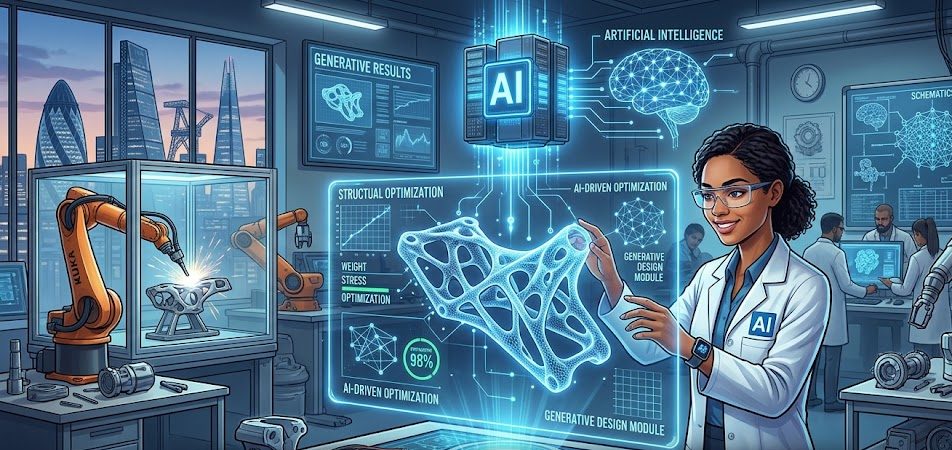
Artificial intelligence is moving beyond its traditional role as a support tool for engineers. A new research framework published in Communications Engineering on October 19, 2026, demonstrates an approach to intelligent generative design that connects natural-language requirements with geometric modelling, assembly planning, and engineering validation.
The research addresses a major limitation of current AI-based design tools: generating a visually convincing 3D shape is not the same as creating a mechanically meaningful product.
The Challenge of Engineering-Aware AI Design
Conventional generative AI systems can interpret written instructions and produce design concepts. However, mechanical engineering requires much more than visual similarity.
A functional mechanical component must satisfy several conditions:
- Geometric dimensions and design constraints
- Functional relationships between components
- Assembly compatibility and clearances
- Motion and kinematic requirements
- Structural and engineering validation
Large language models can understand design descriptions, but they do not inherently possess the spatial reasoning and physical constraint awareness needed for reliable engineering design.
The new framework aims to connect these separate stages into a coordinated process.
Connecting Language, Geometry and Engineering Logic
The proposed system uses a semantic-driven approach. Instead of treating a design request as a simple image-generation prompt, it interprets the engineering meaning behind the requirements.
The framework coordinates several design-related tasks, including requirement interpretation, geometric modelling, assembly planning and validation.
This creates a workflow in which the AI does not simply generate a shape. It attempts to understand what the product is expected to do, how its components should relate to one another, and whether the resulting design satisfies defined constraints.
One particularly important aspect is the integration of assembly constraints and kinematic validation. These capabilities are essential when designing mechanisms containing moving parts, joints or interconnected components.
What This Could Mean for CAD Software
The research points toward a future in which engineers may interact with CAD systems through higher-level functional descriptions.
For example, a designer could describe the intended movement and operating conditions of a mechanical mechanism. An AI-supported workflow could then help translate those requirements into component geometry, assembly relationships and preliminary validation steps.
Potential applications include:
- Early-stage mechanical concept development
- Automated generation of component geometry
- Assembly and mechanism design
- Design exploration and optimisation
- Engineering education and rapid prototyping
Such systems could reduce repetitive modelling work and allow engineers to spend more time evaluating design alternatives.
Why Human Engineering Expertise Remains Essential
The research should not be interpreted as evidence that AI can independently replace mechanical designers or engineering validation.
A generated model still needs to be checked against material properties, manufacturing constraints, tolerances, loads, safety requirements and applicable standards.
A design that satisfies geometric and kinematic constraints may still fail under real operating conditions. Detailed finite element analysis, fatigue assessment, manufacturing reviews and physical testing remain important parts of product development.
The reliability of the generated result also depends on the quality and completeness of the original requirements.
The Future of Generative Engineering
The most important development in this research is the attempt to connect AI reasoning with the technical structure of mechanical design.
The next generation of intelligent CAD systems may move beyond generating shapes and begin supporting complete engineering workflows, from interpreting requirements to preparing assemblies and checking functional relationships.
For the engineering industry, this represents a meaningful direction: AI that understands not only what a designer wants to create, but also how the resulting product is expected to function.
Source: Shi, Y., Ning, F., Lu, J. et al., Intelligent generative design framework for semantic driven mechanical design, Communications Engineering, 19 October 2026. https://doi.org/10.1038/s44172-026-00808-z