How Adaptive AI Is Changing MIG and TIG Welding Automation
Robotic welding has traditionally depended on carefully programmed paths, repeatable part positioning and stable joint geometry.
These conditions work well in high-volume production, where components are manufactured consistently. However, low-volume and high-mix manufacturing environments often involve variations in joint gaps, part positioning and material fit-up.
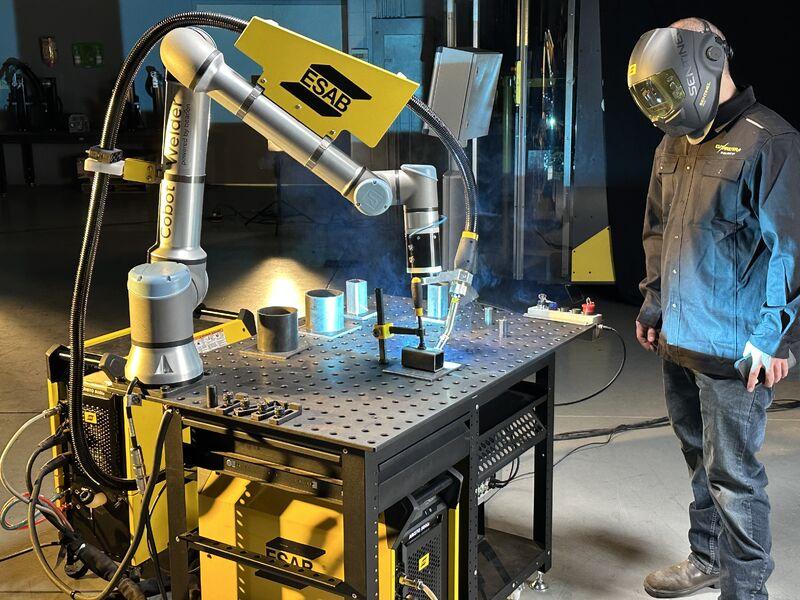
ESAB has introduced ROBBI AI, a collaborative robot system designed to use artificial intelligence and sensing technologies to adapt welding operations to changing real-world conditions.
Moving Beyond Predefined Welding Paths
Conventional robotic welding systems typically follow programmed trajectories. If a component is positioned differently or a joint gap changes, operators may need to adjust the programme or modify the welding setup.
ROBBI AI is designed to take a different approach.
The system uses camera and laser sensing to assess the workpiece, identify the expected joint and generate a welding path. During operation, it can adjust welding motion and process parameters in response to changing joint conditions.
For example, if the gap between two components opens or closes during welding, the system can adapt its travel motion, oscillation or parameters within the established welding procedure.
How the System Works
Before welding begins, the operator provides the relevant welding procedure information.
This includes details such as:
- Base material
- Welding process
- Joint type
- Consumables
- Applicable welding procedure parameters
The system then uses its sensing capabilities to evaluate the workpiece and determine how to proceed within the defined operating conditions.
ESAB also states that ROBBI AI undergoes a simulation-based learning period before deployment. Once installed, it can collect welding data and associated video to help operators investigate defects and improve the system’s recognition of changing conditions.
MIG and TIG Applications
The system is designed for both MIG and TIG welding applications.
TIG welding can be particularly difficult to automate because it requires precise control of the torch, filler material and weld pool.
Pipe fabrication is another potential application, especially in industries where joint fit-up variations and limited availability of experienced welders create production challenges.
ROBBI AI is built around a Universal Robots UR10e or UR20e robot arm and supports compatible welding power sources, including EWM Titan XQ, EWM Tetrix XQ and ESAB Aristo Edge configurations.
Keeping AI Within Welding Procedure Requirements
One of the most important engineering considerations in AI-assisted welding is process control.
A welding system cannot simply change parameters without regard to material, joint design, qualification requirements and applicable welding procedures.
ESAB says its InduSuite software helps keep AI-driven decisions within predefined welding procedure specifications and qualification requirements.
The company also states that AI processing takes place locally on a computer at the customer’s facility rather than relying on continuous cloud communication.
This can support local processing and data control, although manufacturers must still establish suitable cybersecurity, data management and process-validation practices.
What AI Can and Cannot Replace
Adaptive welding technology may reduce repetitive programming and help automate applications that are difficult to manage with conventional robot paths.
However, it does not remove the need for qualified welding procedures, operator oversight, inspection or process qualification.
The system’s performance must be evaluated for the specific materials, joint configurations, production conditions and quality requirements involved.
AI-assisted path generation should be viewed as an additional automation capability, not as a replacement for welding engineering expertise.
The Future of Intelligent Welding
ROBBI AI illustrates a broader shift from conventional automation toward systems that can sense, interpret and respond to physical conditions.
As industrial robots become more capable of adapting to variation, AI may help manufacturers automate a wider range of low-volume and high-mix processes.
The real measure of success will be consistent weld quality, repeatable performance and the ability to operate within established engineering and safety requirements.
Source: ESAB, ROBBI AI collaborative robot announcement, October 2026.