Metal additive manufacturing can create microstructures that are difficult to achieve through conventional processing routes. A study published in Nature Materials on November 2, 2026, reports a laser-based additive manufacturing approach for producing a multi-principal-element alloy with a combination of high strength and ductility across a wide temperature range.
The research focuses on a chromium-iron-cobalt-nickel-aluminium-titanium-based alloy.
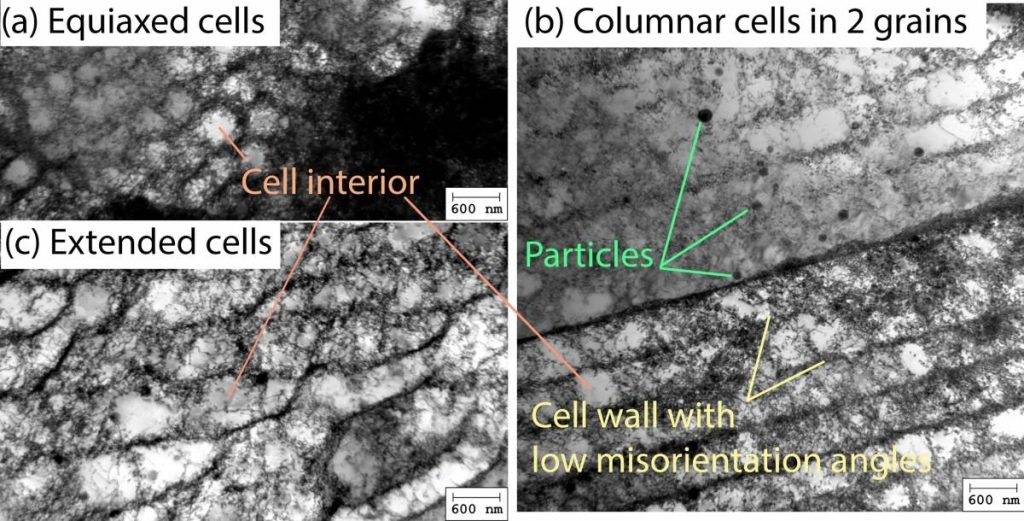
A Process-Formed Cellular Microstructure
The researchers designed an alloy in which a cellular network of phases forms during laser-based additive manufacturing.
The study reports that this microstructure helps maintain mechanical performance without relying on the conventional post-processing route typically used for similar precipitation-strengthened alloys.
The reported material achieved a yield strength above 1 GPa and approximately 20% uniform elongation over a temperature range from 77 K to 873 K.
These results are notable because high strength and ductility are often competing material properties, particularly when temperature changes influence deformation mechanisms.
Why the Microstructure Matters
The research links the material’s behavior to the interaction between different phases and interfaces within the microstructure.
The authors describe mechanisms involving slip transfer, back-stress hardening and relatively stable deformation behavior across the investigated temperature range.
For additive manufacturing engineers, the important point is that process conditions can influence the microstructure formed during fabrication, potentially reducing the need for additional heat-treatment steps.
From Laboratory Results to Engineering Applications
The reported properties are promising, but they do not automatically establish suitability for industrial components.
Further work would be needed to evaluate fatigue behavior, fracture resistance, corrosion performance, process repeatability, component-scale effects and manufacturing cost.
The study nevertheless demonstrates how alloy design and additive manufacturing process development can be combined to create materials with tailored mechanical behavior.