Residual stress is one of the most important factors affecting the dimensional accuracy and structural reliability of metal additive manufacturing components.
During laser powder bed fusion, local heating and rapid cooling create steep thermal gradients. These gradients can generate internal stresses that remain in the component after manufacturing. Depending on geometry, material and process parameters, residual stress can contribute to distortion, cracking and dimensional instability.
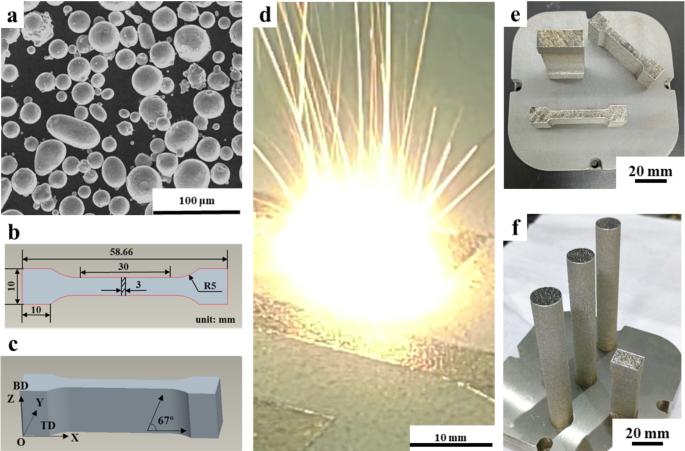
Researchers have investigated three mechanical testing approaches to estimate longitudinal residual stresses in laser powder bed fusion 316L stainless steel.
The methods are based on the early micro-yielding behaviour of near-surface material regions in cylindrical specimens.
The first approach evaluates plastic work density during cyclic loading and unloading. The second uses a mathematical virtual-unloading procedure derived from standard monotonic tensile data. The third identifies the onset of macroscopic micro-yielding at a strain threshold of 0.01%.
The researchers compared their estimates with neutron diffraction measurements across different heat-treatment conditions, including as-built specimens and samples treated at temperatures up to 1,000°C.
The energy-based approaches showed correlations with relative neutron-diffraction stress reductions, with reported R² values of 0.75 and 0.71.
Implications for additive manufacturing
Residual stress measurement is essential when engineers qualify metal AM components for demanding applications.
Neutron diffraction and other advanced techniques can provide valuable information, but they may require specialised facilities and significant resources.
The proposed methods could offer more accessible ways to compare stress-relief strategies and evaluate existing tensile-test data.
They are not a universal replacement for direct residual-stress measurement. Their usefulness depends on material, specimen geometry and the relationship between the measured mechanical response and the actual stress state.
For production engineers, the study is relevant because it connects conventional mechanical testing with the quality-control challenges of metal additive manufacturing.